A construction attorney advises contractors on contracts, payment rights, mechanic's liens, payment bond claims, change orders, delay claims, OSHA matters, defect claims, terminations and dispute resolution. The work covers far more than lawsuits—much of its value comes before a dispute ever becomes formal.
Construction attorneys help contractors protect payment rights, manage project risk, resolve disputes and avoid contract terms that can turn a profitable job into a financial loss. Their work covers more than lawsuits. A construction attorney may review a contract before bid day, help preserve lien rights, respond to a defective work claim, prepare for mediation or defend a contractor after a safety citation.
For contractors, legal counsel is often most valuable before a dispute becomes formal. A missed notice deadline, vague scope clause, unsigned change order or broad indemnity provision can create problems long before a claim is filed. Construction attorneys help identify those risks while there is still time to negotiate, document the issue or preserve leverage.
Modern construction law has become more operational. Contractors are dealing with tighter margins, delayed payments, material escalation, complex public-project requirements, digital tools, safety enforcement and more detailed contract administration. Legal counsel is no longer only a last resort. For many contractors, it is part of protecting cash flow and controlling project risk.
Legal Risk Often Starts Before the Work Begins
Many contractor disputes begin with the contract, not the jobsite. A construction attorney can review project documents before the contractor accepts obligations that are difficult to price, manage or enforce.
This review may include scope language, payment timing, retainage, insurance requirements, flow-down clauses, indemnity terms, change order procedures, notice deadlines, termination rights and dispute resolution provisions. The goal is not to remove all risk from every agreement. The goal is to clarify which risks are normal, which risks can be negotiated and which risks could seriously affect payment or liability.
A few sentences can determine whether a contractor gets paid for extra work, whether delay costs are recoverable, whether material increases are compensable or whether the contractor must defend another party in a lawsuit. Construction attorneys help translate those provisions into practical business consequences.
Contract Review Is a Business Tool, Not Just a Legal Exercise
A useful contract review explains how the agreement will affect project administration, field decisions and payment. Contractors do not need abstract legal commentary. They need to know what the contract requires them to do and where the language creates exposure.
High-risk contract provisions to flag
- Scope of work language that does not clearly define included and excluded work
- Change order clauses that require written approval before extra work begins
- Notice provisions that require quick written notice for delays, changed conditions or added costs
- Pay-if-paid or pay-when-paid clauses that affect subcontractor payment timing
- Broad indemnity language that may expand defense obligations
- No-damages-for-delay clauses that limit recovery for schedule impacts
- Termination provisions that affect payment after suspension or default
- Arbitration, venue and fee-shifting clauses that affect dispute cost
The practical question is not only whether a clause is enforceable. The practical question is how the clause affects pricing, staffing, documentation, leverage and payment risk.
Payment Claims Are Deadline-Driven

Payment disputes are one of the most important reasons contractors need construction attorneys. Construction is cash-flow sensitive, and even a strong claim can weaken if the contractor misses a statutory notice, lien deadline or bond claim requirement.
Mechanic's liens, payment bond claims and prompt payment rights can be powerful tools, but they are technical. Rules vary by state, project type, contract tier and owner classification. Private projects, public projects and federally funded projects often follow different procedures.
A construction attorney can help determine whether lien rights exist, which notices are required, when a claim must be filed, whether a payment bond applies, whether retainage is being withheld properly and whether a lien waiver has already released the claim.
Contractors should evaluate payment rights before invoices become seriously overdue. A timely notice, lien filing or bond claim can change the payment conversation without immediately escalating the matter into litigation.
Change Orders Need Proof, Not Just Field Memory
Change order disputes rarely depend on one document. They usually involve field direction, drawings, RFIs, meeting minutes, emails, photos, cost records and contract language.
Construction attorneys help contractors connect the project record to the contract. The issue is often not whether the contractor performed the work. The issue is whether the contractor can prove entitlement, causation and cost.
What a strong change order file includes
- A clear description of the changed work
- The date the issue or direction arose
- The person who directed or approved the work
- Photos, RFIs, drawings or field reports showing the condition
- Labor, material, equipment and subcontractor cost backup
- Schedule impact records when sequencing or completion changed
- Written notice that matches the contract requirements
Contractors improve recovery chances when they document change work while the project is active. Months later, the other side may dispute the scope, question the cost or argue that notice was too late.
Material Escalation and Tariff Risk Should Be Addressed Up Front
Material escalation has become a recurring contract issue for contractors working with steel, aluminum, electrical equipment, mechanical systems, lumber, fuel-sensitive materials or imported components. Tariffs, freight costs, supply shortages and procurement delays can affect pricing in ways fixed-price contracts may not automatically absorb.
A construction attorney can help evaluate whether a contract includes usable language for escalation, force majeure, change in law, allowances or procurement delays. The most reliable protection is specific contract language negotiated before the project begins.
A strong escalation provision should address which materials are covered, what baseline price applies, how increases are measured, whether tariffs and surcharges are included, what notice is required and whether time extensions are available for delayed procurement.
Contractors should be cautious about relying on general force majeure language for price increases. Force majeure provisions often focus on performance delays, not cost relief. If a contractor needs price protection, the contract should say so directly.
Delay Claims Require Contract and Schedule Analysis
Delay claims can affect labor productivity, equipment costs, supervision, extended general conditions, liquidated damages and downstream subcontractor performance. A delay may involve late design information, owner-directed changes, weather, permitting issues, material delays, labor shortages, site access problems or interference from another trade.
Construction attorneys help determine whether a delay is excusable, compensable or both. An excusable delay may justify more time. A compensable delay may justify more time and money. Some disputes also involve concurrent delay, where multiple causes affect the schedule at the same time.
Counsel may review baseline schedules, updates, daily reports, meeting minutes, procurement records, weather logs and notice letters. The goal is to show not only that a delay occurred, but that the delay affected the contractor's work in a legally meaningful way.
Delay claims are strongest when contractors document impacts as they happen, reserve rights in writing and avoid vague emails that accept revised schedules without addressing cost or responsibility.
Safety Incidents and OSHA Matters Need Fast Response
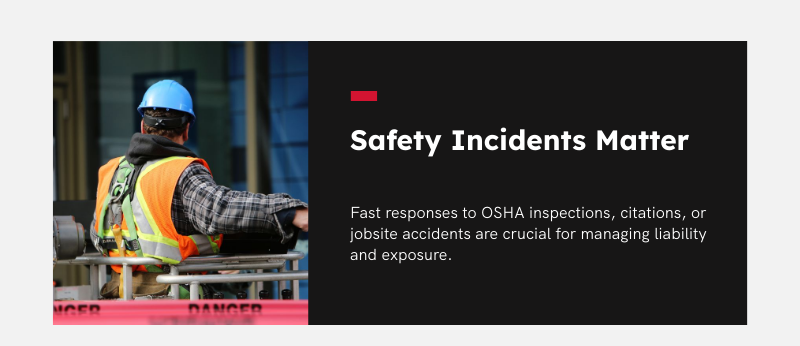
Construction attorneys are often involved after serious jobsite incidents, OSHA inspections, citations, subcontractor accidents or third-party injury claims. Early decisions can affect liability, insurance coverage, defenses and regulatory exposure.
A contractor may need counsel after a fatality, serious injury, fall, trench incident, crane accident, electrical event, struck-by incident, safety complaint or OSHA inspection. Counsel can help coordinate the response while the contractor preserves evidence, protects privileged communications, works with insurers and avoids statements that unintentionally expand responsibility.
This is especially important on multi-employer worksites, where several contractors may have overlapping safety obligations. Legal counsel does not replace a safety director, but it helps the company respond with discipline when an incident becomes regulatory or adversarial.
Public Projects Add Compliance Risk
Contractors on public projects face legal issues that may not appear on private commercial work. These can include bid protests, procurement rules, payment bond claims, prevailing wage obligations, certified payroll, apprenticeship requirements, project labor agreements, disadvantaged business enterprise commitments and false claims risk.
Public work often has strict procedural requirements. A bid mistake, missed protest deadline, incomplete certification or incorrect payroll classification can create serious consequences. Once work begins, subcontractor compliance, wage determinations, fringe benefit credits and certified payroll records must match the project requirements.
Construction attorneys help contractors review bid documents, bond forms, wage obligations, flow-down terms and dispute procedures. This is especially important for contractors entering a new public market, working across state lines or taking on federally funded projects.
Digital Tools and AI Are Creating New Contract Questions
Project management platforms, drones, BIM, AI-assisted estimating, automated scheduling tools, safety analytics and shared document systems are changing how contractors create and manage project records. These tools can improve efficiency, but they also raise legal questions about data ownership, confidentiality, cybersecurity, reliance and responsibility for errors.
Construction attorneys can help contractors address who owns project data, who can access shared files, how model conflicts are resolved, whether AI tools may process confidential information and how cybersecurity incidents must be reported.
AI use deserves particular caution. Contractors should avoid placing privileged, proprietary or sensitive project information into tools that are not approved for that purpose. If AI-assisted outputs affect estimates, claims, schedules or correspondence, the company should have internal review controls before those outputs influence a project decision.
The issue is not whether digital tools are useful. The issue is whether the contract, insurance program and company policies match how those tools are actually being used.
Defect Claims Need Technical and Legal Review
Defect claims can involve workmanship, design, materials, installation methods, code compliance, water intrusion, structural performance or failure to follow specifications. These disputes often require both technical evaluation and legal strategy.
A construction attorney may help determine whether the alleged defect falls within the contractor's scope, whether design documents contributed, whether another trade caused the issue, whether warranties apply and whether insurance may respond.
Counsel may also coordinate experts, preserve evidence, review destructive testing protocols, respond to demand letters and manage communications with owners, general contractors, insurers and subcontractors.
Contractors should be careful about making broad admissions, performing repair work without written reservations or ignoring insurance notice requirements. The goal is to address legitimate problems without accepting responsibility for issues outside the contractor's control.
Termination and Default Notices Can Change the Entire Project
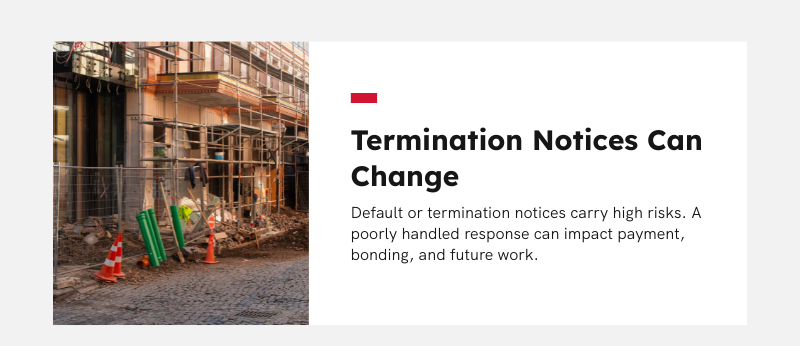
Termination disputes are among the highest-risk matters contractors face. A default notice can affect payment, bonding capacity, reputation and future work. A wrongful termination may create significant damages, but a poorly handled response can weaken the contractor's position.
Construction attorneys help evaluate whether a default notice is valid, whether the contractor has cure rights, whether the other party followed the contract and whether the alleged default is tied to disputed change orders, delayed payments, defective documents or site access issues.
Contractors also need counsel when considering suspension or termination because of nonpayment, unsafe conditions or owner interference. Stopping work without legal analysis can create exposure if the contract does not allow suspension under the circumstances.
A cure response, termination letter or suspension notice should be fact-based, contract-based and supported by the project record.
Dispute Resolution Is Not Always Litigation
Construction attorneys handle negotiation, mediation, arbitration and litigation. The right path depends on the contract, claim amount, evidence, urgency, relationship and business objective.
Negotiation may work when both sides understand the cost of escalation. Mediation can help when the parties need a neutral facilitator and a structured settlement process. Arbitration may be required by contract and can be useful for technical disputes, though it is not always inexpensive. Litigation may be necessary for lien foreclosure, insurance coverage, multi-party disputes or matters requiring court authority.
The contractor with organized notices, clean cost records, strong daily reports and consistent communication usually has more leverage than the contractor relying on general frustration after the project ends.
When Contractors Should Call a Construction Attorney
Contractors do not need legal counsel for every routine project issue. They should consider involving a construction attorney when an issue affects payment, schedule, liability, safety, contract rights or long-term business risk.
| Situation | Why counsel may be needed | What to prepare |
|---|---|---|
| Risky unsigned contract | Risk can often be reduced before signing | Contract, scope, proposal and exclusions |
| Late payment or retainage dispute | Lien, bond or prompt payment deadlines may apply | Invoices, pay applications, waivers and emails |
| Disputed change order | Recovery may depend on notice and proof | RFIs, photos, field reports and cost backup |
| Delay or acceleration claim | Time and cost recovery may require schedule proof | Baseline schedule, updates and daily reports |
| OSHA inspection or serious incident | Early response affects defenses and exposure | Incident records, safety plan and training files |
| Default or termination notice | Cure rights and payment rights may be at risk | Notice letter, contract and project communications |
| Public project compliance issue | Wage, bid, bond or certification rules may apply | Bid documents, payroll records and bonds |
| Defect or warranty claim | Technical responsibility may be disputed | Plans, specs, photos and repair records |
The earlier counsel is involved, the more options the contractor usually has. A well-timed notice or payment preservation step can often reduce escalation before the other side controls the narrative.
How Contractors Should Choose Legal Counsel
The right construction attorney understands both legal doctrine and how construction projects actually operate. Construction disputes involve project-specific language, payment structures, schedule records, field documentation and statutory rights.
Contractors should look for experience with construction contracts, mechanic's liens, payment bonds, change orders, delay claims, terminations, OSHA matters, insurance, indemnity, public work and dispute resolution.
Communication style matters as well. Legal advice should be clear enough for business decisions. A contractor should understand the options, risks, likely costs, timeline and recommended next steps.
Local knowledge also matters. Lien deadlines, prompt payment rules, licensing requirements, anti-indemnity statutes and public-project procedures vary by jurisdiction. Contractors working across state lines may need counsel who can coordinate with local attorneys or advise on multi-state risk.
The Best Legal Strategy Is Built Into Project Controls
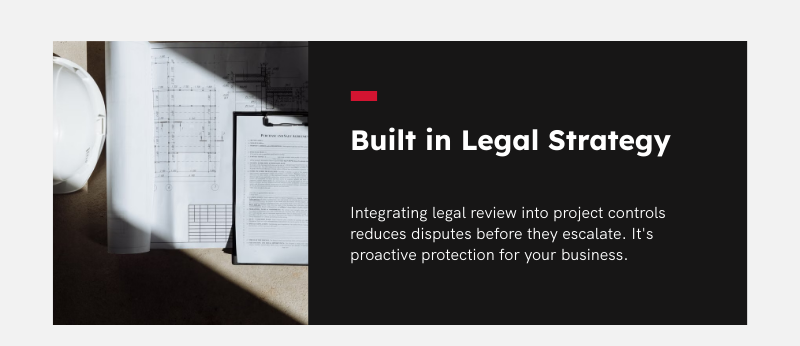
Construction attorneys are most valuable when their work connects to everyday contractor systems. Contract review, notice templates, lien tracking, change order workflows, safety response protocols and claim documentation procedures can reduce disputes before they become formal claims.
Legal review should be considered before signing unfamiliar contracts, bidding unusual projects, entering new public markets, accepting broad indemnity language, facing material price uncertainty, approaching payment deadlines or responding to repeated change order disputes.
This approach does not turn every job into a legal exercise. It helps contractors separate routine project friction from issues that threaten margin, payment or reputation. As contracts, technology, labor requirements and payment risks become more complex, contractors that treat legal review as part of project controls will be better positioned to protect cash flow and make clearer decisions when problems arise.
Key Takeaways
- Most contractor disputes start in the contract, not on the jobsite—review high-risk clauses before signing.
- Payment rights are deadline-driven; preserve lien, bond and prompt payment rights before invoices fall seriously overdue.
- Change order, delay and defect claims succeed on documentation—build the proof while the project is active.
- Safety incidents, OSHA matters and termination notices call for fast, disciplined response to protect defenses and payment.
- The strongest legal strategy is built into project controls, not saved for the moment a claim is filed.
Construction Attorney FAQs
What does a construction attorney do?
A construction attorney advises contractors on contracts, payment rights, liens, bond claims, project disputes, OSHA matters, defect claims, terminations and litigation.
When should a contractor hire a construction attorney?
A contractor should consider hiring a construction attorney before signing a high-risk contract, when payment is delayed, when change orders are disputed, after a serious jobsite incident or when a default, termination, lien, bond claim or lawsuit is possible.
Can a construction attorney help a contractor get paid?
Yes. A construction attorney can help preserve mechanic's lien rights, prepare bond claims, send formal payment demands, evaluate prompt payment remedies and avoid lien waiver mistakes.
Do contractors need an attorney for every contract?
Not every contract needs full legal review, but unfamiliar contracts, large projects, public work, risky indemnity terms, strict notice provisions and unusual payment language should be reviewed before signing.
What is the difference between a construction attorney and a general business attorney?
A construction attorney focuses on project-specific issues such as scope, change orders, liens, bonds, delay claims, construction defects, safety disputes and public-project rules.
What should contractors bring to a construction attorney?
Contractors should bring the contract, proposal, scope documents, change orders, invoices, pay applications, lien waivers, emails, notices, schedules, daily reports, photos and any letters alleging default, delay, nonpayment or defective work.
Looking for a construction attorney? See the top construction law firms from our 2026 ranking, including construction-focused boutiques and firms grouped by region.
Top Construction Law Firms and Attorneys in 2026
Each year, Construction Executive surveys more than 600 U.S. construction law firms for its Top Construction Law Firms™ ranking. Firms are ranked on construction practice revenue, the number of construction attorneys, the share of firm revenue from construction, states where the firm is licensed, when its construction practice was established and the number of construction clients served. The ranking reflects the size and focus of each construction practice. It is not a recommendation for any specific matter, so contractors should still interview counsel using the criteria above.
The 10 largest construction law practices
| Rank | Firm | Headquarters | Construction attorneys | States admitted |
|---|---|---|---|---|
| 1 | Bradley Arant Boult Cummings LLP | Birmingham, AL | 97 | 39 |
| 2 | Peckar & Abramson P.C. | New York, NY | 103 | 20 |
| 3 | Husch Blackwell | Kansas City, MO* | 74 | 49 |
| 4 | Cokinos Young | Houston, TX | 110 | 14 |
| 5 | Gordon Rees Scully Mansukhani | San Francisco, CA | 228 | 52 |
| 6 | Troutman Pepper Locke LLP | Atlanta, GA | 50 | 48 |
| 7 | Duane Morris LLP | Philadelphia, PA | 69 | 43 |
| 8 | Venable LLP | Washington, DC | 45 | 38 |
| 9 | Smith Currie Oles LLP | Atlanta, GA | 73 | 27 |
| 10 | Watt, Tieder, Hoffar & Fitzgerald LLP | McLean, VA | 53 | 18 |
Construction-focused boutique firms
Some contractors prefer a firm that does little besides construction law. These ranked firms earn 90% or more of their revenue from construction work, which can mean deeper familiarity with contract forms, lien practice and industry customs. Larger full-service firms, by contrast, can pull in tax, employment, real estate and M&A counsel under one roof.
| Rank | Firm | Headquarters | Construction share of revenue |
|---|---|---|---|
| 2 | Peckar & Abramson P.C. | New York, NY | 98% |
| 4 | Cokinos Young | Houston, TX | 96% |
| 9 | Smith Currie Oles LLP | Atlanta, GA | 94% |
| 10 | Watt, Tieder, Hoffar & Fitzgerald LLP | McLean, VA | 97% |
| 26 | Varela, Lee, Metz & Guarino | Tysons, VA | 100% |
| 30 | Finch, Thornton & Baird LLP | San Diego, CA | 98% |
| 33 | Hudson Lambert Parrott LLC | Atlanta, GA | 90% |
| 40 | BBG Construction Law | Greenwood Village, CO | 100% |
| 44 | Ahlers Cressman & Sleight PLLC | Seattle, WA | 100% |
| 46 | Griffith Davison P.C. | Dallas, TX | 97% |
| 47 | Allensworth | Austin, TX | 94% |
Ranked construction law firms by region
Because lien deadlines, prompt payment rules and anti-indemnity statutes vary by state, local experience matters. Firms below are grouped by headquarters, with their 2026 rank in parentheses. Many have offices and licensed attorneys well beyond their home region.
Northeast
(8 firms)
- Peckar & Abramson, New York, NY (2)
- Duane Morris, Philadelphia, PA (7)
- Cohen Seglias, Philadelphia, PA (12)
- Hinckley Allen, Boston, MA (15)
- Ballard Spahr, Philadelphia, PA (20)
- Fox Rothschild, Philadelphia, PA (25)
- Goldberg Segalla, Buffalo, NY (28)
- K&L Gates, Pittsburgh, PA (43)
Mid-Atlantic
(5 firms)
- Venable, Washington, DC (8)
- Watt, Tieder, Hoffar & Fitzgerald, McLean, VA (10)
- Varela, Lee, Metz & Guarino, Tysons, VA (26)
- Offit Kurman, Baltimore, MD* (39)
- Williams Mullen, Richmond, VA (50)
Southeast
(14 firms)
- Bradley Arant Boult Cummings, Birmingham, AL (1)
- Troutman Pepper Locke, Atlanta, GA (6)
- Smith Currie Oles, Atlanta, GA (9)
- Akerman, Miami, FL* (11)
- Baker Donelson, Memphis, TN* (16)
- Carlton Fields, Tampa, FL (17)
- Becker, Fort Lauderdale, FL (19)
- Nelson Mullins, Columbia, SC (27)
- Maynard Nexsen, Birmingham, AL (29)
- Hudson Lambert Parrott, Atlanta, GA (33)
- Shutts & Bowen, Miami, FL (35)
- Burr & Forman, Birmingham, AL (38)
- Smith, Gambrell & Russell, Atlanta, GA (42)
- Alston & Bird, Atlanta, GA (49)
Texas and Gulf Coast
(7 firms)
- Cokinos Young, Houston, TX (4)
- Andrews Myers, Houston, TX (13)
- Adams & Reese, New Orleans, LA* (14)
- Phelps Dunbar, New Orleans, LA (18)
- Jackson Walker, Dallas, TX (37)
- Griffith Davison, Dallas, TX (46)
- Allensworth, Austin, TX (47)
Midwest
(6 firms)
- Husch Blackwell, Kansas City, MO* (3)
- Clark Hill, Detroit, MI (23)
- Thompson Hine, Cleveland, OH (24)
- Dinsmore & Shohl, Cincinnati, OH (34)
- Hahn Loeser & Parks, Cleveland, OH (41)
- Fabyanske, Westra, Hart & Thomson, Minneapolis, MN (45)
West and Mountain
(10 firms)
- Gordon Rees Scully Mansukhani, San Francisco, CA (5)
- Stoel Rives, Portland, OR (21)
- Perkins Coie, Seattle, WA (22)
- Finch, Thornton & Baird, San Diego, CA (30)
- Procopio, San Diego, CA* (31)
- Atkinson, Andelson, Loya, Ruud & Romo, Cerritos, CA (32)
- Hanson Bridgett, San Francisco, CA* (36)
- BBG Construction Law, Greenwood Village, CO (40)
- Ahlers Cressman & Sleight, Seattle, WA (44)
- Carney Badley Spellman, Seattle, WA (48)
For full firm data, including attorney counts, practice areas and prior-year rankings, see the complete 2026 Top Construction Law Firms™ list.
Rankings are based on self-reported survey data and are updated annually. Inclusion is not an endorsement by Construction Executive or Associated Builders and Contractors.
How do I find a construction attorney?
Start with firms that have a dedicated construction practice, such as those on CE’s Top Construction Law Firms list, and confirm they are licensed in the state where the project is located. State bar referral services, state board certification in construction law (offered in some states) and referrals from sureties, insurance brokers and industry associations are also useful sources.
How much does a construction attorney cost?
Most construction attorneys bill hourly, with rates that vary by market, firm size and attorney experience. Many firms offer flat fees for defined tasks such as contract review or lien filings, and some contractors keep counsel on retainer for ongoing contract and claims support. Contingency arrangements are less common but may be available for certain collection or payment claims. Ask for a written fee agreement and a budget estimate before work begins.
What are the top construction law firms?
In Construction Executive’s 2026 ranking, the top five construction law firms are Bradley Arant Boult Cummings, Peckar & Abramson, Husch Blackwell, Cokinos Young and Gordon Rees Scully Mansukhani. The full top 10, boutique firms and regional list appear above.
Should I hire a large firm or a construction boutique?
Construction boutiques focus almost entirely on construction law and often know industry contract forms and customs in depth. Large full-service firms can combine construction counsel with tax, employment, real estate and corporate lawyers, which helps on complex or multi-state matters. The better fit depends on the size of the matter, where the work is and what other legal needs the company has.