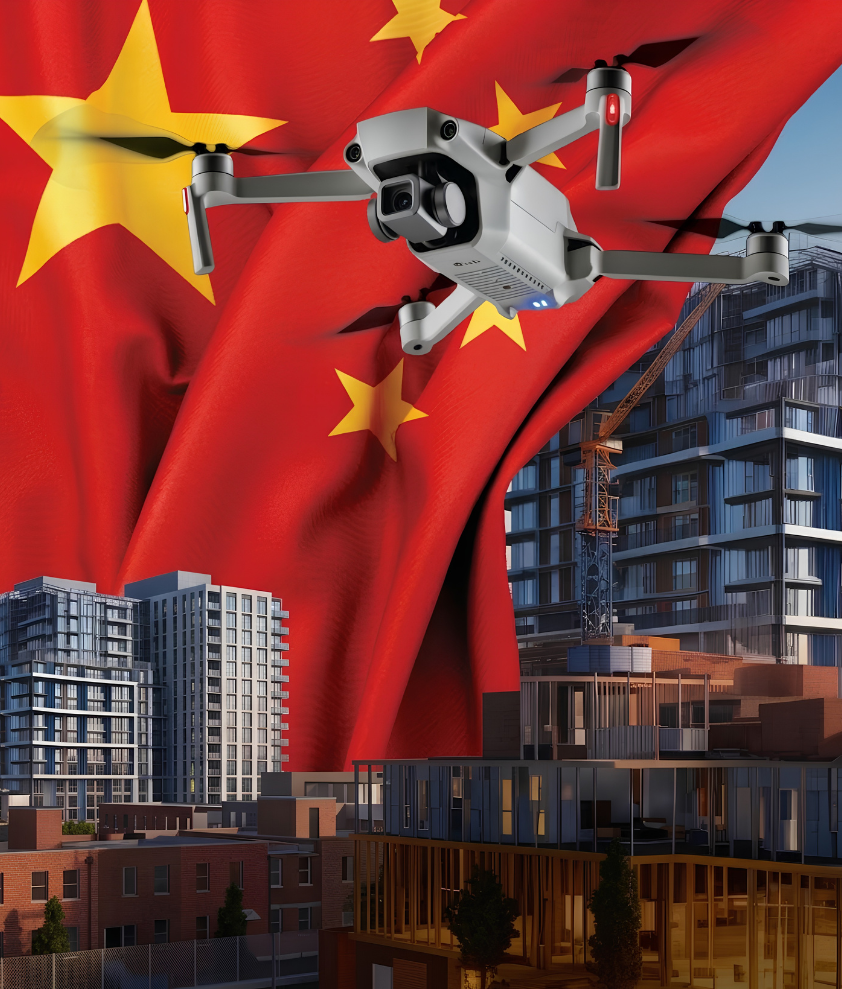
In December of 2025, the CEOs of three construction firms—Hensel Phelps, Brasfield & Gorrie and Bechtel—received a message that didn’t exactly feel like a warm holiday greeting: a demand from two members of the Senate Homeland Security and Governmental Affairs Committee to document their companies’ use of Chinese-made drones over the past five years. The U.S. government has banned federal agencies and contractors from using drones manufactured in China due to national security concerns, but the letter spelled out that the government was worried “about the extent to which construction contractors may be using prohibited drones on government contracts, as well as the extent to which data gathered by approved drones may be stored on vulnerable computer networks.”
While those leaders felt the biggest pressures, it’s safe to say the rest of the industry was watching. A survey conducted by Associated Builders and Contractors shows that 36% of contractors are using drones, and of those companies, nearly all of them—97%, to be exact—rely on Da-Jiang Innovations (DJI), a Chinese manufacturer that has faced intense scrutiny for potential national security issues since 2017. The other 3% weren’t any better off: They used Autel Robotics, another Chinese manufacturer.
Those numbers add up to what Matt Abeles, vice president of construction technology and innovation for Associated Builders and Contractors, calls “the biggest topic in construction technology that we aren’t talking about enough.” When Abeles talks to contractors who have an inventory of Chinese-manufactured drones, he regularly poses one question to all of them: What would happen if those drones went away tomorrow?
“I get the same response constantly,” Abeles said. “They say they would not use drones on as many projects, and they would only make large investments for drones on the mega projects that absolutely need them.”
Will they actually disappear from the skies? What’s next for drone legislation? And how should contractors be preparing for the future? One year after Construction Executive first examined the new regulations on DJI drones, conversation continues hovering over the drone market to see how the industry can avoid encountering too much turbulence.
A KEY INGREDIENT FOR INNOVATION
Before understanding what’s on the horizon for drones, it’s important to understand how they’re currently being utilized in construction. When Abeles reviewed more than 340 projects that were nominated in ABC’s 2025 Excellence in Construction awards, 53% of them used drones. “This is a critical technology supporting contractors to be more profitable, help them win more work and ensure the safety of their workers,” Abeles said.
In ABC’s research, 80% of construction companies currently using drones rely on them for site progress monitoring, which gives real-time updates without requiring anyone to manually walk a jobsite, and 50% of those companies are using them for inspections. While success stories of drones on U.S. jobsites are tough to find these days—no doubt due to the Congressional scrutiny—the rest of the world is full of stories of the new possibilities that drones unlock. For example, consider an example from outside the U.S. from FEDS, a Dubai-based drone operator: The company managed to map a 1.15-square-mile area in under five hours with a fleet of drones before using AI detection to identify construction waste in less than 15 minutes for faster and cheaper waste removal and site clearance. And in South Korea, using DJI drones on a massive construction project for a semiconductor chip manufacturing facility managed to reduce surveying time from what would have taken a few days to just a few hours.
The reason that DJI appears in so many of those stories is simple: China’s tech market involves an unmatchable level of state support. Past reporting from The Washington Post indicated that four government-backed investment firms have stakes in DJI.“I’ve talked to people who were leaders at DJI,” Abeles said. “They have very clearly stated that no one is going to do the amount of research and development that DJI did. No one’s going to spend the same kind of money, time and resources.”
FOLLOW THE MONEY
It may be tough to replicate China’s historical level of investment, but the dollars going to drone development in the U.S. are beginning to pile up. For now, the bulk of the money is focused on developing military tools. The latest budget proposal from the Pentagon requested nearly $54 billion in funding for drones, quadrupling the 2026 budget for “autonomous systems.” Scott Shtofman, vice president and counsel, regulatory affairs for the Association for Uncrewed Vehicle Systems International, believes that defense-related investments will carry over into the non-military uses, too.
“History shows that when government backs defense innovation, it pulls private capital and research and development investment into the broader commercial market right behind it,” Shtofman said. “The innovation happening in defense isn’t staying siloed there. It’s already fueling the manufacturing base that construction will draw from.”
Abeles agreed, pointing to Procore’s recent $845 acquisition of DroneDeploy as evidence. “We’re going to make world-class drones for this country for defense,” Abeles said. “I’ve got to imagine that technology will apply to infrastructure in the future.”
A FOUR-LETTER FUTURE: DaaS
Paul Doherty is one of the individuals who is focused on making drones accessible to contractors. Doherty has spent more than three decades advising governments on building smart cities as the president and CEO of the Digit Group, and he recently branched out to launch Sky Hawk Systems. Initially, the Louisville, Kentucky-based company had an eye on capturing a slice of the surge in defense-related investments. However, after looking at development opportunities inspired by watching Ukrainian drone swarms, Doherty took a step back. “I went, ‘What am I doing?’” Doherty said. “First off, I’m a pacifist. And second, the pricing felt like a race to the bottom.”
Doherty pivoted the business model to what is known as drones-as-as-service, commonly shortened to DaaS, where contractors pay an outside vendor to own and pilot the drones to lower their overhead capital expenses. Over the past 18 months, the company—which includes one of the pioneers behind Google Earth—has been offering its services to large-scale projects such as airports, school districts and theme parks for free. “We aren’t doing it to capture the visuals,” Doherty said. “We’re doing it to capture the mapping.”
It’s part of his aim to shift from what he believed would be a drone manufacturer to a new vision as a data company. The data inputs include a range of details such as local zoning codes and terrain variances that can help accelerate decisions—finding the ideal spot on a site to unload supplies, for example. “As a building is being designed or a piece of infrastructure is being designed, the majority of the architecture and engineering professionals go get a site plan from a government agency and they start to design,” Doherty said. “They don’t know that there’s a two-foot ridge that they’re going to have to account for. So they’re making decisions on design without all the proper information. Now, they can have it.”
Doherty says that his company is beginning to manufacture drones in southern Indiana. With a pilot program in coordination with ABC members in Central Florida and plans to offer education to local ABC chapters, Sky Hawk Systems is making a name for itself in the industry. However, it’s not the only company aiming to capitalize on the possibilities of DaaS. One forecast from Fortune Business Insights estimates that the drone services market will be worth more than $261 billion in 2034—quite the uptick from today’s valuation of approximately $42 billion. How much will contractors pay for access to drones as that market surges? It’s tough to say. None of the emerging companies in the DaaS market publicly display their pricing models, although Doherty is contemplating a structure that can account for scale. “Is this a subscription model?” he asked. “That may be smart for a large-scale general contractor, but maybe it’s a per-project price for medium-sized contractors or maybe it’s just a one-off cost for a standalone need.”
Shtofman cautions contractors to pay close attention to the details when reviewing DaaS packages and ask if the service includes software, along with ongoing access to new capabilities. “When a manufacturer’s revenue depends on an ongoing relationship rather than a single sale, it keeps R&D and customer support front and center,” Shtofman said. “You’re not just buying a device. You’re buying continued investment in making that device better. Contractors already understand this instinct with other equipment they lease or service contracts.”
Abeles sees a real return for companies that cannot afford to shift human capital away from their current demands. “You haven’t taken someone off the jobsite to fly a drone,” he said, “and that’s one less asset you need.”
If DaaS catches on the way that many expect it to, firms will no longer be comparing which drone model to buy. Instead, they will be thinking about a different set of questions: What information do they need, and which company has the data and capabilities to help them get it?
WHAT DO TO NOW—AND WHAT’ S COMING NEXT
Josh Leonard, senior manager of legislative affairs, Associated Builders and Contractors, points out that contractors will have a different immediate path forward depending on the type of work they’re doing. “If you’re a federal contractor, you’re playing by a completely different set of rules,” he said. “You can’t be using DGI or Autel Robotics drones on those federal projects. But if you’re a small contractor or a contractor who only performs commercial construction, you can continue using those drones that you already have and that you can acquire currently on the market.”
If you’re one of those smaller, commercial-only firms, it’s easy to understand confusion about the headlines related to DJI and Chinese-made drones, too. Leonard said that an FCC proposal issued in July to prohibit importing certain types of drone equipment was “overly broad and inclusive in its definition of what classifies as military-grade technology.” And shortly after that notice, the U.S. Court of Appeals for the District of Columbia Circuit ruled to reevaluate the Pentagon’s DJI ban.
Leonard stressed the importance of contractors taking an active role in conversations with companies working to help the country catch up in the drone market. “Talk with some of these U.S. manufacturers and tell them what the industry needs,” he said.“Contractors, no matter their size, should be reaching out to these manufacturers and explaining their needs.”
Shortly before this article went to print, the Trump Administration unveiled a new set of tariffs on drones, including a 100% levy on any with sensitive military capabilities (encompassing essentially every drone made in China) and additional duties on drones and parts from much of the rest of the globe. In the U.S., the story continues to look brighter. Despite numerous headlines of worries that America is losing the drone race, research from AUVSI tracked more than $40 billion flowing into the U.S. drone industry in the first half of the year. The money has already created 87 new or expanded manufacturing facilities and more than 14 million square feet of production space.
“Can U.S. manufacturers can keep pace as contractors replace their existing drones over time, as those drones naturally reach end of life?” Shtofman asked. “Right now, they’re building capacity fast enough to do that—faster than they were even two years ago. It won’t be an overnight swap, but the manufacturing base to support that shift is there and growing.”
For contractors, then, the question may no longer be whether Chinese-made drones will disappear from jobsites tomorrow, but what they will use when the time comes to replace them. Between a growing U.S. manufacturing base, new service models and continued investment in drone technology, the alternatives are beginning to take shape. What isn’t changing is construction’s need for the technology—and the competitive advantage that comes from putting better jobsite data in the hands of the people making decisions. Contractors that start evaluating their options now will be better positioned for whatever ultimately takes flight.
SEE ALSO: ‘TIME TO BE HUMAN’: PAUL DOHERTY TALKS TECH AND ARCHITECTURE