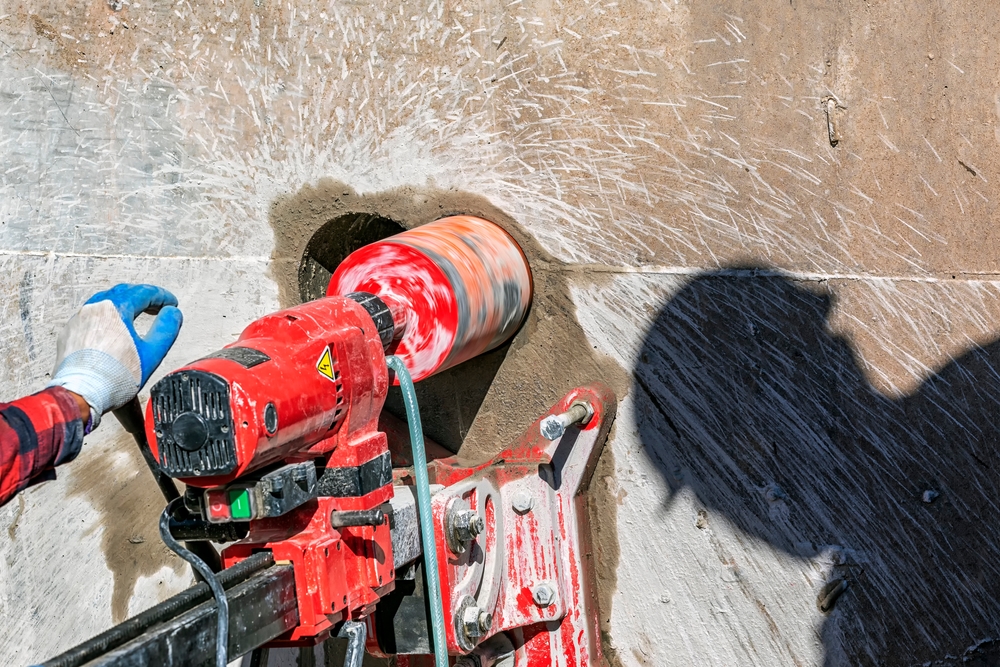
Core drilling often looks like a routine construction task. A penetration may be only a few inches wide, the drilling itself may take minutes and the location may already appear on a drawing. Yet what lies inside the slab can turn that small opening into a costly safety and schedule problem.
Rebar, post-tension cables, electrical conduit, plumbing and communications lines are frequently embedded in concrete. Striking any of them can lead to injuries, structural concerns, damaged building systems, emergency shutdowns, repair work and delays for multiple trades. For contractors, one of the most effective ways to manage those risks is to treat every penetration as a field-verification task rather than a simple drilling assignment.
Pre-drilling verification does not eliminate every uncertainty, but it gives project teams better information before irreversible work begin.
Why Concrete Penetrations Carry More Risk Than They Appear To
Concrete conceals critical building components by design. Reinforcing steel supports structural performance. Post-tension tendons apply forces that help slabs span longer distances with less concrete. Electrical conduit and communications pathways may serve occupied spaces above or below the work area. In some facilities, plumbing, fire protection lines or process systems may also pass through or near the proposed penetration zone.
The danger is not limited to the object that gets hit.
A damaged conduit can trigger an electrical outage. A severed post-tension cable can create an immediate safety hazard and require structural engineering review. Damaged reinforcement may need to be evaluated before the project can continue. Even when no injury occurs, one bad penetration can generate repair costs, work stoppages, revised sequencing and difficult conversations with owners. That is why the drilling location should be verified in the field before the bit touches the slab.
Start With Drawings, but Do Not Stop There
Structural and mechanical, electrical and plumbing drawings provide essential context. They can show slab design, reinforcement patterns, tendon layouts and planned utility routes. As-built drawings may offer additional information about what was actually installed. However, drawings are not a substitute for field verification.
Renovations, tenant improvements and previous repairs can create conditions that differ from the record set. Conduit may have been rerouted during original construction. Additional reinforcement may have been added around openings. Older buildings may contain undocumented systems or abandoned utilities. Even accurate drawings may not provide the precision needed to clear a specific coring location.
The best use of drawings is to inform the investigation. They help scanning technicians and field teams understand what may be present, where higher-risk areas exist and which findings require closer review.
Scan the Exact Work Area
A common mistake is assuming that a previously scanned room, slab or general area automatically clears a later penetration. A scan is only useful when it covers the actual location where the work will occur.
Before scanning begins, the contractor should define the proposed penetration location, diameter and expected depth. If several possible locations are under consideration, each area should be included in the scan zone.
This becomes particularly important when field coordination causes a penetration to move. A location shifted several inches to avoid ductwork, framing or another trade conflict may enter a section of concrete that was never evaluated. In that situation, the revised location should be verified before drilling proceeds.
For teams comparing GPR concrete scanning providers, the scope should be clear about the exact slab areas, wall areas or penetration points that require investigation rather than simply requesting a general scan.
Understand What the Scan Can and Cannot Show
Ground-penetrating radar is widely used to identify changes and targets within concrete. Depending on site conditions and equipment, scanning may help locate reinforcing steel, post-tension tendons, conduit and other embedded features.
The technology is valuable, but results still require interpretation.
Signal quality can be affected by slab thickness, closely spaced reinforcement, concrete conditions and target depth. Some embedded objects may produce similar responses. Scanning also does not automatically determine whether an unidentified target is safe to cut through.
That makes technician experience and field communication important. A qualified operator should be able to explain the scan area, markings, likely targets, limitations and any locations that remain uncertain.
When evaluating concrete scanning services project teams can access, contractors should consider not only the equipment being used but also how clearly findings are communicated to the superintendent, cutting crew and other affected trades.
Treat Post-Tensioned Slabs as a Higher-Risk Condition
Post-tensioned concrete deserves additional attention because tendons are placed under substantial force. Damaging a tendon can create safety concerns and may affect structural performance.
Before coring a post-tensioned slab, project teams should identify the slab type, review available structural information and verify tendon locations in the work area. If the proposed penetration conflicts with a tendon or another significant structural element, the location should be moved or reviewed by the appropriate design professional.
A GPR scanning company working on these projects should also be prepared to distinguish between routine reinforcement patterns and conditions that warrant additional investigation.
The purpose of the scan is not simply to place marks on concrete. It is to support a decision about where work can proceed with the least avoidable risk.
Build Verification Into the Work Plan
The strongest approach is to make pre-drilling verification part of the normal penetration-control process.
Before work starts, the team should confirm the penetration location, review available drawings, identify the slab or wall type and determine whether critical systems may be present. The scan should then cover the planned work area, and findings should be communicated to the person authorizing the cut. If the location changes, the verification process should follow the change.
This is especially useful on projects where concrete coring and scanningcontractors schedule must be coordinated with multiple trades in tight spaces. A documented process reduces the chance that one crew assumes another crew has already cleared the location
The same principle applies throughout the region. Ground penetrating radar concrete scanning project teams use is most effective when scanning, marking, field coordination and drilling are treated as connected steps rather than separate activities.
Small Hole, Large Consequences
Core drilling may be a minor line item in a construction schedule, but the consequences of getting the location wrong can be significant.
The safest and most productive projects recognize that concrete is not an empty material waiting to be penetrated. It may contain structural reinforcement, tensioned systems and active building services that affect far more than the immediate work area.
Pre-drilling verification gives contractors an opportunity to identify those conditions before a routine task becomes a repair, shutdown or schedule event. The goal is not to add another layer of process. It is to make sure the decision to drill is based on current field information, clear communication and an understanding of what is hidden inside the concrete.
SEE ALSO: CONCRETE IS COMPLEX: WHAT CONTRACTORS NEED TO KNOW WHEN BUILDING ANIMAL CARE FACILITIES