The construction industry, by definition, is an industry that is always striving to enhance operational efficiency and become more modern and more cost effective, and thus, more profitable. Manual processes, on the other hand, is the exact opposite of what those in the construction industry are attempting to achieve. Therein lies the main root of the issue. While the construction industry endeavours to optimize their processes through tried and true manual efforts, leveraging the latest and greatest technology and software solutions is left by the waste side.
With an increasingly competitive landscape, construction businesses are experiencing greater pressure to become more efficient while increasing profits at the same time. Many companies are quickly falling behind and losing customers to their competitors, without a clear understanding of why this is happening to their business. While overall operating costs are increasing and the prospect of less customers is very real, construction companies are facing a tough challenge of continuing to grow their businesses.
Implementing an automated construction software solution has helped numerous construction companies become more modern and grow their business, increase revenue, enhance productivity, reduce costs, and create a more streamlined operation overall. Many businesses have realized substantial gains through reducing their reliance on manual processes such as timely data entry, which can lead to human error, and physical paperwork, which is cumbersome for technicians to complete and return back to the office. With greater advancements in technology, information can be automatically integrated within the software solution, lessening the time it would take to manage and operate the business.
Benefits of Becoming a More Modern Construction Company
Operating a typical manual construction company has an impact on all aspects of the business. We look at each business process and how automation can modernize a construction company.
Reporting and Analytics
For a typical construction business, reporting can prove challenging without an automated and integrated construction software system. The reasoning behind this is the lack of real-time information, which is critical to effective decision making. While companies are able to report on their financials, the information is not only susceptible to inaccuracies due to common manual data entry errors, but the information available is often outdated. Making timely decisions for your company will prove extremely difficult, as the financial information cannot be trusted. If you cannot rely on the numbers, knowing where the business stands will be problematic to say the least.
By implementing an integrated and automated construction software solution, not only will the financial information be available in an easy-to-read dashboard view, but you will also be able to easily drill down into the financials and be proactive instead of reactive with your decision making. A real life example of a company effectively using an automated construction software solution to handle their reporting is Metric Contracting Services. With the executive dashboard, their management is able to access information in a single view, providing them with insight into the status of the business, allowing them to report on their business and make more informed decisions. With the ability to drill down into the financials, Metric is able to analyze and uncover any discrepancies in their financials, before it’s too late, and drive decision making.
Accounting
While many companies continue to perform their accounting manually, opportunities are being lost to improve cash flow and reduce their billing cycle times. For any construction business that wants to be successful and profitable, this is a problem. On one hand, if accounts payable is continually in arrears, not only will the customers be unhappy, but the company stands to lose a lot of business due to inefficiencies. On the other hand, with the inability to manage accounts receivable properly, maintaining an understanding of who has paid the business and what payments are still due can be very challenging. The problem with completing accounting processes manually, such as in an Excel spreadsheet or using an accounting only software is two-fold. Not only is the information locked into a single location, which doesn’t automatically integrate with the rest of the business, but the actual time to track and manage the process is quite time consuming and costly, especially as your business grows and more accounting staff is required.
With that being said, an automated construction software solution can eliminate the need for extra accounting personnel and can allow construction companies to process payables and receivables in real-time. Take Pyramid Construction for example.Pyramid Construction Ltd. specializes in heavy construction, general contracting, and land development. Prior to implementing an automated software system, Pyramid found themselves relying on greater amounts of accounting staff, as majority of their processes were being done manually. Thanks to the efficiencies gained through implementing an automated and integrated software solution, Pyramid was able to reduce their manual accounting workload by almost 60%. They now only require one controller to handle the accounting needs for all divisions, which has truly made them a more cost-effective company. They are now in complete control of the payables and receivables process and are confident that no matter how much the business grows, they will not have to add more accounting staff.
Job Costing
Completing job costing manually, typically done through Excel spreadsheets, can create a host of problems for any construction company. One of the main concerns is double and triple entries. When the initial document is created, the information is stored in a single spreadsheet with the data locked into that sheet. Because the information is not integrated, when it comes to payroll or reporting for example, the job cost information must be re-keyed which is not only prone to error, but extremely time consuming as well. Another issue is the process of making changes. While change orders may come through or additional items need to be added, making changes to spreadsheets can be quite confusing, especially if the document has not been updated or if there is more than one document for each job. Performing job costing manually leaves construction companies vulnerable to risk and can really disrupt business processes.
DMS Industrial Constructors Inc. specializes in industrial piping and equipment installation for new construction as well as expansions, maintenance turnarounds and plant relocations. With some jobs containing thousands of cost items, the process of entering these items manually became very cumbersome for DMS. They also had difficulty tracking and managing their job costing. The job costing process was quite inefficient and very time consuming for their employees to complete. Once DMS implemented an automated construction software solution, things began to change. With all of the cost items already integrated into the software system, they are now able to load thousands of cost items in only 5 minutes, as opposed to the 3 to 4 days it took to complete manually. Having an automated and integrated software solution has also eliminated the inefficiencies from using multiple spreadsheets and software.
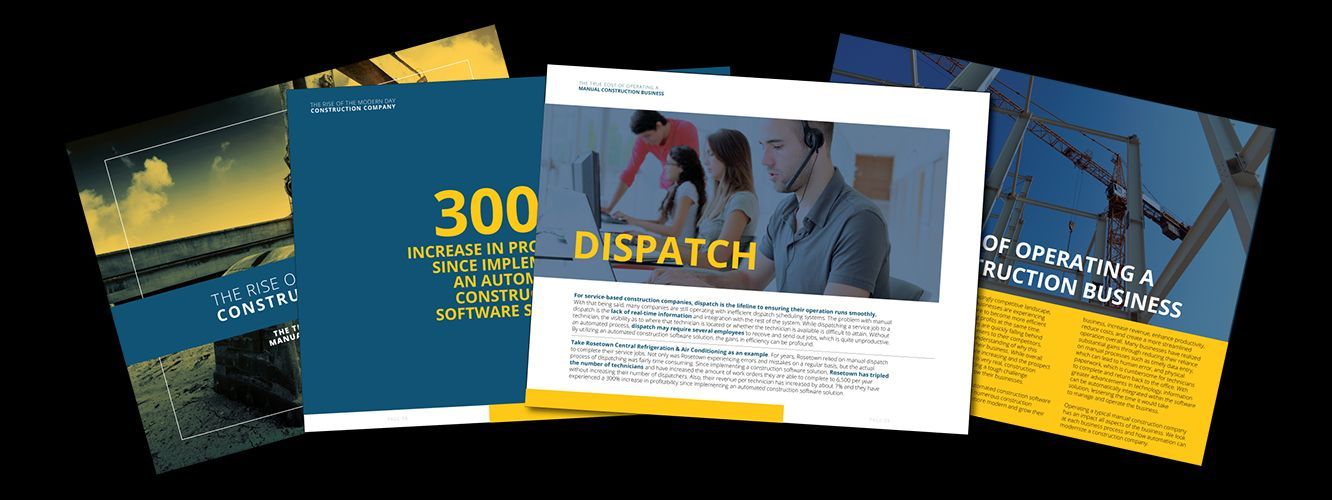
To learn about the benefits of implementing a fully-integrated and automated construction software solution and how it can modernize any construction business, download the complete white paper entitled: ‘The Rise of the Modern Day Construction Company’.
Download ‘The Rise of the Modern Day Construction Company’