Each year, construction project competitions across the globe showcase some of the industry’s most ambitious and complex work. In the United States, among the most prestigious are the ABC Excellence in Construction Awards, where Eagle-winning projects represent the highest levels of project performance, innovation and execution.
But beyond recognizing exceptional work, the data behind these projects may also offer a roadmap for delivering better outcomes across the broader construction industry.
Can the performance metrics from award-winning projects help owners, designers and contractors make decisions that lead to safer jobsites, stronger budget performance and more predictable schedules? According to ABC’s growing EIC data set, the answer appears to be yes.
Over the past several years, ABC has enhanced and automated the EIC application process, enabling the organization to capture and analyze detailed project-performance data across hundreds of projects nationwide. The findings reveal several clear trends among top-performing projects: value-based procurement dominated over low bid selection; preconstruction services consistently improved schedule reliability; and contractors investing in technology and early collaboration often delivered stronger safety and budget outcomes.
The 2025 EIC portfolio—recognized at ABC Convention 2026 in Salt Lake City—provides one of the clearest pictures yet of what project excellence looks like in practice.
The portfolio includes 341 national-level projects totaling $15.09 billion in construction value, representing 38 million work hours, 48 million square feet of construction and 3.6 million acres of developed land. The projects span every major market sector, including data centers, healthcare, multifamily, petrochemical, institutional, renewable energy and aviation.
Collectively, the projects achieved a total recordable incident rate of 0.68—70% below the 2025 industry average TRIR of 2.3. Ninety-eight percent finished within the final contract budget despite collectively overcoming 2,647 days of delays. Across the portfolio, contractors deployed a wide range of technologies, including robotics, telematics, drones, virtual reality and artificial intelligence.

The data also challenges several longstanding assumptions about high-performing construction projects. While many EIC projects exceed $100 million in value, nearly 200 are valued below $20 million, suggesting the practices driving excellence are not limited by project size. The portfolio also demonstrates that merit shop contractors are successfully delivering large-scale, technically complex projects while achieving industry-leading safety performance.
Taken together, the portfolio significantly outperformed broader industry benchmarks in safety, budget reliability and schedule management—raising an important question: What were these projects doing differently?
The data points to several leading indicators that consistently show up in award-winning construction.
THE VALUE OF EARLY ENGAGEMENT
Project success begins with procurement strategy and the services purchased during project development.
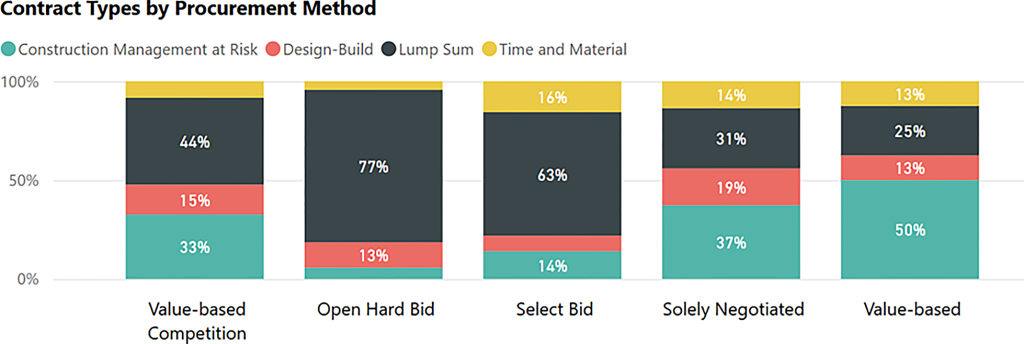
All procurement methods were represented across both general and specialty contracting. However, 60% of projects were procured primarily on value- or qualification-based selection, while 40% were procured primarily on price. Of the price-based projects, half were awarded through select bidding processes involving prequalified contractors.
While much of the broader construction market still relies heavily on price-driven procurement, EIC projects skewed strongly toward qualification- and value-based selection (encompassing both the “value-based” and “solely negotiated” designations in the preceding and above infographics).
Every market sector selected contractors primarily on qualification at least 50% of the time. The high-tech/data center sector and renewable energy sector relied most heavily on qualification-based procurement, at 74% and 75%, respectively.
“Owners are increasingly seeing that selecting a construction partner based on best value, not just low price, leads to savings overall,” says Buddy Henley, president of Gaithersburg, Maryland-based Henley Construction. “Having a trusted partner engaged during design allows risks to be identified earlier and problems to be solved before they become costly. That early collaboration improves cost certainty, supports smoother schedules and significantly reduces surprises in the field.”
Government projects relied most heavily on open hard bid or price-based procurement, using that method 27% of the time. By contrast, the high-tech/data center market procured just 15% of projects through open hard bid.
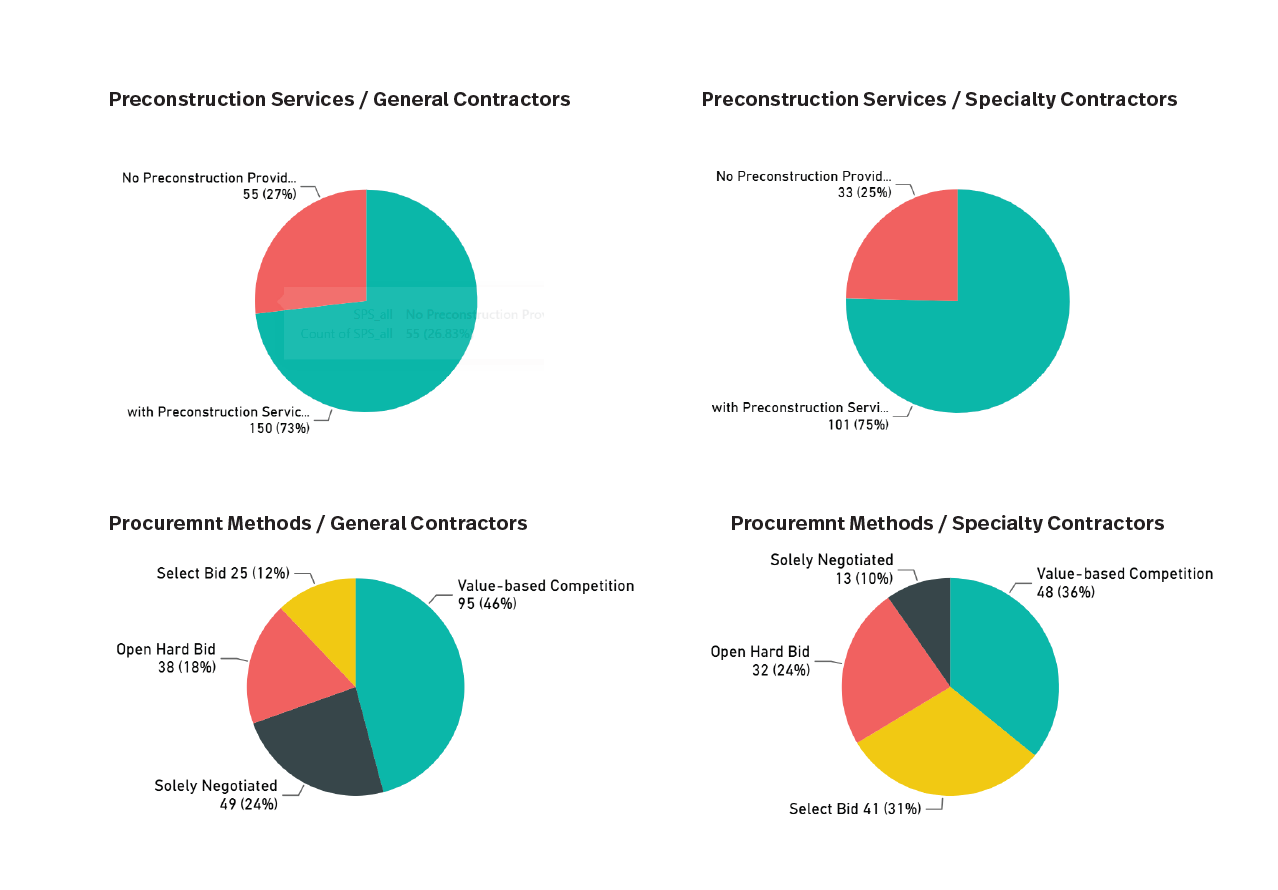
Among general contractors, 74% were selected primarily on a qualification basis. Nearly one-quarter of those projects were solely negotiated, and those projects represented the highest average contract value at approximately $101 million.
“The most successful projects are the ones that bring the design team and construction manager together at the very beginning. Early collaboration improves constructability, clarifies scopes for the trades, and reduces gaps that create risk,” Henley says. “That early alignment leads to better budget predictability and stronger trade relationships, which directly supports safer and more successful projects.
When owners focus on value-based procurement instead of low bid alone, the outcomes are consistently stronger. Choosing teams based on experience, collaboration and the value they bring creates real partnership across the project. We see better cost control, higher-quality results and safer jobsites when the right team is selected from the start.”
Lorri Grayson, partner and founder of Rehoboth, Delaware-based GGA Construction, echoes Henley’s sentiments. “Early involvement creates an atmosphere of strong collaboration among project stakeholders. It enables the project team to define the scope of work, identify long lead items and, most importantly, control costs from the earliest stages,” she says.
“It also helps develop a bid strategy that responds to current market conditions. For example, early involvement on our current project, The Continental, located at the University of Delaware, saved the owner over $5 million on a $90-million project,” Grayson says. “Early coordination allowed us to identify critical procurement needs and minimize budget risks, resulting in a more efficient and cost-effective process.”
That emphasis on early collaboration and value-driven procurement was reflected throughout the EIC portfolio data. Just 18% of general contractor projects were procured through open hard bid, and those projects represented the lowest average contract value at approximately $15 million.
The owner perspective also supports early contractor involvement.
“Successful projects are built on strong partnerships rooted in trust, transparency and psychological safety—where titles are set aside and teams feel comfortable speaking openly to solve problems together,” says Spencer Moore, vice president and chief facilities officer for globally renowned cancer center UT MD Anderson. “Early collaboration creates that foundation, allowing teams to address challenges with humility and ownership before moving toward solutions.”

That same emphasis on qualifications, collaboration and long-term value also appeared in how specialty contractors were selected across the EIC portfolio. Specialty contractors were procured primarily on qualification 46% of the time, while 31% were selected through select bid and 24% through open hard bid. Contract value did not appear to significantly influence procurement methodology for specialty trades.
One of the more surprising findings in the data was that procurement strategy did not necessarily dictate contract structure. Regardless of how projects were awarded—whether through qualification-based selection, negotiated work or open bid—top-performing projects utilized virtually every form of contracting across the portfolio.
One notable distinction emerged between general and specialty contractors: Lump-sum contracting overwhelmingly dominated among specialty contractors regardless of procurement method.

THE PRECON ADVANTAGE
Across all market sectors, preconstruction services were provided on 74% of projects—well above what many contractors would consider typical across the broader marketplace. General contractors delivered preconstruction services on 73% of projects, while specialty contractors did so on 75%.

“Early involvement allows specialty contractors to contribute practical, experience-based insight before key decisions are locked in. When we’re engaged during preconstruction, we can identify coordination challenges early, help refine scope and sequencing, and offer practical yet innovative solutions to tough problems–reducing rework,” says Matt Terry, president of Dallas-based mechanical contractor TDIndustries. “That upfront collaboration directly improves schedule reliability, cost certainty and overall project performance.”
Steve Grauer, executive vice president for Hensel Phelps, agrees. “In my experience, the best outcomes to project success on complex projects are rooted in project teams that exemplify a high level of trust, practice transparency, have accountability, truly collaborate, and have a high level of executive commitment and engagement in the project and where there is open communication by all the stakeholders,” he says. “These traits are best embedded when project teams have some type of early engagement, giving them an opportunity to work collaboratively to resolve early challenges and work to build personal relationships prior to the start of construction.”
Notably, no preconstruction services were provided on 51% of projects procured through open hard bid.
While preconstruction services were utilized across all procurement methods and contract structures, the combination of open hard bid procurement and lump-sum contracting most frequently resulted in projects without preconstruction involvement.
Twenty-six percent of all EIC projects did not utilize preconstruction services, and 75% of those projects followed the open hard bid/lump-sum model.
FROM PLANNING TO PERFORMANCE
At a time when the construction industry continues to battle cost escalation, labor shortages and schedule disruption, EIC projects significantly outperformed broader industry benchmarks in safety, budget reliability and schedule management. The EIC portfolio overcame more than seven years of cumulative delays, delivering 98% of projects within budget and achieving a TRIR of 0.68.
The next question? Whether procurement methods, contract structures or preconstruction services contributed to those outcomes.
When comparing planned project duration to actual construction duration—including delay recovery—projects utilizing preconstruction services demonstrated stronger performance.
Projects with preconstruction services showed slightly better schedule outcomes overall. Fifty-two percent achieved shorter actual durations compared to projects without preconstruction services.
More importantly, projects with contractor involvement during preconstruction overcame more delay days and exhibited lower schedule variation.
Projects without preconstruction services experienced a 14% variance between planned and actual construction duration, including delays.

The same trend appeared across contract structures. Lump-sum contracts—which included preconstruction services on only 47% of projects—experienced an 11% variance between planned and actual duration. Construction manager-at-risk projects, where preconstruction services were included on 96% of projects, experienced only a 1% variance.
The trend became even more pronounced among general contractors. Design-build and CMAR delivery methods significantly reduced schedule duration variance compared to lump-sum and time-and-materials contracts. This aligns with the fact that design-build and CMAR projects incorporated preconstruction services on 90% and 96% of projects, respectively.
“The biggest gains we see come under the construction-manager-at-risk approach. Early cost validation during design helps identify savings without sacrificing quality,” explains Henley. “Clarifying scopes and resolving issues early reduces financial risk and improves safety across all trade partners.”
Among specialty contractors, preconstruction services also reduced schedule variation regardless of procurement method or contract type. Projects without preconstruction services experienced a 25% schedule variance. When specialty contractors participated in preconstruction, that variance was reduced by at least half.

Although 98% of EIC projects finished within the customer’s final approved budget, variation still existed between original and final contract values through approved change orders.
Projects utilizing CMAR and design-build delivery methods experienced lower budget variation than lump-sum and time-and-materials contracts, suggesting fewer scope changes and change orders over the course of construction.
No significant correlation emerged between procurement method, contract type and safety performance, with one exception: time-and-materials projects recorded an exceptionally low TRIR of 0.04.
Time-and-materials contracting was most common in industrial, infrastructure and renewable energy markets.

CONSTRUCTION TECHNOLOGY
Technology adoption continues to expand across the construction industry.
- The four most commonly used technologies during the past three years remained consistent:
- Project-management platforms
- Safety workflow technologies
- Drones
- Jobsite security technologies
TECHNOLOGY MOVES TO THE CENTER
Just three years ago, artificial intelligence was virtually absent from EIC projects. Today, 18% of projects report using AI technologies.
Importantly, no major technology category has declined in usage over the past three years, suggesting contractors continue to realize measurable return on investment.
Technology deployment also spanned all contract types and project sizes.
Construction technologies were utilized across projects of every size category. Data indicates that technology deployment frequency remains consistent regardless of project dollar value.
“During the past three years, we have experienced unprecedented growth which we attribute to two key factors,” says Rob Griffith, chief operating officer of Gaylor Electric. “First, we are collaborating with our customers earlier in the precon process. The second—related—factor is our commitment to utilizing innovations that increase efficiency and safety for our workforce and the speed at which we deliver reliable outcomes on projects.”
Projects utilizing safety technologies consistently reported lower TRIR rates than projects without those technologies.
The trend suggests that investments in safety-focused technology are contributing to improved jobsite performance.
“Technologies like BIM, VDC, field-management platforms and real-time reporting help teams communicate more effectively and make informed decisions faster,” Terry says. “Our longstanding investments in these tools give our teams a distinct advantage when delivering high-quality results. This amounts to better productivity, safer jobsites and more predictable outcomes for owners.”

WHAT THE INDUSTRY CAN LEARN
Companies qualifying for EIC awards should take pride in their performance. The data confirms that ABC’s EIC-awarded projects significantly outperform industry averages across safety, budget and schedule metrics.
- The analysis also reinforces several broader conclusions:
- Preconstruction services deliver measurable value
- Technology adoption is accelerating and becoming a key differentiator
- Safety leadership remains foundational to project excellence
- High-performing contractors consistently deliver quality projects regardless of procurement method or contract structure
The data also provides insights worth sharing broadly across the industry. Regardless of project size, market sector or delivery method, the conditions for excellence can be created through intentional planning, collaboration, innovation and leadership.