Keith Horton is used to dealing with wet soil, but this was different.
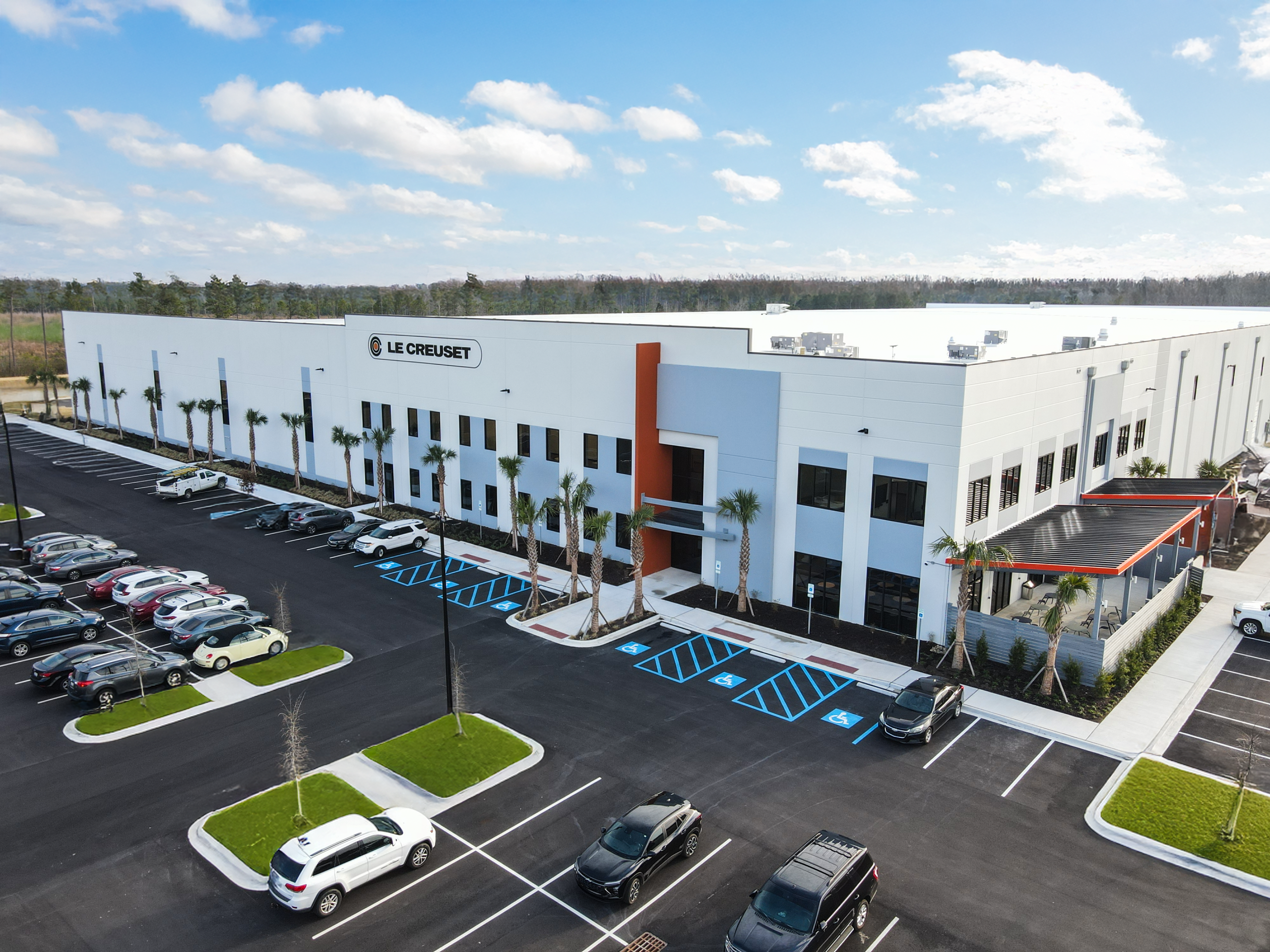
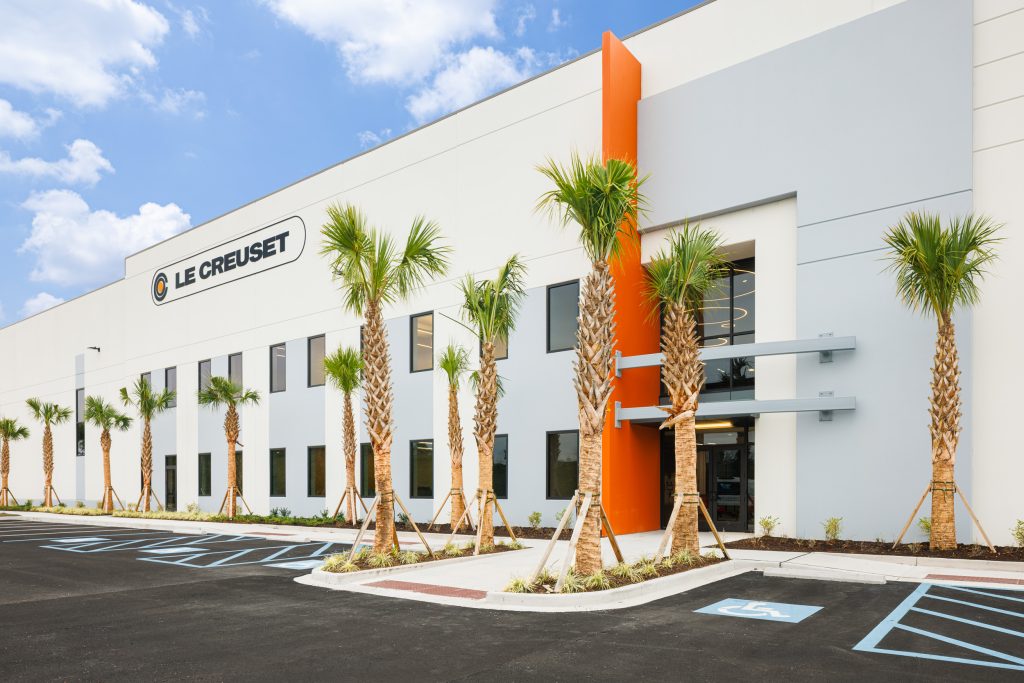
The location was Early Branch, South Carolina, the site of a new 300,000-square-foot distribution center and 23,000-square-foot office building for French-Belgian cookware company Le Creuset. The designs for the company’s new 62-acre campus were striking, but the damp dirt was jarring even for a Lowcountry construction veteran like Horton.
“It was probably the wettest site we’ve ever built on,” says Horton, project director for Frampton Construction Co., which has offices in South Carolina, North Carolina and Florida. “We’ve dealt with it before, but this dirt was super saturated. When we got the reports back on the moisture content, they were kind of off the charts. We had reports before taking the job, so we knew what we were getting into, but it ended up being worse than we thought.”
Fortunately, Horton was well-suited to handle the challenge. He has managed roughly 30 distribution center projects during his career, and Frampton’s willingness to address the difficult soil conditions while still completing the project within 12 months helped the company win the job. Groundbreaking took place in February 2025.
“Le Creuset had deadlines they had to hit, and we figured out a way to do it,” Horton says. “The owner later told us, ‘You had four or five other people bid against you. Everybody said it was probably about a 15-month project. You guys came in and said 12.’ That was a big deal for them. They had to trust that our schedule was right.”
The compressed timeline was driven by the holiday season. Le Creuset needed to install racking systems and move products into the facility ahead of Thanksgiving and Christmas, when sales increase significantly. The installation was completed in phases while construction continued.
“There was a lot of sequencing because they were moving product while we were still under construction,” Horton says. “We worked really well together as a team to make sure they could do what they needed to do while also protecting their product and keeping everyone safe. It required a lot of coordination.”
The project’s remote location created additional logistical challenges. The nearest major cities—Charleston, South Carolina, and Savannah, Georgia—are both more than 55 miles away.
“You’ve got to get construction materials, subcontractors and everything else to a site that’s not near a major city,” Horton says.
To stabilize and dry the soil, Frampton implemented cement soil stabilization. However, Early Branch was not close to cement suppliers, and the area lacked major ready-mix concrete providers capable of supporting the project’s slab and wall pours.
The solution was to build an onsite concrete batching plant, which improved quality control and helped keep the project on schedule.
The campus ultimately opened on time, with a grand opening celebration held Feb. 20. Horton says competing bidders later called Le Creuset to ask whether Frampton had really completed the project in 12 months.
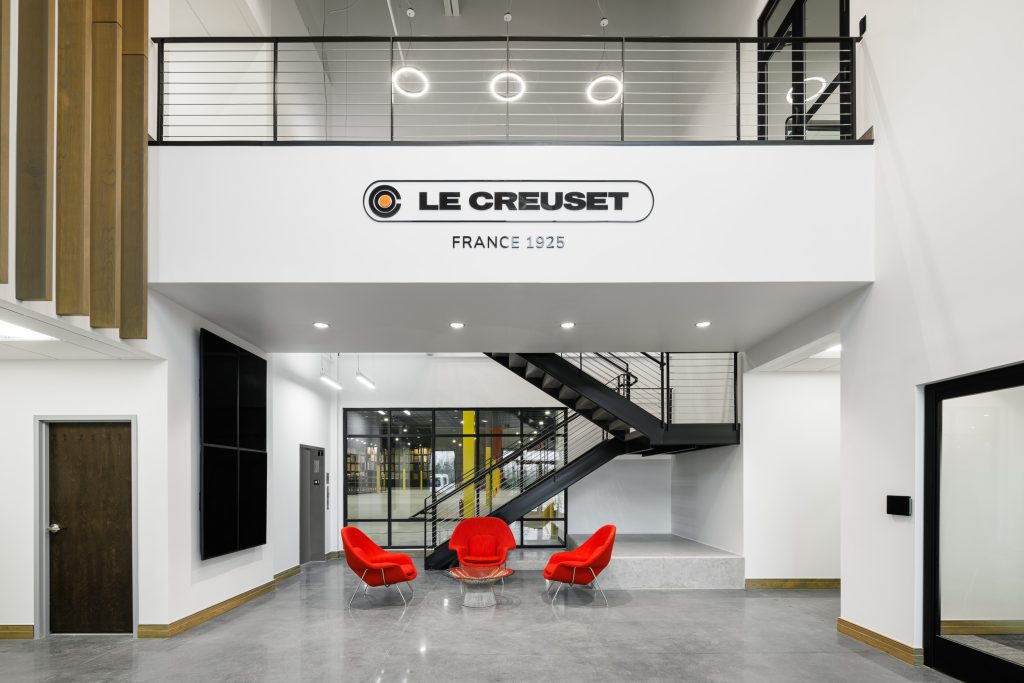
The distribution center itself is a concrete tilt-up facility designed to accommodate future expansion. But Horton says the office building became the project’s showpiece.
The space features open ceilings, polished concrete floors and a two-story lobby anchored by a grand black-metal staircase. Le Creuset’s signature bright, warm colors—inspired by its cookware products—were incorporated throughout the office by design firm McMillan Pazdan Smith.
The lobby bathroom sink, for example, is a flame-orange Dutch oven, while the elevator interior is bright red.
“They’re the colors they use on their products, so it’s more fun than a normal office space,” Horton says. “The flooring, wall tile and furniture are all colorful. The cubicles are red, orange, blue and green. Their team was very specific about what they wanted the space to look like, and we made it happen for them.”
The campus was also designed with employees in mind. Amenities include a cafeteria with a covered patio and grills, walking trails around the property and pond, and locker rooms.
Horton says employees have responded enthusiastically to the space, but for him, the project’s greatest success was the trust established between Frampton and Le Creuset. The cookware company hired Frampton directly without using a third-party construction manager.
“They know how to make Dutch ovens and pots and pans. They don’t know how to build buildings,” Horton says. “They trusted us to manage the construction and do what was right for them. I think we built that trust early in the interview process. I’m proud of our team. We guided them through the process, stayed on budget and avoided major surprises.”
Other than the wet dirt, of course.
SEE ALSO: BRINGING HOME THE (FANCY ITALIAN) BACON: HOW TO BUILD A NEXT-GEN GOOD PLANT