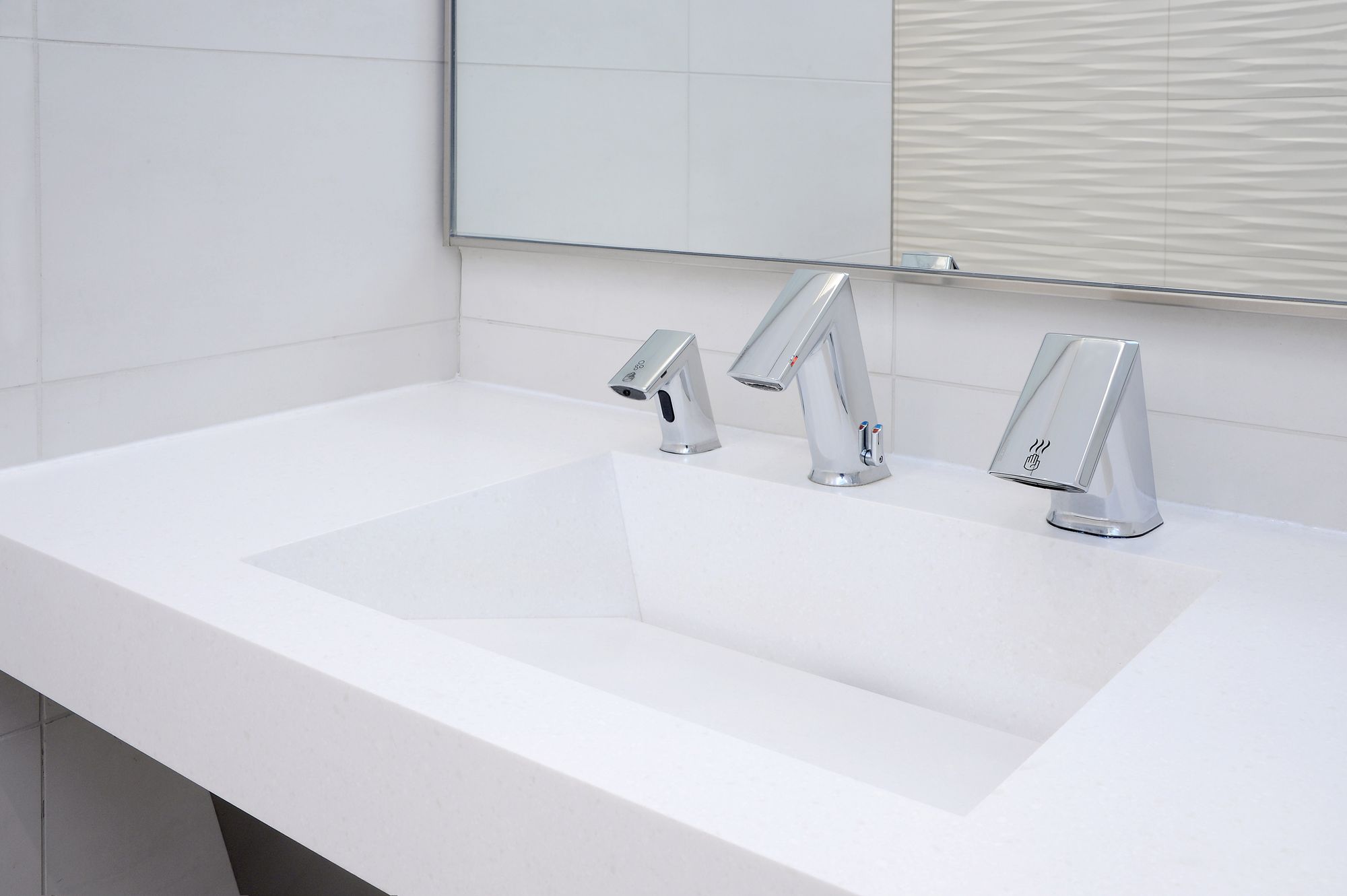
The focal point of commercial restroom sustainability has long been aimed at water conservation. Yet, as water-saving innovation has continually evolved over the years, low-flow fixtures simply don’t have much room to go any lower without sacrificing drain line carry.
With engineers now developing water closets with gallons per flush as low as 1.1—and in some instances completely water-free urinals—commercial restroom manufacturers have essentially reached the floor of flush and faucet volumes and are turning their attention to a new wave of sustainability.
That next evolution is coming in the form of a product’s impact on the environment, with complete product visibility becoming an essential part of commercial restroom specification as architects and contractors continue to push green design further. While water conservation continues to be a point of emphasis of any restroom fixture, the environmental and health impacts that those fixtures make is now the trend that is carrying the torch into the next generation of restroom sustainability.
A Declaration of Sustainability
Transparency reports are providing unprecedented visibility into the impacts of the components and materials specified for projects. Manufacturers are now generating Environmental Product Declarations (EPD), Health Product Declarations (HPD) and Declare Labels for their products that outline how production details throughout a product’s lifecycle can impact human beings and the environment.
More specifically, EPDs and HPDs are breaking down various stages of a product’s lifecycle—from production and installation to use and end-of-life. Manufacturers are then looking at how those different lifecycle stages impact the environment.
Researched impacts include how much carbon is generated, how it affects the ozone, the amount of smog produced and how much fossil fuel is being used or depleted throughout the entire lifecycle. With the help of these indicators, manufacturers are able to act on the learned data to change the manufacturing process and the chemicals and materials used in their products to reduce their impact levels.
Some manufacturers have taken action on the data from their EPDs and have improved the environmental impacts of their products. The embodied carbon in manufactured products can be reduced through various methods such as entering into Power Purchase Agreements (PPA) to purchase zero carbon renewable electricity or completely offset the embodied carbon by investing in forestry carbon offsets.
The United States Green Building Council (USGBC) has taken notice as well. The latest version of USGBC’s LEED green building rating system now offers additional credits for specifying products that have documented the environmental impacts across the entire life cycle of a product, asking manufacturers to provide EPDs or third-party verified life cycle assessments. EPDs and HPDs can now correlate directly to additional LEED points, the ultimate measure of green building.
Reclaiming Earth’s Most Precious Resource
While a product’s composition certainly contributes to its effect on the environment, the biggest carbon footprint of commercial restroom products actually has nothing to do with how manufacturers are extracting the brass, where it’s coming from or the machining of the product. Instead, the heaviest impact of commercial restroom products stems from the potable water flowing through it.
With new water conservation efforts starting to slow down due to the existing innovation of low-flow fixtures, learning how to maximize non-potable water is the next wave of sustainability facing manufacturers.
With only so much water on our planet, the existing challenge is to convert fixtures from potable water and onto a grey water system to reclaim as much as possible. When considering the heavy impact that potable water brings, it raises the question as to why we’re taking so much valuable, energy-intensive water and simply flushing it away. Instead, there are other types of water that we should be using to flush both toilets and urinals.
Focusing on the Future
Innovating sustainable, low-flow fixtures that positively impact buildings and the occupants inside is keeping manufacturers busy today, but it’s never too early to look ahead. We’re already starting down a path to where products can communicate to users in real time to deliver up-to-date data in an effort to save time and money thanks to predictive maintenance.
With this focus on human health and innovation, the industry is beginning to build additional frameworks designed to take a closer look at how products and the chemicals that compose them can adversely affect the people that interact with those products on a daily basis.