A crane arrives on site marked available, exactly as the inventory list promised, and then the day unravels. The boom needs an attachment still sitting in a yard across town, and a hydraulic line that failed its last check was never repaired. Three crews stand idle while a dispatcher works the phones, and two days pass before the machine even begins to move dirt.
Despite the common scenario outlined above, labor shortages and material pressures get most of the attention, and not without reason: the RICS-AACE Q1 2025 USA Construction Monitor found that skill shortages, general labor shortages and rising material costs were among the leading factors inhibiting construction activity. This is complemented by McKinsey research showing that large projects already tend to run about 20% longer than planned. The real issue is not that contractors lack machines, but that a machine counted as ‘available’ cannot always work.
True availability is a matter of defined readiness criteria, not physical presence, and closing that gap is where the quickest gains appear.
‘Available’ doesn’t mean usable
Many field teams judge a machine ready by where it sits or by a single status line in a log, a shortcut that skips the details that determine whether it can perform. Maintenance currency, attachments, operator certification and site-specific setup all sit beneath the word ‘available’, and anyone can stop work cold.
Consider a dozer marked available for grading. On paper, it is ready, but in practice, it still needs greasing, a fluid check and a safety inspection before it can work. A loader can sit idle because no one has confirmed its hydraulic function or whether its attachment is suited to the soil. In each case, the asset was present, but it wasn’t ready to go.
This is where status and scheduling collide, because a status that means ‘present’ rather than ‘ready’ quietly brings a planner’s start time into the realm of guesswork.
Equipment moving across sites creates visibility gaps
Machines rarely stay put in a multi-site operation, and every move risks losing track of one. A transfer logged late, or not at all, creates phantom availability, so the same excavator can read as available at two sites at once, with the conflict surfacing only after both crews have planned around it.
The fallout then lands on handoffs. A compactor stuck at Site A past its return date leaves a Site B crew waiting on a machine that the system still shows as on the way. The log said one thing, the yard said another, and the schedule suffered as a result.
Ultimately, cross-site visibility is less about technology than trust: the confidence that every asset’s location and status can be relied on at a glance. Without it, managers can’t properly plan.
Informal handoffs reduce accountability
Equipment changes hands far more often than the paperwork suggests, passing between crews, back from a subcontractor to the general contractor, or site to site, often over little more than a call or email that records nothing about its condition.
That informality is where accountability erodes. Without a signed condition report, the receiving team inherits whatever the last team left behind. For example, a telehandler can turn up with low fuel, unreported wear and a missing fire extinguisher. The crew loses a morning sorting it out, and with nothing documented, no one owns the problem.
The same gap also raises change-order risk, since an undocumented condition can lead to disputes over damage, with downtime and arguments built on little evidence. A formal sign-off at each transfer keeps responsibility for the asset attached as it moves.
Maintenance disrupts schedules when it is not planned
Reactive maintenance is among the most disruptive forms of downtime, precisely because it arrives without warning. IoT Analytics estimates that unplanned industrial downtime costs manufacturers $1 trillion globally each year, underscoring how quickly equipment issues can become operational and financial problems. On a jobsite, a machine that should have been ready can become an urgent breakdown at the worst moment.
That cost rarely stays contained to the machine itself. When a skid steer is flagged for service during a critical grading phase, it does not just stop; it stalls the crew assigned to it, because no backup was checked for availability in advance. Pull any machine mid-shift for service, and a chain of crew reallocations ripples across the day.
Planned maintenance changes that dynamic. Tied to real service intervals and honest pre-use checks, it turns those surprises into scheduled events, so an anticipated breakdown becomes a routine task, not a delay.
Defining equipment readiness as a productivity metric
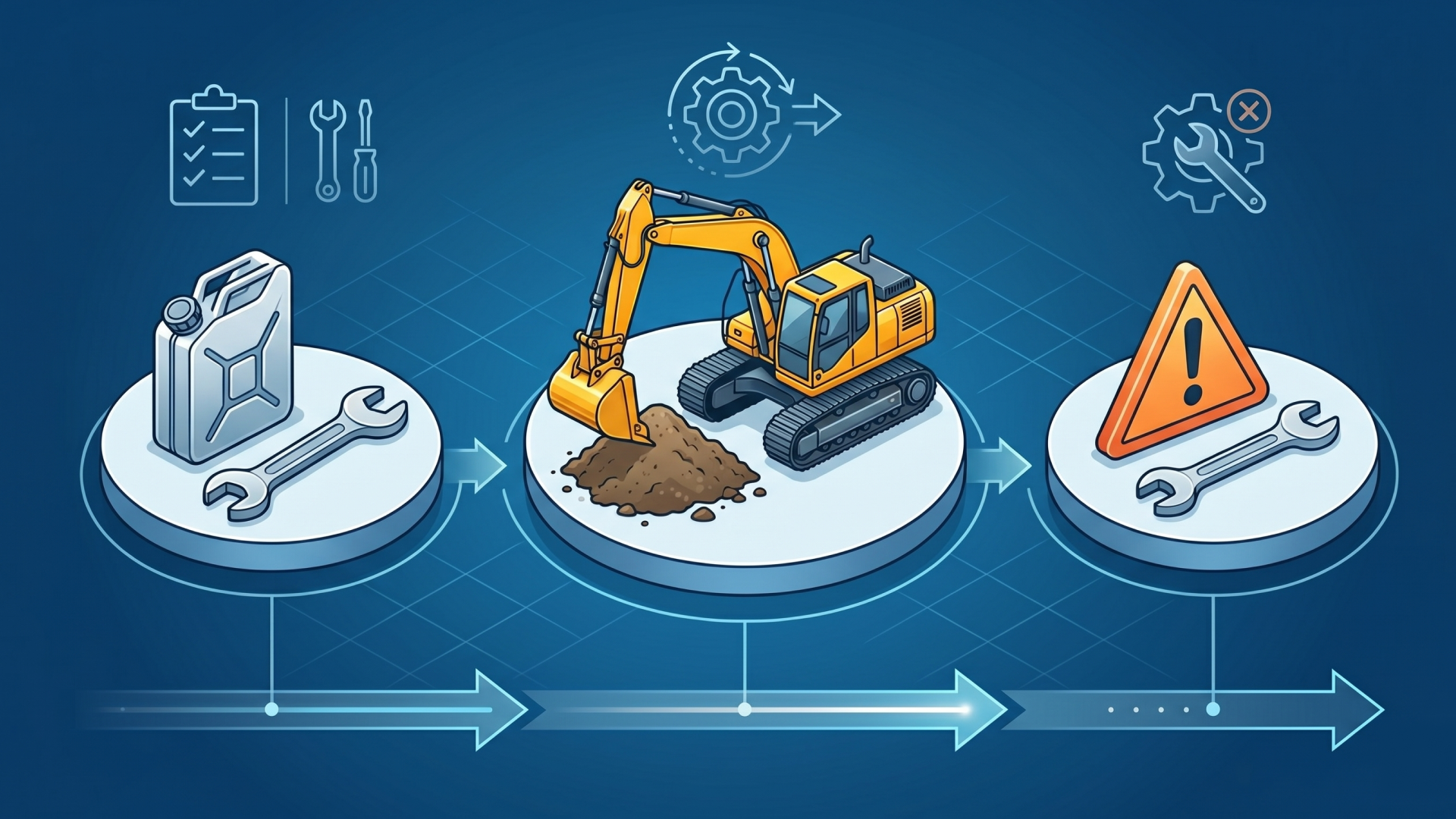
The fix starts with language. Availability remains a judgment call until it is broken down into states that anyone can verify, giving every machine a status that means the same thing to the yard, the planner and the crew. One workable model:
- Inspected: pre-use and safety checks are complete.
- Fueled and configured: topped off and set up with the right attachments for the task.
- Certified: a qualified operator is assigned and current.
- Site-deployed: physically on the correct site and logged there.
- In use: actively working and not open for reassignment.
- Maintenance-due: flagged for service and out of the planning pool until cleared.
These states turn a subjective ‘available’ status into objective checkpoints, so a project manager can filter for genuinely deployable machines rather than guessing from an inventory list. Readiness becomes measurable, and what is measurable can be managed.

Improving cross-site visibility and formalizing handoffs
Putting readiness to work requires only a few process controls, most of which cost little. A centralized view of real-time status lets every site work from the same picture; mandatory transfer records, signed at both ends, help to keep accountability attached to each move; and pre-shift readiness audits catch the greasing, the fuel and the missing attachment before a crew stands idle.
None of these demands a large technology purchase; many teams begin with a shared spreadsheet or a mobile checklist and tighten from there. The discipline matters more than the platform: process first, tools second.
There are limits worth respecting. Overly rigid states can slow a small crew that does not need six checkpoints for three machines, so the sensible approach scales to equipment value and project phase, with tighter controls on high-value assets and critical-path work.
Turning readiness into a schedule advantage
Schedule slippage on this scale is widespread. A KPMG survey found that more than a third of firms missed budget or schedule targets by at least 20%. Much of that is treated as unavoidable, yet a real share traces back to equipment that looked ready on paper but was not.
Construction productivity depends on more than access to equipment. It is contingent on whether that equipment is ready when and where the plan needs it. A machine that is present but unusable causes avoidable delays, hidden in inventory lists that look complete.
Defining readiness states, making the status visible across sites and formalizing handoffs turn equipment from a quiet schedule risk into a schedule accelerator. Better still, these controls are mostly process rather than procurement, so most teams can begin within a week. The contractors who treat readiness as a measurable productivity driver, rather than an afterthought, are the ones who stop losing days.