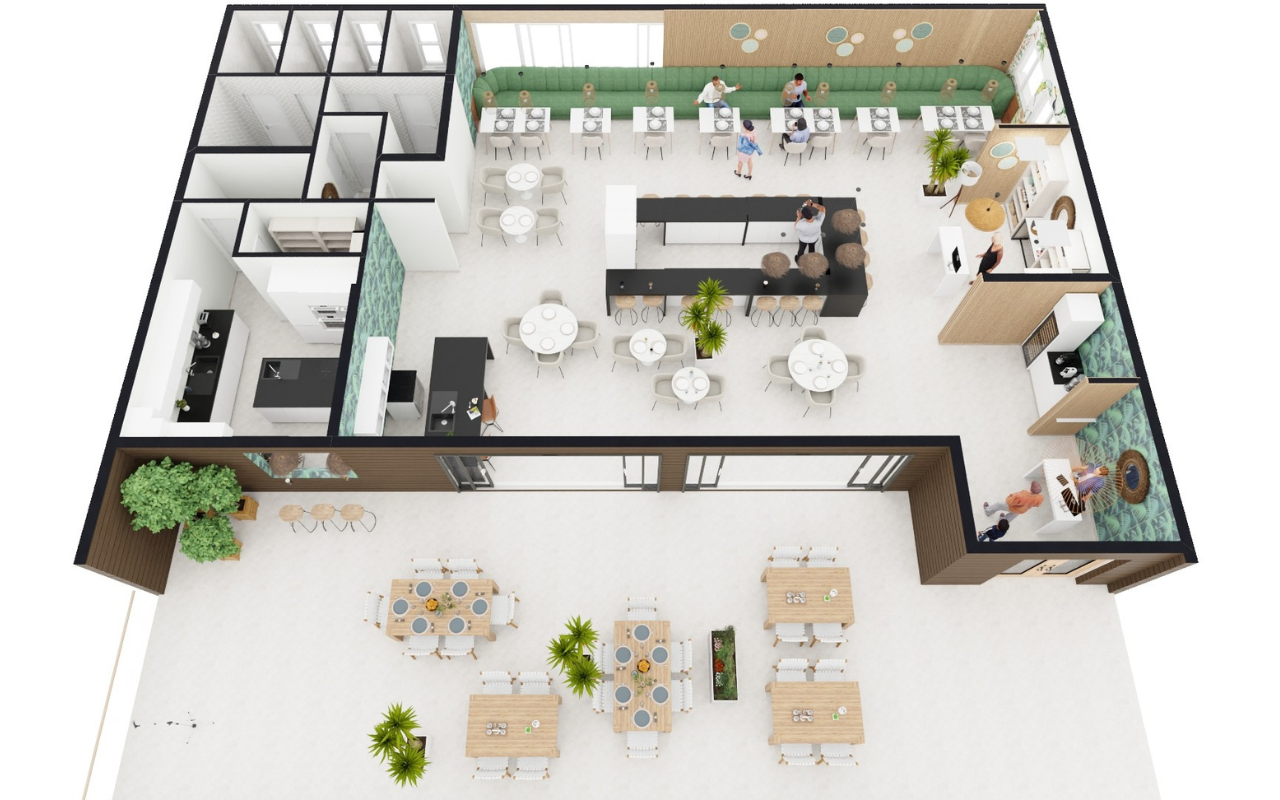
Small commercial projects are often described as straightforward because the footprint is limited. In practice, they can be some of the most presentation-sensitive jobs a contractor takes on. A neighborhood café, a compact pharmacy, a boutique retail fit-out or a fitness studio may involve less square footage than a large office project, but the room for layout error is often smaller. A misplaced service counter can slow transactions. A weak circulation plan can create friction for customers and staff. An incomplete presentation package can delay approvals, confuse vendors and stall sign-off.
That matters in today’s market because many commercial clients want to open quickly, control spending and make every square foot work harder. The National Restaurant Association says U.S. restaurant industry sales are projected to reach $1.55 trillion in 2026. The National Retail Federation said core retail sales reached a record $5.28 trillion in 2024. IBISWorld estimates the U.S. gym, health and fitness club market at $47 billion in 2026. At the same time, NFIB reported in early 2026 that only 15% of small business owners said it was a good time to expand, underscoring how cautious many operators still are.
For contractors, that creates a clear challenge. Small commercial clients are still investing, but they want fewer surprises, faster approvals and stronger evidence that the proposed layout will support daily operations from the day the doors open.
What Commercial Clients Need to See Before Signing Off
Before a client approves a layout, the central question is rarely whether the space looks good on paper. The real question is whether it will work in live operation.
First, clients need to understand customer and employee flow. In a café, that means the path from entry to ordering, pickup and seating. In retail, it means how shoppers enter, browse, queue and pay. In a pharmacy or clinic, it means separating waiting, consultation, storage and staff circulation in a way that feels controlled and clear. In a fitness space, it means showing how members move between reception, lockers, equipment zones and recovery areas without congestion.
Second, clients need confidence that the design respects real constraints. Accessibility, life safety, privacy, sanitation and egress are not abstract review items. They shape whether the space can open on time and whether the operator can run it efficiently once it does.
Third, the plan has to support business performance. Many small commercial operators think less in design language than in seat count, transaction capacity, privacy, storage density, staff efficiency and throughput. If a presentation does not connect the layout to those outcomes, it often feels incomplete.
Finally, the presentation has to make functional zones obvious. Clients should be able to identify what is public, what is staff-only, what is regulated and where the likely bottlenecks may appear. A basic line drawing can define walls, but it does not always explain how the business will actually function.
Where Presentations Often Fall Short
One common mistake is focusing on the shell of the project while underexplaining the user experience. Contractors may describe dimensions, partitions and finishes accurately, but still leave the client unsure about what customers and staff will experience in the space. That uncertainty tends to slow approval.
Another mistake is presenting a static footprint without presenting the business process the footprint must support. A restaurant owner is thinking about ticket flow, staff movement and table turnover. A pharmacy operator is thinking about privacy, waiting conditions and secure storage. A gym operator is thinking about equipment spacing, visibility and circulation. When that operational logic is not visible in the presentation, the client has to imagine too much on their own.
A third weak point is failing to show a normal day in the life of the space. A technically correct floor plan may still fall short if the client cannot picture a lunch rush, a checkout queue, a restock path or a locker-room transition. Approval slows when the operator must mentally simulate the entire business from a drawing that does not make movement obvious.
The last recurring issue is underplaying sector-specific equipment and installations. In food service, that may include prep clearances, exhaust needs, refrigeration adjacency and dish return flow. In health care-adjacent environments, it may involve privacy, controlled storage and hygienic separation. In fitness, it includes spacing, mirrors, showers, lockers and staff oversight. In retail, it includes sightlines, display depth, stockroom access and point-of-sale positioning. The smaller the space, the more damage these omissions can do.
How Sector Needs to Change

Restaurants And Cafes
In food service, the layout has to explain the relationship between front-of-house and back-of-house in operational terms, not just architectural ones. Clients need to see where the queue forms, how pickup works, how servers pass one another and whether the kitchen can support the proposed seating plan. With restaurant sales projected at $1.55 trillion in 2026, operators remain focused on labor efficiency, speed of service and revenue per seat. When a presentation does not clearly show adjacencies, prep flow, service routes and customer movement, owners often hesitate for good reason.
Pharmacies, Clinics And Wellness Spaces
Healthcare-adjacent commercial spaces need to communicate calm and control while still showing compliance-minded zoning. Waiting, consultation, pickup, staff circulation and storage must be easy to read. Privacy is not optional. Neither is queue management. Contractors do not need to overload the plan, but they do need to annotate it in business terms so the client can quickly see where confidential conversations happen, where secure products are stored and how staff move without crossing patient-facing areas unnecessarily.
Retail
Retail layouts live or die on customer journey. Entry sightlines, decompression space, merchandising sequence, impulse zones, checkout location and back-of-house access all affect sales performance. The broader retail sector remains enormous, with NRF reporting record core retail sales of $5.28 trillion for 2024. That helps explain why even smaller retailers care deeply about presentation quality. They are not approving abstract square footage. They are approving a selling environment.
Fitness
Fitness spaces are easy to underestimate because they can appear simple on paper. In reality, they require disciplined circulation and careful zoning. Equipment layouts must support movement and clearance, not just placement. Locker rooms, showers, reception, stretching zones and staff oversight need to function as one system. IBISWorld estimates the U.S. gym, health and fitness club market at $47 billion in 2026, which helps explain why operators want more than a furniture layout. They want confidence that the member experience will feel smooth, safe and commercially credible.
How to Make Functionality Obvious
The most effective presentations show the space as a working environment, not just a bounded area.
A strong package often starts with clear visualization. Not because visualization is fashionable, but because it helps clients understand flow, scale, furniture placement and pinch points faster. The goal is not to impress with graphics alone. The goal is to reduce interpretive effort and accelerate sound decisions.
Plans should also include annotations that clarify operational and regulatory zones. Accessible routes, staff-only areas, counters, storage rooms, waiting zones, wash areas and equipment clearances should be labeled in plain business language. Contractors often assume these elements are obvious once drawn. In practice, they become much easier for clients and third parties to understand when explicitly identified.
Realistic views also matter. A client should be able to look at a perspective and immediately understand how an entry feels, how a service line reads or whether a waiting area looks exposed. These images help reduce second-guessing because they turn a technical document into something the operator can evaluate from a business standpoint.
Finally, the presentation should be backed by documentation that is easy to circulate. That means scaled plans, clear notes, site context and any elevations or sections needed to support review. The package should be understandable to landlords, consultants, vendors, reviewers and internal decision-makers without requiring a separate meeting just to decode the drawings.
“This software is easy to use and offers me the ability to let customers see their finished product before it is built. Many customers have a hard time visualizing typical construction plans. The 3D view lets our customers get a true feeling of the finished product they will be getting.”
Why the Right Tooling Matters
This is where a design software becomes more than a drafting aid. It becomes a communication tool.
Contractors need outputs that build confidence quickly. On its commercial design page, Cedreo says users can add plan notes and key furniture symbols so owners, contractors and vendors can understand how the space works, then export floor plans to scale in JPG or DXF.
Cedreo also says it can produce photorealistic renderings, branded presentation documents and site-planning context, including boundaries, setbacks and grading. For contractors trying to move from concept to presentation without stitching together disconnected outputs, that is a relevant value proposition. Gail, contractor, uses this commercial design software to present his designs: “This software is easy to use and offers me the ability to let customers see their finished product before it is built. Many customers have a hard time visualizing typical construction plans. The 3D view lets our customers get a true feeling of the finished product they will be getting.”
The return is easiest to justify in process terms. Better presentation does not guarantee a fixed increase in conversion or revenue, and no responsible contractor should frame it that way. What it can do is reduce back-and-forth, limit misunderstandings, shorten review cycles and improve the odds that unresolved questions are addressed before they become field problems.
What This Means for Contractors
Planning small commercial spaces well means presenting them as businesses in motion, not as empty rectangles with dimensions. Clients need to see flow, compliance, profitability and functional zoning before they are comfortable signing off. They also need to see that the contractor understands the operational realities of their sector, whether that means restaurant service, pharmacy privacy, retail conversion or fitness circulation.
The broader market supports that conclusion. Restaurants, retailers and fitness operators continue to represent large, active parts of the U.S. economy, but many of the small-business clients behind these projects remain careful about timing, spending and risk. NFIB’s early-2026 readings reflect that caution. In that environment, better planning is not just a design upgrade. It is a sales, coordination and risk-reduction strategy. Contractors who present small commercial projects with that level of clarity are more likely to shorten approvals, reduce avoidable revisions and build confidence before the job reaches the field.