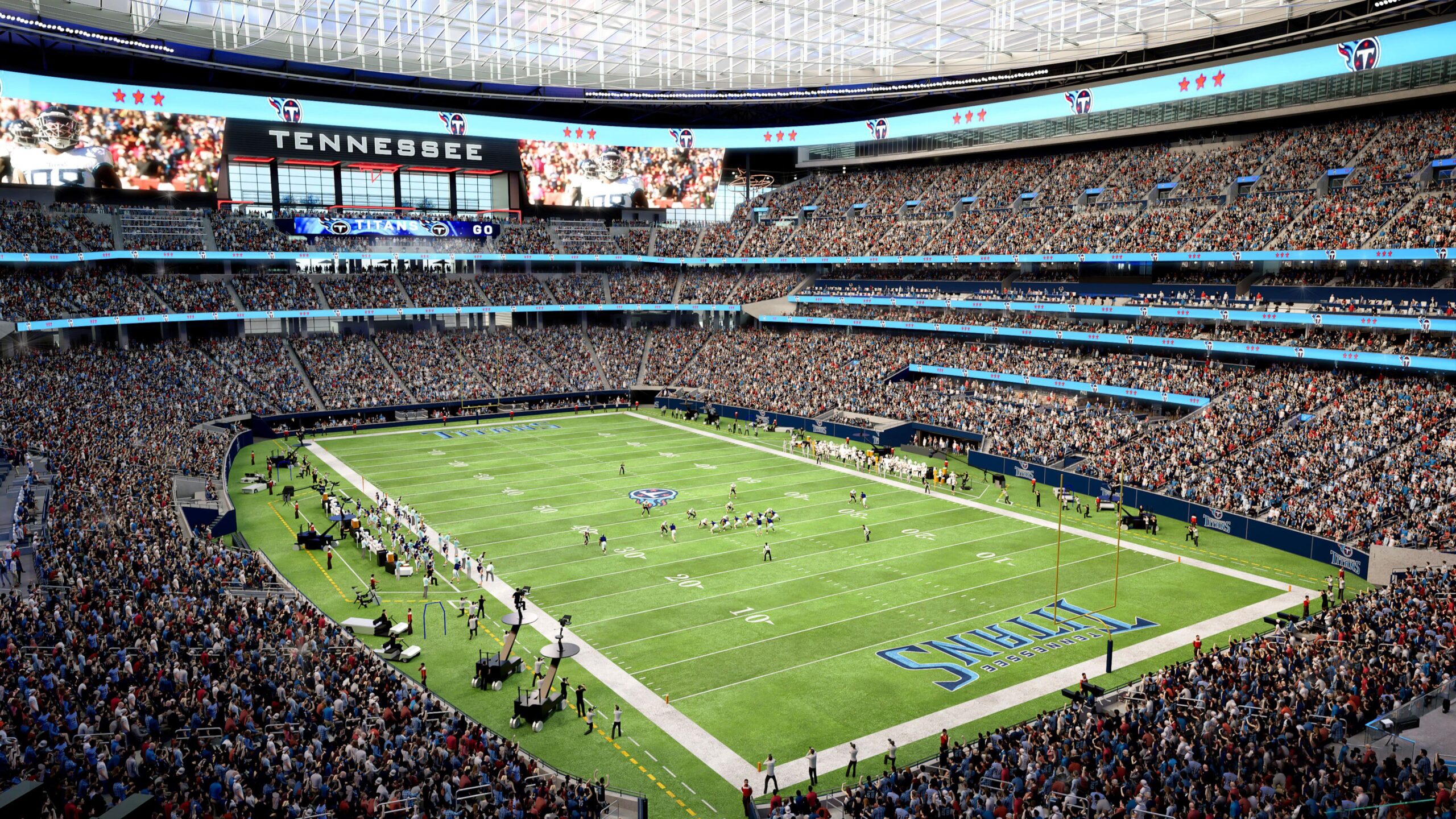
The new Tennessee Titans sports complex rising up on the banks of the Cumberland River in Nashville is a big project no matter how you look at it. Nissan Stadium will have 60,000 seats, cover 1.85 million square feet and cost an estimated $2.1 billion. Four contractors are involved, operating under a joint venture called the Tennessee Builders Alliance: Turner Construction Co., AECOM Hunt, Polk & Associates Construction and I.C.F. Builders & Consultants. And nearly 20,000 workers will play a role over the project’s three-year timeline.
The sheer size and scope of the job led Tyler White, TBA’s environmental health and safety director, to think that the project needed to approach safety on a similar scale. The result is a first-of-its-kind public-private partnership between the Tennessee Occupational Safety and Health Administration and TBA.
“I thought it would be a good idea,” White says. “I know they’re stretched thin, but [we’re] very appreciate of advocating and allocating their resources.”
READY FOR INSPECTION
After gaining approval from TBA leadership, White first approached TOSHA about a potential partnership between the two organizations about a year ago—well before the project broke ground this past February. The idea was to scale up TOSHA’s Consultative Services program, through which the agency performs inspections for employers as a way of identifying workplace hazards and providing ways to create safer workplaces. During an inspection, TOSHA doesn’t issue fines or citations if the employer later corrects any hazards that inspectors find; the program is voluntary and comes at no cost to the employer.
For Nissan Stadium, “I reached out to our neighboring states and saw what other pilots they were doing,” says Garrett Rea, TOSHA’s assistant administrator. “I came up with kind of a template for what a consultative partnership could look like in terms of agreements, confidentiality, frequency of visits, etc.”
As of now, the plan is for TOSHA to visit the jobsite once a quarter, but more if there is an urgent issue. The first visit was scheduled for mid-June.
AN EXTRA SET OF EYES
Slated to open in 2027, Nissan Stadium will also host not just the NFL’s Titans but also concerts and other civic events, with a goal of attracting high-profile programs such as the Super Bowl, NCAA college playoffs and even professional wrestling. The facility’s translucent, enclosed roof will allow events to take place even during bad weather, while its use of advanced, sustainable building materials and techniques aims to minimize environmental impacts, reduce waste and conserve water and energy.
With such a massive project come many safety concerns. “It’s a stadium—it’s a challenging build,” White says. “We have a lot of heavy equipment, a lot of cranes and a lot of fall hazards. We just have a lot of people.”
During the three-year project, TBA estimates that about 125 prime contractors will use up to 500 subcontractors and employ 19,000 workers. According to White, the onsite workforce will peak at 1,600 people. The building of the stadium will involve about 18,000 tons of steel, 30,000 cubic yards of concrete and more than 700 drilled piers.
Rea, who has a background in industrial hygiene, is particularly mindful of health exposure during the job. “Exposures in construction are sometimes difficult to capture,” he says, “just because of the dynamic nature of construction.”
With that in mind, White says partnering with TOSHA gives TBA an imperative extra set of eyes. “We’re smart on a lot of things, but we don’t know everything, and TOSHA is the expert,” White says. “And so, having them as a resource to pick up the phone and say, ‘Hey, TOSHA team, we’ve got this coming up, and we need your help.’”
LIVES AT STAKE
TOSHA is a small operation, which is a challenge for Rea and his team as they allot resources for the Nissan Stadium project. But, regardless, “An OSHA visit increases safety awareness on the site,” Rea says. “And after that visit, you see a measurable reduction in injury and illness.”
For TBA, that’s the most important thing for a project that is so strongly rooted in the fabric of the community. “Our No. 1 focus at the TBA, through the proposal and as we’re building the project, is the community of Nashville,” White says. “And when you talk about the community of Nashville, you’re talking about people—you’re talking about lives.
“You’re talking about husbands, fathers, mothers, daughters, brothers, aunts, uncles, and they all have an opportunity to come and build this new stadium to better their lives, to better the lives of their family. And we owe it to the community of Nashville, and we owe it to the men and women who are building this project.”