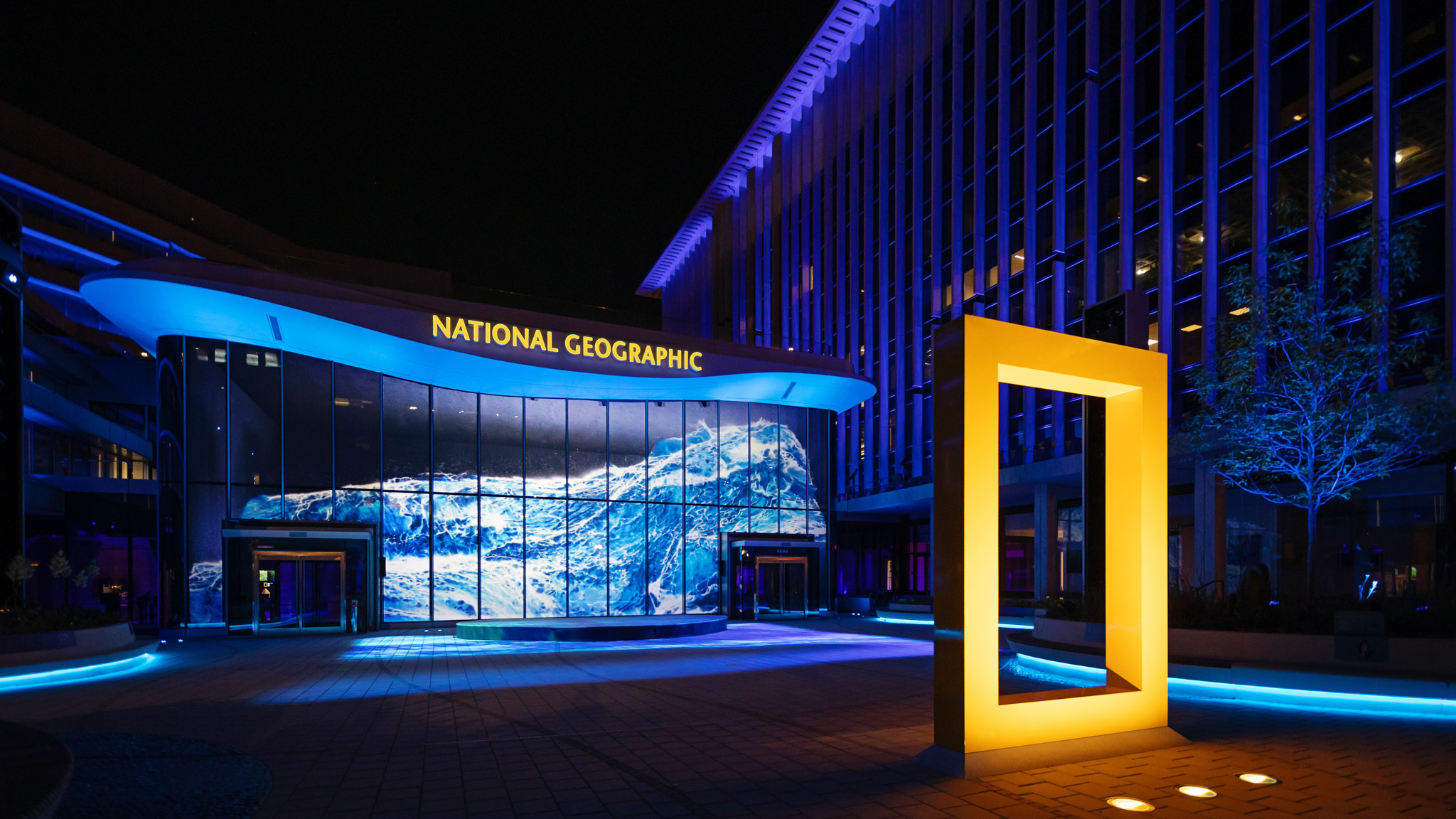
The immersive nighttime experience ‘Wonders of Our World: Ocean’ at the National Geographic Museum of Exploration.
Credit: Moment Factory
On June 26, the National Geographic Museum of Exploration opened its brand new doors at 1600 M St. NW in Washington, D.C. Since that grand opening, it has seen tens of thousands of attendees—families, individuals, school groups, private tours, courtyard parties and more.
National Geographic Society’s vice president of creative, John Boyer, says, “The goal has always been to open this to the public, to bring people in, to get them excited, to spark curiosity. Now is that moment and we’re excited to see people in the building. Let’s see their reactions, let’s get them excited about something. It’s surreal.” Boyer notes, too, that this renovation won’t stop in 2026—the space has been designed to be flexible, “to change and evolve as we move forward as an organization.”
But should this grand opening perhaps be considered a re-opening? The first installment of this article series relayed that the MOE campus comprises multiple buildings—Hubbard Hall (1904), named for the group’s first president, Gardiner Greene Hubbard; the administration building (1912-1913); the south wing and central pavilion (1932); the Stone building (1964), named for its architect Edward Stone; and a fourth modern wing (1984). Those buildings were brought together—literally—by contractors HITT and Hickock Cole to form the twenty-first century design.
If you think merging multiple centuries of construction sounds challenging, you’d be correct. Emily Dunham, the National Geographic Society’s chief campus and experiences officer, says, “One of the most challenging things has been the coordination: finishing the physical building while also finalizing all of the experiences, technology, exhibit cases and objects. Then, of course, things might arrive later than expected or aren’t working quite as we expected. We ended up with so many different vendors in the space at the same time.”
This is where having strong relationships partners and vendors—like HITT, Hickock Cole, Rolex, Cengage and more—proves symbiotic.
“That makes all the difference,” says Dunham. “Rolex is a 70-plus-year partner and has been supporting National Geographic and our explorers for decades. Telling the story of what an explorer is on the Rolex Explorers Landing and including that partnership is natural for us.”

Credit: Elman Studio
Similarly, Cengage supports the Learning Launchpad. “They have been publishing National Geographic textbooks and other learning materials for a long time,” says Dunham. “And so they were the natural partner to sponsor the National Geographic Learning Launchpad, powered by Cengage. From the development of the physical space to the selection of exhibits to the feeling of the overall experience, having the right partners has made all the difference in completing this on time at the level of quality we always strive to serve.”
The quality of the campus is of course found within the information it showcases and the inspiration it instills, but the concrete, steel, sustainable ash wood, 3D-modeled features and temperature-regulating glass are of the highest quality as well, earning the building LEED Platinum.
On June 22, Construction Executive was invited to take a preview tour of the MOE, guided through exhibits by National Geographic Explorers from around the world.
The MOE covers more than 100,000 square feet, a boundary which begins at the grand entrance pavilion, featuring a larger-than-life version of the iconic yellow border and sweeping curved planters filled with bronze animal statues that inhabit island archipelagos, meandering glacier rivers and places in between.

A rooftop terrace overlooks the courtyard to host immersive nighttime experiences and other events, and a massive digital display wall projects film, photos and other media. A step inside the front doors brings you into the main lobby with a rippling skylight that enriches the entire space—from floor to 40-foot ceilings—with natural light, which gives the sense of being both high up in a rain forest and below the surface of the ocean all at once. Another high-tech video wall towers behind the welcome desk. Immediately to the left sits a new store and renovated cafeteria, but less immediately noticed is a model of the RMS Titanic in a repurposed staircase turned in-floor display. It was here that Bob Ballard, a Nat Geo Explorer-at-Large, who is also an iconic oceanographer, spoke about his helping discover the legendary vessel.

Step into The Archives and discover the legacy of exploration and storytelling that defines National Geographic. By blending traditional displays, spotlighting legendary expeditions, and innovative media immersing you in our storytelling, we’re inviting you to experience iconic moments of discovery firsthand.
Photo by Rebecca Hale/National Geographic
Then on to The Archives. Once inside and embraced between the bronze Nat Geo emblem on the floor and coffered woodwork on the ceiling, the past came alive via a welcoming digital presentation and Lee Berger, a paleoanthropologist and Nat Geo Explorer-in-Residence, who detailed his explorations into human origins in Africa and Micronesia—which have yielded discoveries of two new species of early human relatives. Some of Lee’s work can be seen in The Archives.

Then two masterfully crafted French doors open seemingly by magic into the Learning Launchpad sponsored by Cengage. This space is highly interactive, allowing students and groups to try their hand—or their foot—at trivia on their digital display floor. The Learning Launchpad also houses Kirsten Elstner’s National Geographic Photo Camp. Another Explorer-in-Residence, Elstner founded and directs the Photo Camp as part of her mission working with youth from diverse global communities to develop their own skills—and stories—through photography.

Learning meets adventure at the Geoverse at the National Geographic Museum of Exploration featuring rotating shows for students, families and everyday explorers of all ages.
Photo by Rebecca Hale/National Geographic
Just beyond the Learning Launchpad is the Geoverse theater, where Peruvian biologist Ruthmery Pilco spoke on her works in conservation and biodiversity projects in Costa Rica and Peru. This stop was highlighted by a theater viewing of a documentary excerpt on her work preserving the Ukuku—the Quechuan word for bear—in the Peruvian Andes.
Around the corner is the nearly 400-seat Grosvenor Auditorium—which will officially open later this summer.

Credit: Joy Asico-Smith
A trip up the spiraling staircase takes you to the Rolex Explorers Landing where the pillars of Nat Geo—spark, impact, purpose and trek—shine. You will see artifacts like a bathysphere from the New York Zoological Society, an atmospheric diving JIM suit, an off-roading vehicle equipped with tent top and camera attachment, and more. This is where Steve Boyes, who launched the National Geographic Okavango Wilderness Project in 2015, spoke on his lifelong dedication to conservation of Africa’s wilderness and wildlife employing integrative and innovative methods.
Back down and to the right of the entrance is the photo gallery, which is grounded by a perimeter of static feature pieces—including the iconic portrait of the Afghan Girl from the 1985 cover—and a center selection which rotates a few times per year.

Credit: Rebecca Hale/National Geographic
Lastly, the Photo Ark next to the photo gallery is completely curated by Joel Sartore, a Nat Geo photographer, conservationist, speaker, author and teacher. He spoke outside his own exhibit on the creation of the digital and interactive photo/video gallery, highlighting endangered animals and insects, species and landscapes with imagery taken at scale in accordance with their level of endangerment. The gallery will become a travelling exhibit after leaving the MOE at the end of this year.
Other hidden gems worth mentioning include the parametric molded cornice—a striking architectural feature on the facade echoing sand dunes that required complex 3D modeling never previously seen in the United States; the Magazine Gallery, digitally depicting every single published National Geographic cover to date; a Terracotta soldier from Emperor Qin Shi Huang’s famous Terracotta army; an exquisite mosaic of shimmering tiles in the shape of two massive jellyfish in the downstairs bathroom; and more you will have to see for yourself to believe.
For the day, the professional explorers brought the museum to life, embodying the depth, meaning and purpose behind Nat Geo’s larger mission, but if you feel you’ve missed out on the initial fanfare, fear not. The MOE will also feature regularly scheduled public programming including:
- Farmstand
- Trivia
- Nat Geo Nights
- Coffee With an Explorer
- Drinks With an Explorer
- Concerts in the Courtyard
- Pop-Up Talks With an Explorer
For the days to come, the future visitors are what will bring life to the museum. At the top of the tour, Nat Geo’s CEO Jill Tiefenthaler mentioned that this museum was, in fact, not built for the explorers met at each exhibit, but rather for the next generation of explorers. What Dunham hopes that future generations take away from their own tours through the MOE is a spark.
“We have a space on the Rolex Explorers Landing,” she says, “that’s called the Spark exhibition. It’s about different explorers sharing their own stories of inspiration—inspiration that for them changed the course of their life and gave them a purpose to pursue—in hopes of sparking questions that maybe someone hadn’t asked before; ideas that hadn’t been thought of. And what I hope is that every visitor has a spark moment, big or small. Everyone can be an explorer.”
Even without that iconic yellow border welcoming visitors through the new courtyard and into the new lobby underneath the new skylight, the MOE is unmistakable as a National Geographic creation.
“It’s the wonders of the world on display,” says Dunham.
Boyer concurs: “It’s the stories of our explorers. It’s the mission of the society. It’s everything on display—the media, the animals, the sculptures, the portraiture. Everything is part of the mission and part of the storytelling of the wonders of the world.”
For information on museum hours, special events and more, visit moe.nationalgeographic.org.
SEE ALSO: STATUE OF LIBERTY MUSEUM USES STRUCTURAL THERMAL BREAKS TO PROTECT THE PAST AND THE PLANET