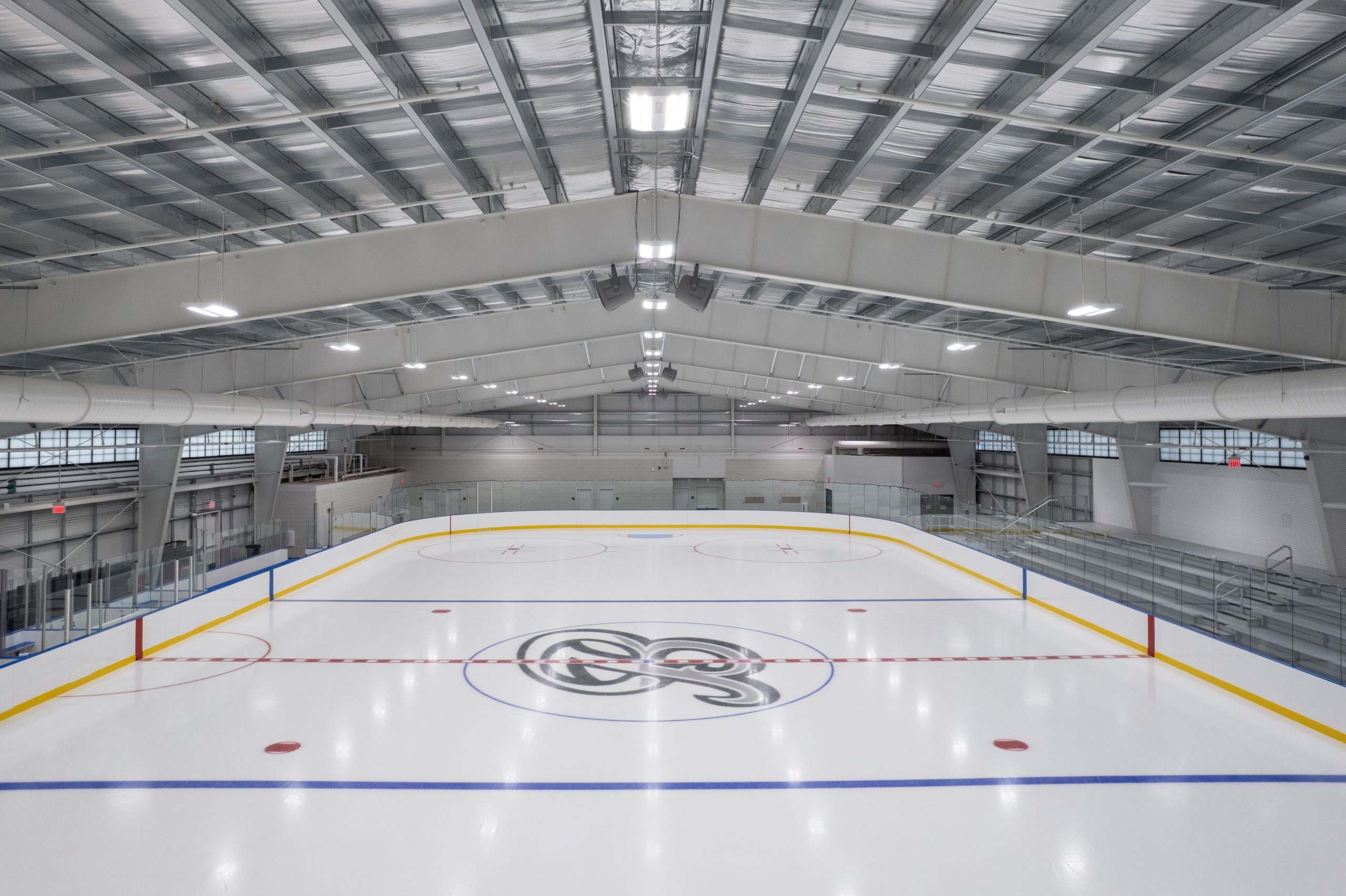
The town of Belmont, Massachusetts, needed a new ice rink. The existing rink, which opened in 1971, had reached the end of its hockey and recreational skating lifespan. Originally built as a roofed, open-air facility—walls were added in the early 1980s—the James “Skip” Viglirolo Ice Rink, named for a local high school hockey coaching legend, had its share of cold-weather quirks. During a high school hockey playoff game years ago, frigid temperatures caused the ice to crack, creating a fissure and forcing the game to be postponed.
“What rink can’t you play in when it’s too cold? It was the old Belmont rink,” Belmont High School athletic director George Tahan recalled recently to local news site WickedLocal.com.
All of that has changed. In November 2025, two years after the old rink was demolished, the town celebrated the grand opening of a new Viglirolo rink built by Skanska USA, a Swedish-owned company with 28 offices in the United States. The facility—a 40,300-square-foot, steel-framed, pre-engineered metal building with a 200-by-85-foot ice sheet—is part of the new $32-million Belmont Sports Complex, which houses the town’s athletic and recreation programs.

One key consideration guided the project: Leaders and voters in Belmont, a Boston suburb with about 27,000 residents, wanted an energy-efficient, fossil fuel-free facility.
“They were committed to certain energy goals,” says project manager Mike Morrison. “From working in multiple towns, I can tell you community members truly support energy-efficient efforts, and they’re willing to put in the work to achieve them, which I think is unique.”
Those decisions were not simple. For the rink’s refrigeration system, the town could have chosen a system that used a traditional chemical refrigerant that was being phased out because of its environmental impact but was still legally permissible during the planning phase. Instead, Belmont opted for a greener, more expensive system that uses carbon dioxide as a refrigerant and far exceeds environmental requirements.
“That came at a premium, and they’re one of the first communities in the Northeast to have it,” Morrison says. “It’s not easy to commit to something like that. You have to be passionate and willing to stand behind it.”
The CO₂ system has a low carbon footprint, and Skanska installed photovoltaic solar panels on 75% of the roof. The panels offset about 50% of the building’s electricity use.
“There’s no gas, there’s no oil,” Morrison says. “That’s where solar was so important—to help offset some of the electricity being produced.”
Skanska also incorporated energy recovery systems throughout the facility.
“When these systems make ice, heat is rejected, and if you don’t capture it, it just gets wasted,” Morrison says. “We use that rejected heat for things like a snow-melt pit in the Zamboni area. Some water heaters are also supplemented by waste heat. We’re trying to maximize the byproducts of cooling and keep the building as energy efficient as possible.”
One of Morrison’s favorite—and easily overlooked—spaces is a storage room for nets and other hockey equipment that doubles as a birthday party room.
“They were really trying to keep the footprint small, so we created dual-use spaces,” he says. “We call it the birthday party room, but it’s really a storage room with an overhead door. It gives them flexibility to store equipment, while also serving as a space for activities. There were a lot of pushes and pulls between storage and community space.”
The rink also includes four high school team locker rooms, four dressing rooms, public restrooms, bleachers for more than 200 spectators and a concession stand. But for residents who lace up skates, the project will be judged on one thing: the quality of the ice.
“I’m not a big skater—I wouldn’t know good ice from bad ice—but I’ve been in the facility and watched students and residents who went without a rink after the old one was demolished,” Morrison says. “They’ve been thrilled with the ice and the rink itself. Seeing people use it, enjoy it and hearing that feedback—that’s been the best part of the project for us.”
SEE ALSO: MLK WAY: RESHORING PHILADELPHIA’S FAMOUS BRIDGE