Forney Independent School District in Forney, Texas, is giving a whole new meaning to career and technical education—and a whole new building in which to learn. Sitting just east of Dallas, Kaufman County, in which Forney is located, grew 7.6% in 2022-2023, making it the fastest-growing county in the U.S., according to Census Bureau data. But despite this large growth rate, Forney is still a small town in some respects: lacking a mall, civic center, community center, boys and girls club, youth center, YMCA, public transportation and many more citizen-centric facilities. So, why does it seem everyone wants to move to Forney?
Opportunity—the Keith Bell Opportunity Central, to be specific. Named for Texas’ District 4 U.S. Representative and former Forney ISD School Board President Keith Bell, the first-of-its kind development and brainchild of the school district’s superintendent, Dr. Justin Terry, is opening doors for high-schoolers in CTE programs, preschool students, local business owners, college kids returning to town, teachers, performers and many more. But where did a district that lacks the necessary infrastructure find the facilities to house so many programs? It built them.
Mixed-use projects are booming across America following a surge in demand for housing and a simultaneous decline in demand for office space. As Forney lacks such properties—both mint-condition and defunct—and as the U.S. lacked blueprints for this type of project at all, Dr. Terry started from scratch. While many projects combine residential, restaurant and retail, no one has thrown education into that mix. Soliciting the design and construction expertise of architecture firm Huckabee and contractor Gallagher Construction Company, Forney ISD sought out to set a new precedent for mixed-use and education construction. Kristin Zastoupil, executive director of communications for Forney ISD, says, “We thought, ‘Why couldn’t we blend learning with entrepreneurship, especially when we have all these school facilities that sit empty sometimes on evenings and weekends?’ They could be utilized for so much more than just the regular school day.”
In the fall of 2019, a $623-million bond was passed by the school district, with $150 million designated for The OC. Then, in early 2020, representatives from Forney ISD, Huckabee and Gallagher began site visits—to malls, food courts, event venues and other mixed-use facilities—to gauge a proper design concept. Kate Dunfee, a principal at Huckabee, says, “We [had] never designed anything like this, and [after] all of the searching that we did, all of the searching that Dr. Terry did and that the Gallagher team did, we couldn’t find anything like this across the country. So, we just had to figure out from all these different other types of venues, what worked and what didn’t. So, we visited facility types that were anything but schools. The whole team—Forney, Gallagher and our design consultants—needed to understand the features, operations and impacts in each of these other facility types and how they would work within a school environment. Our expertise is schools. And while this facility is at heart a school, it’s so much more.”

THE THREE Cs
Career, college and community: That was the foundation upon which Forney ISD and Dr. Terry crafted their design dreams for The OC. It was Huckabee’s job to design those dreams and Gallagher’s to bring them to fruition. Jeff Fisher, president of Gallagher, says, “It’s such a unique building that it was a whole new ball game, and would’ve been a whole new ball game for anybody that designed it or built it. We fully expect that there will be several of them across the United States at some point, because once people start hearing about it and seeing how it functions and seeing the benefits that it gives to the students as well as the community, I think it will be a popular concept.” In fact, Fisher has already been in contact with two more school districts interested in this design.
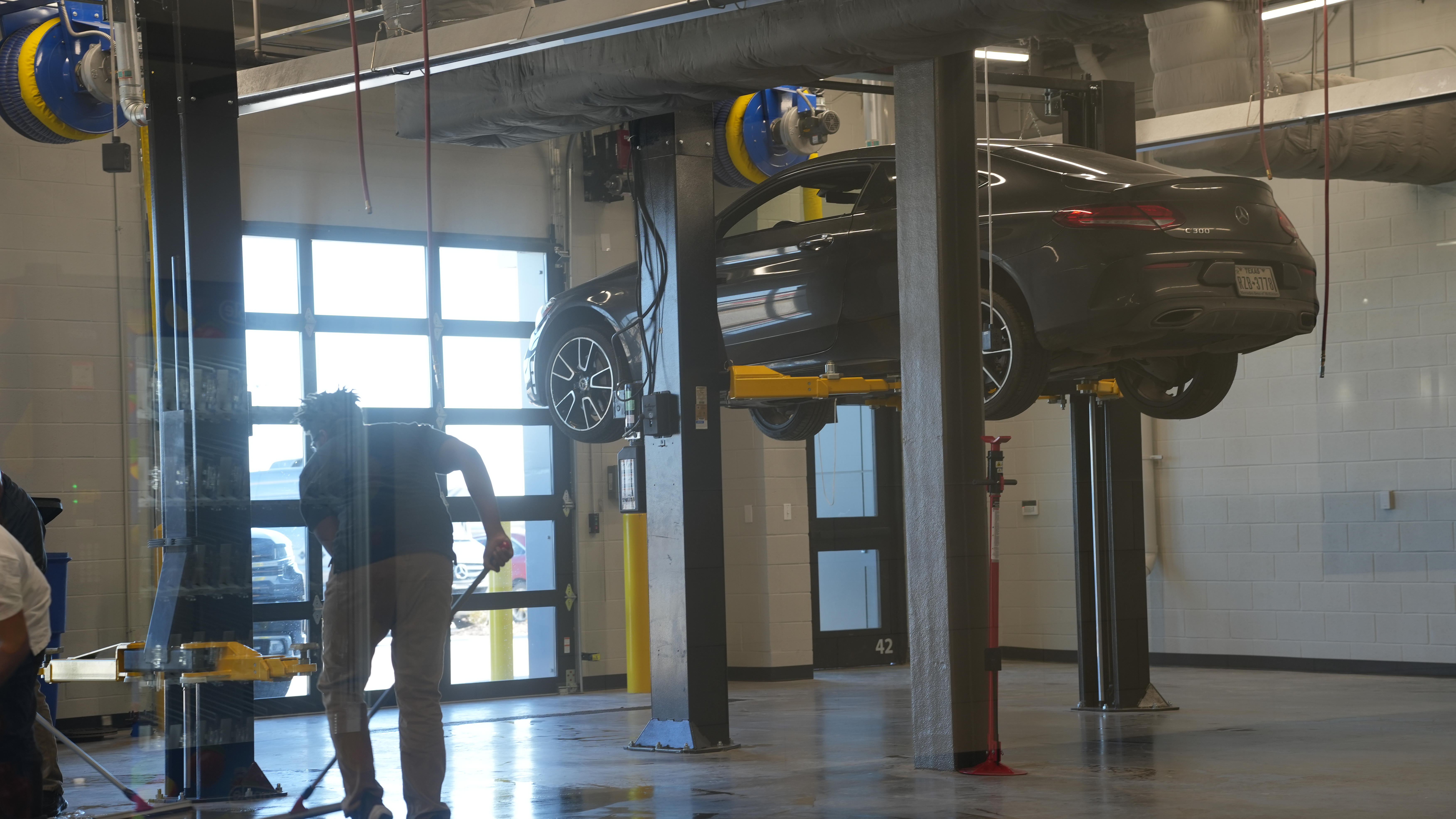
Both of Forney ISD’s two high schools already have robust CTE programs. The OC was designed to give those students a dedicated home base for those CTE classes—from cosmetology to auto mechanics to early childhood education and more. The early childhood education center, known as OC Junior, features pre-k classrooms and a play tower. The OC also offers a coworking space for high-school students who are dual-enrolled in college, as well as college students home on break. On one occasion, a media crew from Dallas was filming The OC and asked to interview a group of students about their experience learning in the new space. “But,” Zastoupil says, “they told them, ‘No, we are college students home on break. This is the coolest place and we come here to hang out with friends and work on our projects.’”
The OC’s retail space offers local entrepreneurs a home base, as well, such as White Rhino Coffee Company, Southern Social restaurant, Pine and Ivy boutique, The Gallery art studio, a recording studio and more. What’s more, the close proximity of those businesses to the students allows opportunity for real-life application of what those students are learning and real-life income for those businesses. One group of OC students even helped a resident business create a social media campaign, which led to the first-ever sell-out of their inventory.
Considering Forney is located in the fastest-growing county in the country, the school district used a demographer to plan for its future population and thus the capacity of The OC. The campus sits at roughly 330,000 square feet, three stories tall, with five restaurants, 16 retail spaces and 13 secured classrooms on the first floor, 48 multi-use classrooms on the second and third floors and a 6,400-seat arena. It also includes a two-story early-childhood center and a multi-purpose black box theater. While the campus was already properly zoned, the permitting process for all of the building’s use cases was far from ordinary.
“They permitted the whole building for the skeleton [construction], from the ground up and for grading. But once we actually got into the retail components, the first floor really turned into more of a tenant finish-out project,” Dunfee says. Any business that was operated by an entity outside the school system had to acquire their own construction permit for the interior finishing of their own space. The new flow of permits was a big change for the school district. “Normally, we just start construction and build a school and it opens in August,” says Dunfee. “But we were really rolling the openings within this building much like we see in a retail center or a mall, because each [business permit] has their own process that they go through.”

DESIGN AND CONQUER
While combining so many uses and opening the building to the public might be a recipe for risk, the design team built in safety and security elements to ensure not only protection for the students and business owners utilizing the space, but peace of mind for parents as well.
“We had to make sure that parents felt comfortable sending their kids to school here,” Zastoupil says. “We worry about that every day in today’s world. So, we made sure that we had a building where there were credentials and badge access, and that we had the latest technology to help us ensure that.” Other security technology at The OC includes a covert weapons-detection system similar to that used in high-risk arenas, such as Inglewood, California’s SoFi Stadium. With the first floor of the campus open to the public, that weapons-detection system offers peace of mind, along with the stationed security guards and nearby police station. The second and third floors are closed to the public, only accessible by students and faculty with their designated credentials—but students and faculty do have access to the first floor as part of their hands-on education.
“There were a whole lot of moving parts during the design,” says Fisher. “And then even when we got into construction, once we got things built, instead of it being on paper they could see it live and in 3D. They would say, ‘Well that doesn’t really work the way we thought it was going to work so let’s change this.’”
Despite all these changes, Huckabee reveled in the process. “It was as much an experiment for us as it was, I think, for [Gallagher],” says Dunfee. “And it’s always exciting to be a part of some of those things, especially when our skill set as a design team is problem solving. Working through those kinds of challenges is really fun.”
But while Huckabee enjoys problem-solving, 2020 presented a really big one. “The biggest challenge that we had with this particular project was COVID,” says Fisher. “Because we’re a construction company that builds infrastructure, we had the ability to keep working. Which was good, but also what COVID did to the whole construction industry was it slowed down the supply chain, just like it did for a lot of things.” Fisher notes acquiring materials, adjusting the budget and navigating COVID protocols on the jobsite all made for an interesting time, “but we made it through.” The OC officially opened to students in August 2023 and has been quickly filling its community and business spaces.
THE FUTURE IS IN FORNEY
As Forney’s population grows, so too will The OC’s popularity, but it’s built for that.
“You really have to make everything future-proof,” says Zastoupil, speaking from experience. As she describes how what she learned in high school 20 years ago isn’t her occupation now, she believes that notion will be the same for her own high-school-aged son 20 years from today. “Can we equip him with skills like communication, entrepreneurship, teamwork that will stand the test of time no matter what career path he chooses? That was really the goal behind the building and making something that fit our community. What could we create that would pull our community in and let them be partners with us in educating our kids?”
Now that a precedent is set, how does the team expect to see The OC impact construction for CTE, mixed-use and overall community experience across the country going forward? “It’s not what we expect to see,” says Fisher. “It’s what we’re already seeing. People are already coming to see it. They’re liking the idea and they’re trying to figure out how they can do something similar in their communities.”