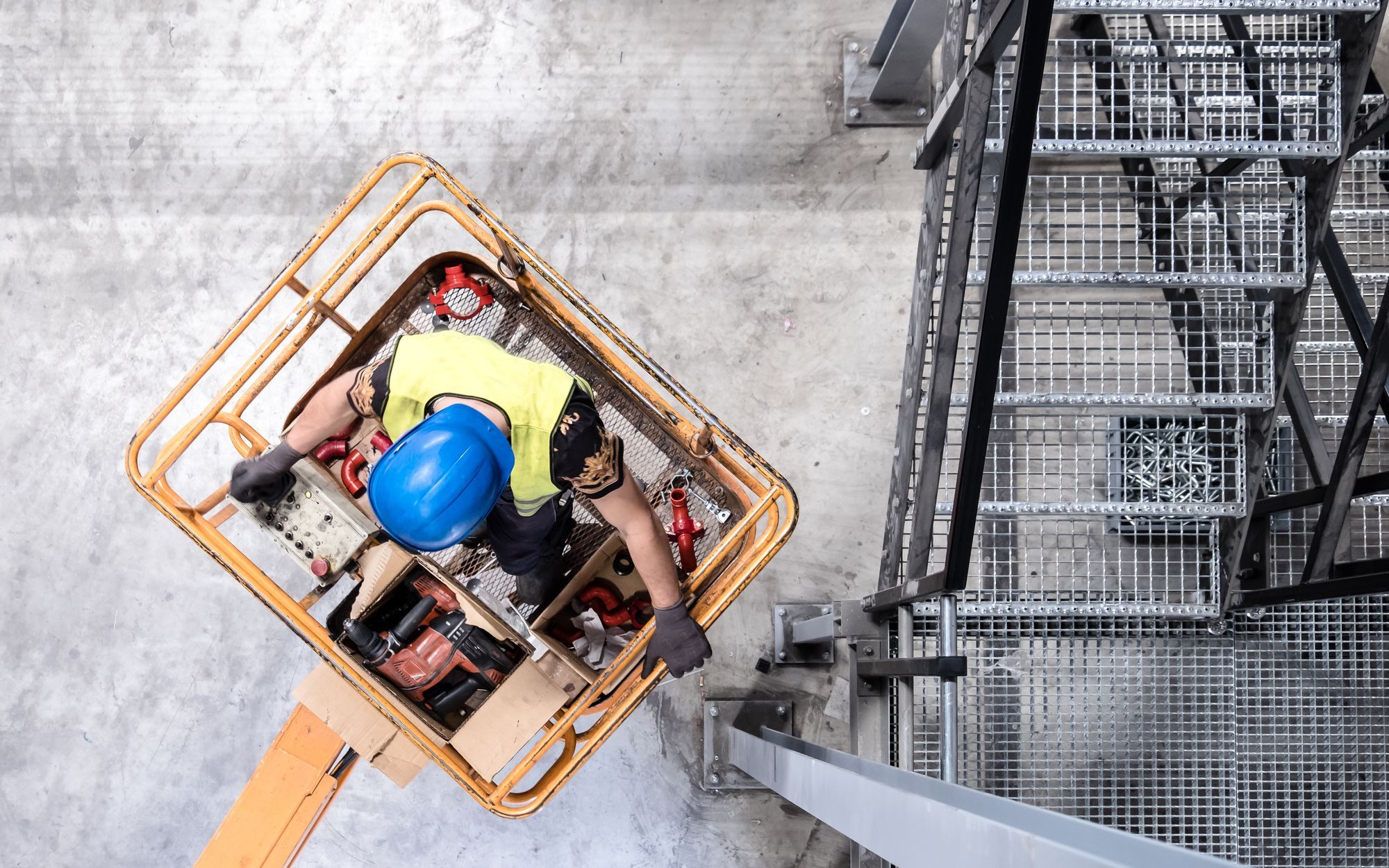
As builders and construction firms navigate the varied implications of COVID-19 for the construction industry in different parts of the U.S., they may not have had a chance to focus on new rules governing the operation, maintenance, safety and training requirements for aerial platforms deployed in all types of projects. In December 2019, the American National Standards Institute changed its name for Aerial Work Platforms to Mobile Elevating Work Platforms (MEWP), reclassified them into two groups and types, and established a new set of rules for their safe operation.
The new rules, which govern the operation of these platforms, as well as training, maintenance, risk assessment and repair, must be fully understood and complied with by builders, contractors, subcontractors and trades. Significantly, the rules apply to any firms using this equipment regardless of whether they own, rent or lease it. Over the years, the use of these platforms has become widespread at all types of projects and job sites, including as economical, safer and more versatile alternatives to scaffolding.
Here are key aspects of ANSI’s new aerial platform classifications and related rules that may apply to construction firms and the use of MEWP on their worksites.
MEWPs now classified in two groups
Platforms that move vertically but within the tipping lines, such as scissors lifts, are classified as Group A. MEWPs that can move beyond the tipping lines (outriggers or wheels), such as a boom lift, are considered Group B.
- Three types of MEWPs. Equipment designated as “Type 1” can only be driven with the platform in its stowed position. “Type 2” equipment can be driven elevated, but is controlled from the chassis. “Type 3” equipment can be driven elevated, but is controlled from the work platform.
- Robust requirements for risk assessments and site safety planning. All MEWP users, including companies that own, rent or lease aerial equipment, must develop a risk assessment and site safety plan. The plan must be written and documented before work begins, shared with everyone on the work site, and include a description of the job, location and time frame. It also must identify risks related to using the MEWP, including all hazardous materials; list names of workers who have received training as well as measures to prevent unauthorized use of a MEWP. It should describe procedures and safety measures implemented to prevent incidents and accidents and include a rescue plan for workers in the event of a fall or if the MEWP breaks down.
- Expanded rescue planning requirements. Under ANSI’s new rules, rescue plans now must include steps to be taken after a fall, as well as if the platform becomes entangled and if the machinery fails. Rescue plans must be documented, added to the company’s training manual and shared with all workers on the job site.
- Rescue training. Anyone working in or around the MEWP now must receive training on what to do if they see someone fall from a MEWP or if they themselves should fall. The rescue plan also must include a set time limit for how long a properly restrained worker can hang suspended in the air. It can provide details for self-rescue, assisted rescue or technical rescue from qualified company staff or local emergency services.
- MEWP operational training requirements extended to occupants and other personnel. While training continues to be mandatory for MEWP equipment operators, the new standards also require training for occupants, supervisors and repair and maintenance personnel. ANSI defines an “occupant” as anyone in the MEWP platform other than the operator. Under the new standards, occupants must receive training on fall protection systems and what to do if the operator can no longer operate the lift.
- Operator safety responsibilities. The operator is responsible for ensuring every occupant in the platform knows how to work from the MEWP safely. The rules also require someone on the ground outside the equipment who can act as the operator from the ground and return elevated workers to the ground in the event of an unexpected malfunction or an emergency.
- Broader definition of supervisor expands training requirements. Under the new ANSI rules, a supervisor is defined as: “An entity assigned by the user to monitor operator performance and supervise their work.” Thus, anyone who directly supervises or oversees the work of a MEWP operator is technically considered a “supervisor” and must complete MEWP safety training.
- Training requirements for MEWP maintenance and repair personnel. The new rules require maintenance personnel to conduct annual inspections and to evaluate any MEWP put into use after being out of service for three months or more. Maintenance personnel must also be trained on any new features, such as the load limit alarm, tilt sensor and wind speed sensor.
- New equipment standards. The rules include new requirements for equipment manufacturers. While existing equipment does not need to be retrofitted to meet the new standards, construction firms considering the renting, leasing or purchase of new equipment should be aware of the following requirements:
- all new MEWPs must have a gated entrance to the work platform; chains are no longer permitted;
- some models will have reduced lift and load speeds;
- MEWPs used on rough terrain will be required to have foam-filled or solid tires;
- indoor-only equipment may be developed;
- the minimum height for equipment platform railings will increase from 39 to 43.5 inches; and
- if the safe load limit is exceeded, an alarm must sound and a sensor must activate that prevents normal operation.
In addition, a tilt sensor alarm and system to disable boom functions if the machine exceeds its slope limit must be installed along with a wind-speed sensor to reduce load capacities and enhance safety in outside windy conditions.
Additional MEWP safety precautions
The question always comes up on whether fall protection should be used with Group A scissor lifts. Falls are the leading cause death in the construction industry; contractors should do anything they can to help mitigate this risk.
As an industry best practice, full body harness and lanyards should be used when operating scissor lifts. One problem, however, is that most scissor lift manufactures do not install an anchorage point rated at 5,000 pounds in their units. Instead, they install a restraint point where the lanyard should be attached to limit the ability of the occupant to “step up” on the railings to gain additional height when using the platform.
A key issue with lanyards is that they tend to be too long for the application and consequently still allow employees to “step up” on the rails. Thus, contractors should strive to use a shorter lanyard. A leading manufacturer of scissor lifts states s on its website that it “… recommends that a full body harness be used with a lanyard attached to an authorized lanyard anchorage point when operating … scissor lifts or vertical mast products that do not have a 30-inch (76 cm) maximum lanyard length limit.”
With respect to boom-style lifts in Group B of the new ANSI standard OSHA is clear:
1926.453(b)(2)(v) A body belt shall be worn and a lanyard attached to the boom or basket when working from an aerial lift;
Note to paragraph (b)(2)(v): As of January 1, 1998, subpart M of this part (1926.502(d)) provides that body belts are not acceptable as part of a personal fall arrest system. The use of a body belt in a tethering system or in a restraint system is acceptable and is regulated under 1926.502(e).
Because the boom can extend many feet from the body of the machine, any bump, holes or rough terrain is amplified to the individual in the basket. All occupants should have on a lanyard, harness and be properly anchored when operating the machine.
Site safety considerations
To add to the protection of the occupants and ground personnel, the area around scissor or boom lift should be barricaded off or a “spotter” should be used to warn all individuals in the area of the hazards above.
In addition to the ever-present danger of aerials being dropped from the elevated work area to the ground, there is a potential for the machines to be struck by other equipment on the jobsite. The spotters can help reduce these risks, improve safety of individuals on the ground and those operating and occupying the MEWP, and facilitate a safer work environment for all personnel on the job.
By understanding and following the new ANSI standards for MEWP, builders and contractors will be in position to improve safety, avoid related accidents, reduce equipment breakdowns and maximize the cost savings, versatility, productivity and other benefits this equipment brings to their jobsites.