The D.C. Students Construction Trades Foundation in Washington, D.C., combines academic and technical studies to prepare middle- and high-school students for a potential career in construction. With a curriculum accredited by NCCER, students study architecture, design, carpentry, electrical, HVAC, renewable energy, sustainable building, math, science, physics and other subjects. They go on to become construction managers, architects, engineers, landscape architects, interior designers and entrepreneurs.
The foundation runs four main programs: Academy of Construction and Design (ACAD) internships and work-based learning; the Build a House, Build a Future homebuilding program; the D.C. Apprenticeship Academy, which offers all levels of related instruction leading to licensing and professional certifications for employees of industry contractors in D.C.; and an NCCER Accredited Training sponsor of skilled trades curriculum in adult worker training programs. Through these programs, the foundation acts as a partner to public schools, a resource for students looking for more options after high school and an intermediary bridging the workforce training needs of industry employers. “We’re a small team and we wear a lot of hats,” says Paula Ralph, chief operating officer for the foundation.
Small but passionate, the team is dedicated to its students. Shelly Karriem, ACAD’s director, says that, although she began her career as an elementary school teacher, the foundation turned out to be the perfect fit. “I was able to marry my education background with construction—because my father was a home-improvements guy,” she says. “Once I started, I knew this was more than just a job. This was truly a mission.”
Glass Half Full
A 12-member board of directors, a 21-person industry advisory committee and numerous partner companies—including United Bank, SunTrust Foundation, Ameritas and The Richard E. and Nancy P. Marriott Foundation—bring resources, oversight and advice to the foundation’s core programs. “Our offerings create a pathway in that, for the younger students, we offer career exploration, so they can find out about careers in this rapidly changing industry,” Ralph says. “As students progress in accredited and industry-recognized curriculum, we offer work-based learning opportunities.”
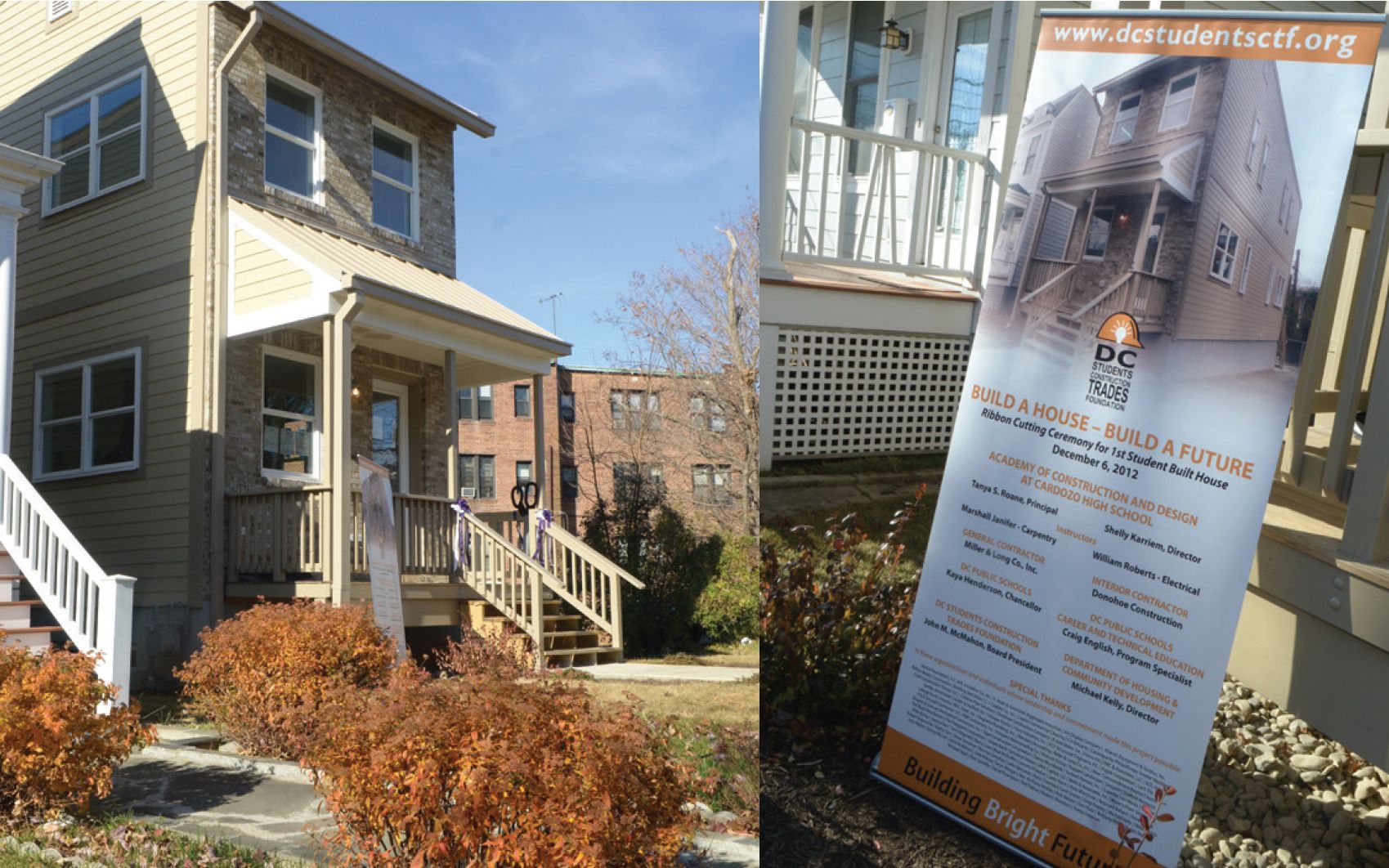
That might mean working in a traditional classroom environment, but it could also include going onsite with a construction company or participating in an internship. The foundation takes a variety of approaches. For example, it launched ACAD in 2005 with the goal of bringing construction and trades back to Washington, D.C., public schools by starting students early, while Build a House, Build a Future offers an opportunity for project-based, hands-on learning through the construction of an entire house. In 2021, students broke ground on the second house in the program’s history, on East Capitol Street in D.C. (The Montgomery Country, Maryland, program on which this initiative is modeled has built more than 40 homes.)
“These sites support a practicum level of experience for students who have completed the core curriculum and are in level one or level two of their trade instruction,” Ralph says. Students get used to the day-to-day of a site, including tools training, working under a foreperson and safety protocols. The home on East Capitol Street is the first to be built by participating students from multiple schools, meaning a revolving door of schedules, coordination and maintenance on the part of the foundation’s team. COVID-19 requirements are a continuing priority during the process.
“I’m one of those people who sees the glass as half full,” Karriem says. “We’re working feverously and diligently to make sure that these students get the best experience, safety first. And the more students we have from different schools, the more we get to build and the more they’ll learn. If they learn to love the industry, one day they’ll drive by that house and say, ‘I helped build that house.’ I’ve seen it happen.”
Building a Future
ACAD’s first class of students was diverse, from background to GPA—but they all had the same inquisitiveness about the industry. While not all students have chosen careers in the trades (one has become a playwright), many of them have continued to work with the companies they were paired with via internships. Another segment went on to college—an achievement all the more impressive because, historically, many students who are referred to ACAD by school counselors are labeled “difficult” or a “problem” and have documented disciplinary issues.
Whether it’s because not all children are visual learners and ACAD offers tactile learners an alternative, or because of the supportive environment, or simply because they fall in love with the material, students with documented concerns improve their course grades. Of those who have participated in the program, 90% have graduated high school and 60% of those graduates have pursued four-year college. No wonder Karriem’s mantra is “Once an ACAD kid, always an ACAD kid.”
“The impact on the students is indescribable,” Karriem says. “These kids are breaking the cycle because they have learned to do something that has become a career, a way to support their family, buy homes, get married and have children. It goes far beyond earning an industry credential and building a house.”
But students who participate in ACAD do earn that trade credential, gaining access to a legitimate career that builds financial stability. “We’re changing lives and perceptions,” says Mark Drury of Mark Drury and Associates, the foundation’s president. “People are starting to realize that construction is a viable career—and it’s not all about digging ditches or dirty or dangerous.”
While college is still heavily pushed in schools nationwide, institutions like the foundation offer high-school graduates additional access to credentials and careers with less student debt. Plus, the foundation’s curriculum is designed to educate the “whole child,” incorporating essential professional skills, career research, Myers–Briggs testing and goal setting. “There are too few young people in this community who are able to take advantage of all of these opportunities that are being generated all over this region—and really all over this country,” Ralph says.
A Little Bit in Awe
Employer engagement—and engagement on the part of the industry as a whole—is integral to the foundation’s model. The spark of interest is created in middle school, students begin the program and earn the credential in high school, but outreach from employers is crucial to recruiting passionate, would-be industry leaders during a time when many of their peers are beginning the college-application cycle. “We are trying to do a lot of the preparation and legwork for the employer,” Ralph says. “When they step in the door to a job fair, apprenticeship or internship, we’re introducing candidates for whom the lightbulb has already turned on.”
Drury adds: “Programs like this give us, as an industry, an opportunity to step up and be in front. If you’re not in construction, you don’t appreciate the good things, like the shoes on your feet and the car you drove to work. But when you break it down to the factory that made the shoes and the road that you were able to drive on, the water systems, the electricity and other creature comforts, that’s when people are a little bit in awe of everything we do.”