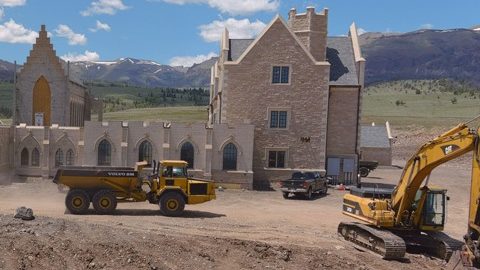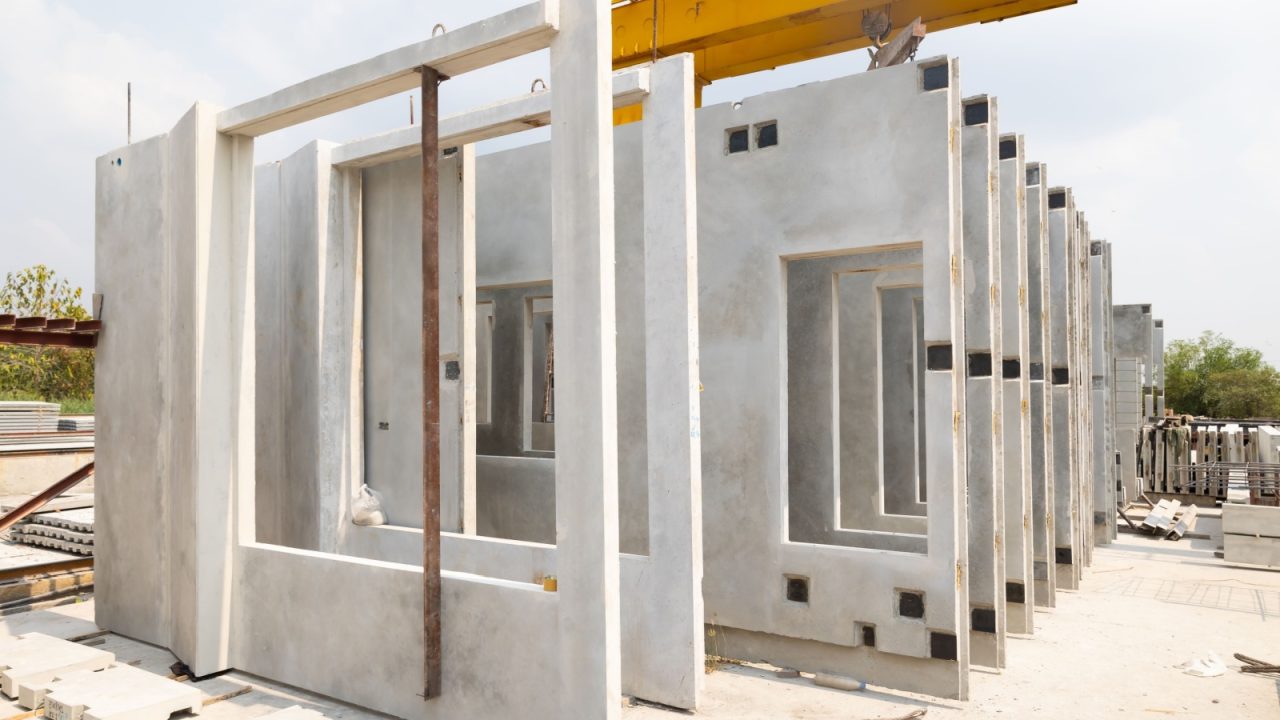
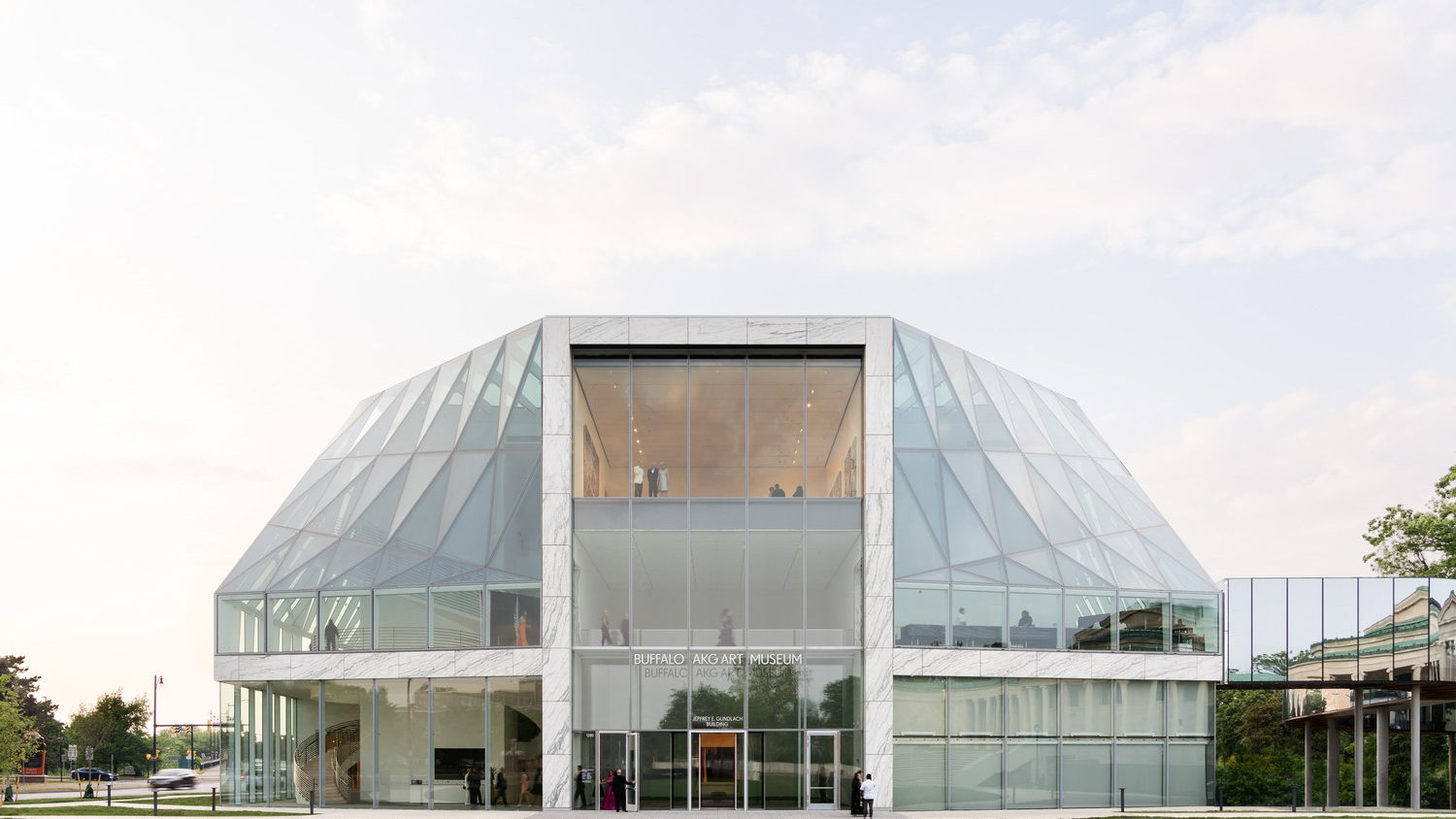
This project was different. Everyone seemed to feel it. Perhaps it was the weight of local history: Buffalo’s Albright-Knox Art Gallery—now known as the Buffalo AKG Art Museum—was founded in 1862 and opened its first building in 1905. Or maybe it was the scope of work: The four-year project involved not only renovations to the original neoclassical building and its 1962 modernist addition, but construction of the glass-façade Jeffrey E. Gundlach Building, which added 27,000 square feet of interior gallery space and a 6,100-square-foot exterior terrace. Perhaps it was the site’s status as a cherished public space for walkers, wedding photographers and art lovers. Most likely it was all three.
“The sense of camaraderie on this project stood out,” says executive architect Jason Cadorette of Cooper Robertson, which worked on the project in conjunction with international firm OMA. “We had challenges all the time and people came together to confront those challenges and solve them. There was a lot of collaboration.” And a lot of local pride—some contractors had visited the museum when they were kids.
“From beginning to end, I knew what this meant to Buffalo,” says senior project manager Ryan Disch of Gilbane Building Company, which has completed more than 50 museum projects, 30 of them over the last 10 years alone. Disch’s personal resume includes the renovation and expansion of the Norton Museum of Art in West Palm Beach, Florida (a 78,000-square-foot project), and the Corning Museum of Glass in Corning, New York (103,000 square feet). But this was bigger: The $195-million Buffalo project encompassed 118,000 square feet of new construction and 28,360 square feet for the renovations.
GLASS ACT
Crews got to work on the original 1905 building in August of 2019, beginning with reroofing the entire structure, resetting all the gutters, and removing and re-anchoring the marble coping stones. Microabrasion cleaning transformed the marble façade and its fluted columns from dark tan to bright white. Many of the interior spaces were renovated, most notably the galleries, which originally featured stone floors. “We took out the stone, reinforced the underside of it, and then installed red oak to match the floor in the new Gundlach building,” Disch says.
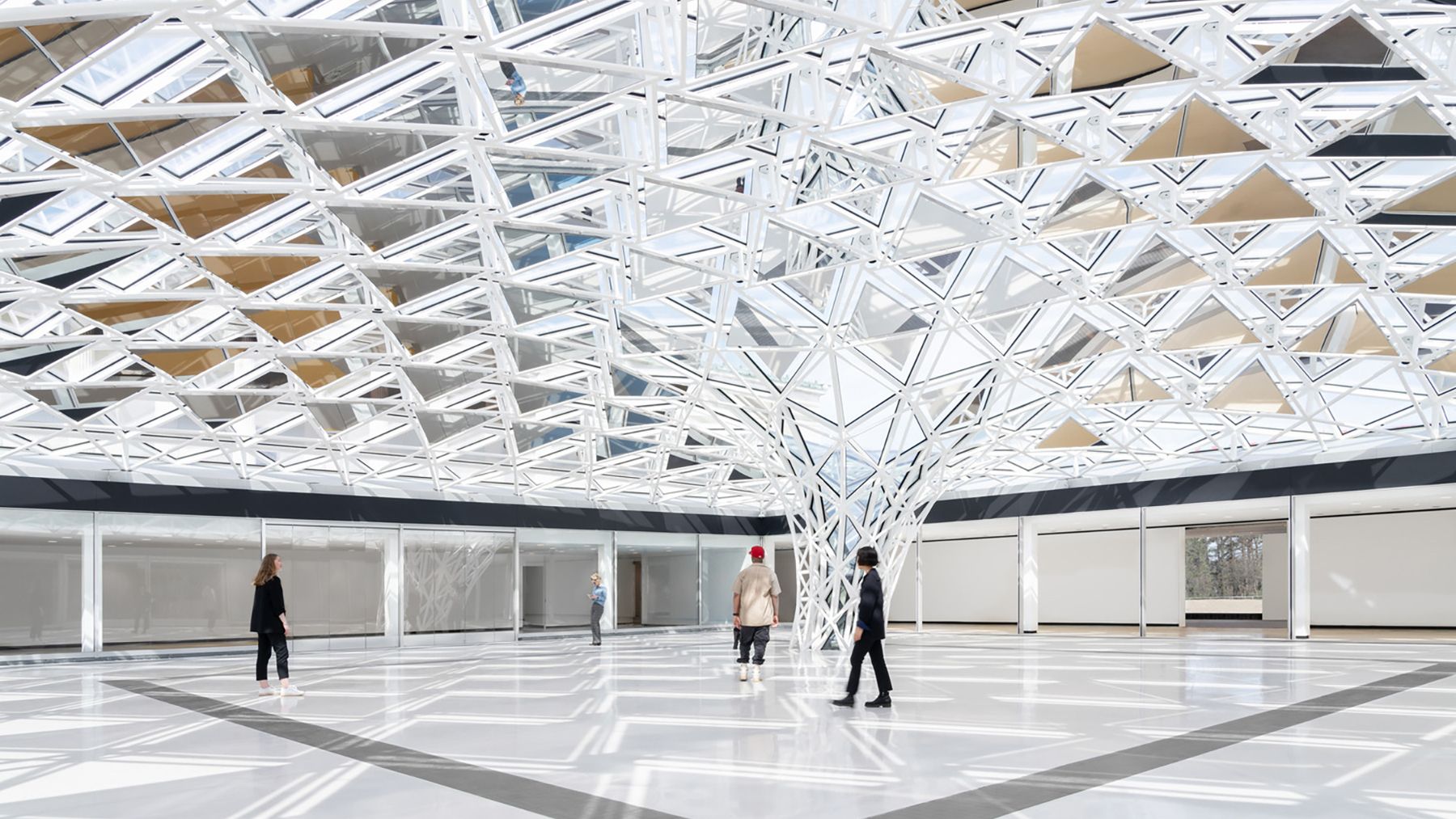
The 1962 addition involved a fragile undertaking: enclosing a 6,000-square-foot courtyard with a glass-and-mirrors canopy. Designed by artist Olafur Eliasson and architect Sebastian Behmann, the canopy—an artwork titled “Common Sky”—connects to the ground through a space-frame column that resembles a funnel. The funnel was built in Germany, disassembled, then shipped and reassembled in Buffalo. For Gilbane, the bigger issue was the courtyard’s preserved exterior walls. “We had to get drill rigs into tight spaces, and do some massive concrete pours, and we’re weaving them through an eight-foot door opening,” Disch says. “There was an incredible amount of earth work—excavation and soil disposal—and large blue duct work in a very small footprint.”
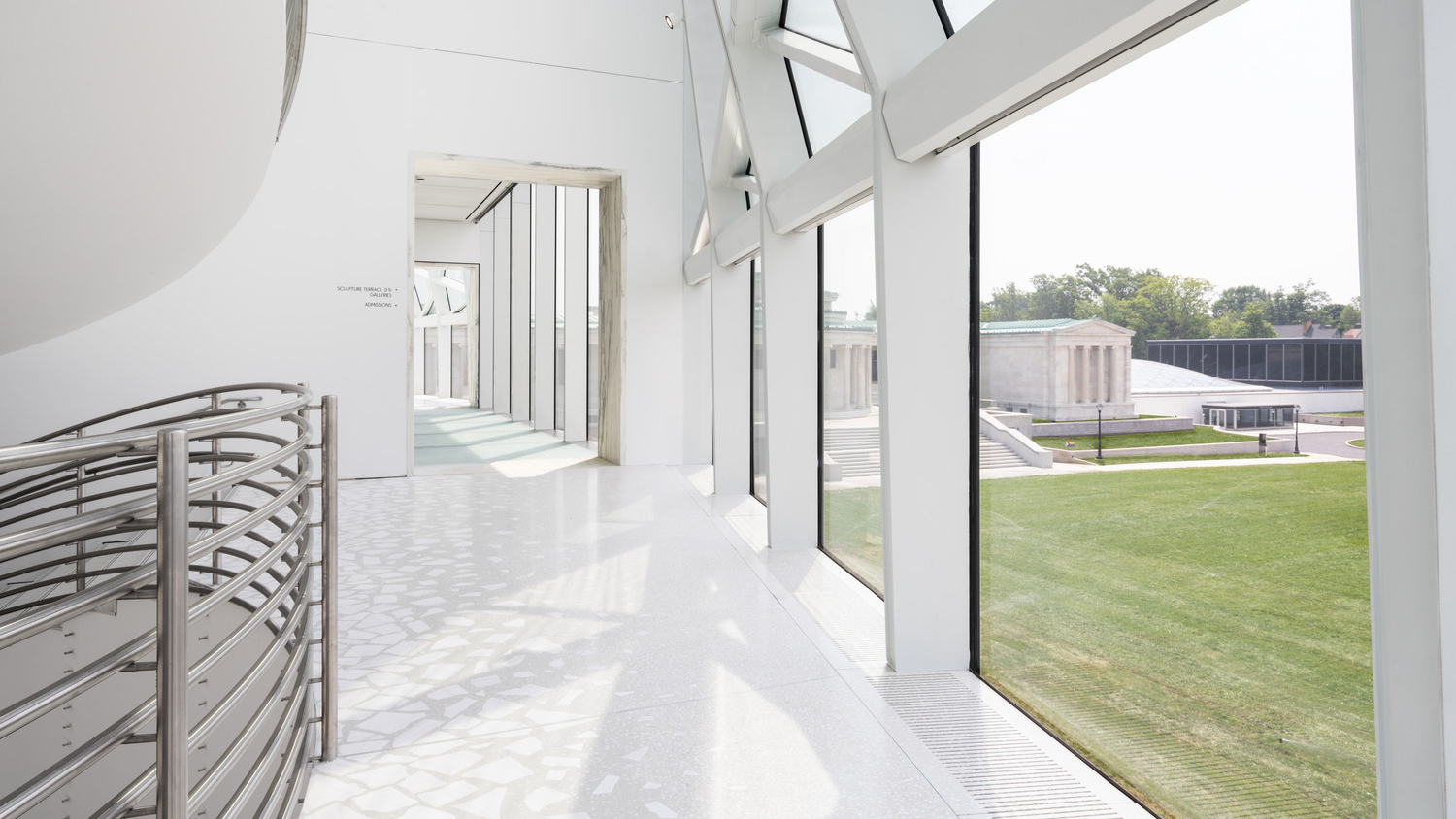
The architectural highlight, though, is the new Gundlach gallery, which features a distinctive glass façade that Cadorette says isn’t typical of museums.
“Traditionally museums are closed, opaque, solid buildings,” he notes. “But the glass gives a visual connection. People from the outside can see what’s happening inside the museum.” It also created another challenge for the building team: “Because the façade was glass, we essentially had to enclose the building to do all of the high-end finishes,” he says. “It’s all solid red-oak wood flooring and there are stringent temperature and humidity controls in museums that need to be tested and balanced and stabilized. With typical buildings, you’ve got a bank of windows, you’ve got a lot of solid walls, so you can create separations where you can move forward on finishes without having the 100-percent façade. We couldn’t do that here.”
LEGACY WORK
Ultimately, the biggest challenge was the scope of the project itself. It was really several projects in one—not just the renovations and the new Gundlach building, but features such as an underground parking garage and an elevated glass pedestrian bridge connecting the new to the old. And all of that work happened simultaneously, which required intense coordination.
“When I would go to the site and talk to Ryan and his team, you had to talk about one project at a time and put on a different hat,” Cadorette says. “Working on a clay tile floor in the 1900s building is much different from a slab-on-metal deck.”
The big payoff? The project’s timelessness. One of Disch’s favorite features in the new building is a spiral staircase with two miles of stainless steel railing and lighting in the handrail. The stairs use terrazzo gradients: Two dozen different colors every several steps, transitioning from dark pink to bright white as you reach the top.
“The owner of the terrazzo company was out there placing the big shards of stone before he poured the terrazzo, which was cool to see,” Disch says. “He viewed this as a legacy project. A lot of the subs did.” Disch has felt that same sense of pride since the museum reopened in June 2023. “Every time I walk into the museum or on the campus, I’m awestruck by how beautiful it is,” he says.
“You could place this anywhere in the world. It could be in Milan, it could be in Barcelona, it could be in Paris. And the community loves it.”