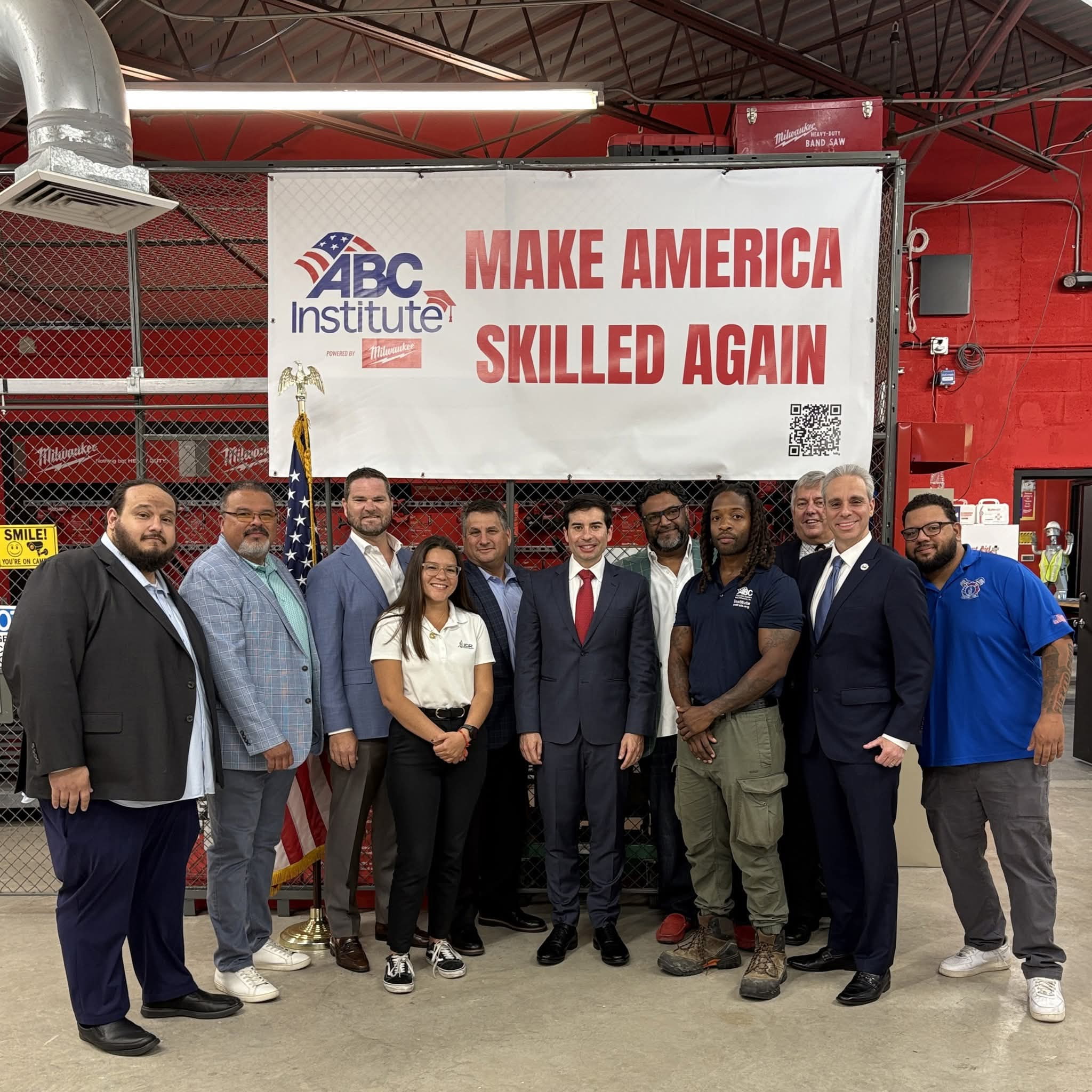
A visit by U.S. Deputy Secretary of Labor Keith Sonderling to the ABC Institute—Associated Builders and Contractors’ Florida East Coast Chapter’s education affiliate—underscored the growing national focus on apprenticeship and workforce development as solutions to America’s skilled labor shortage.
The visit, facilitated through longstanding relationships between ABC leadership and federal policymakers, offered a firsthand look at Florida’s apprenticeship model—one that industry leaders say is among the strongest in the nation. With tuition-free education, progressive wages, guaranteed employment and innovative training tools such as virtual reality labs, the ABC Institute is positioning itself as a blueprint for workforce development at a time when policymakers across Washington are searching for scalable, effective alternatives to traditional higher education pathways.
“This was about showing decision makers what’s actually working,” says TC Wolfe, principal at New Century Government Affairs, who has worked closely with the chapter’s government affairs team for several years. “Everything that people are talking about in the higher education community in Washington for the last 15 to 20 years has been return on investment, cost to the student, outrageous debt and the ability to get a good job. Florida has a model that answers all of those concerns.”
BUILDING FEDERAL AWARENESS THROUGH RELATIONSHIPS
Wolfe, who spends significant time in Washington, D.C., working with members of Congress and their staff, says fostering relationships between policymakers and ABC chapters is a core function of his role. Those relationships, he says, are critical to ensuring lawmakers understand the construction industry’s workforce needs and the role apprenticeship plays in meeting them.
“We’ve had House members out, staff from Sen. Scott’s office and Sen. Moody’s office,” Wolfe says. “We’ve gotten statements for the record recognizing the importance of commercial construction, the workforce and the industry in Florida.”
The deputy secretary’s visit followed meetings in Washington where ABC leaders discussed apprenticeship policy with Department of Labor officials and regulators, including representatives from OSHA. During those meetings, Wolfe says, ABC leaders made a point to “brag on the Florida model.”
“[Florida’s apprenticeship model] is tuition-free to the students with progressive pay wages,” Wolfe says. “We wanted to make sure the folks leading these conversations in Washington are aware of that.”
That outreach culminated in a handwritten invitation extended to Sonderling to visit the ABC Institute in person—an invitation he later accepted.
FLORIDA’S TUITON-FREE MODEL STANDS OUT
According to ABC-FEC President and CEO Peter Dyga, Florida’s tuition exemption for registered apprenticeship programs is what most clearly differentiates the state’s approach from others across the country.
“We think that exemption is what makes apprenticeship unique in the state of Florida,” Dyga says. “In Florida, it’s tuition-free. Most other states use more of a technical college model where they’re charging thousands of dollars.”
Under the ABC Institute’s model, apprentices do not pay to attend classes. Instead, participating contractors pay a fee to enroll their apprentices—a structure Dyga says ensures employer investment and long-term commitment.
“Our experience has been that charging contractors and getting them vested is an important component, and it works well for us,” he says.
Beyond affordability, Dyga emphasized that apprentices earn wages from day one and nearly 100% of graduates are employed upon completion.
“You’re not an apprentice unless you’re employed,” Dyga says. “We talk a lot about progressive wage increases as you go through the program and 100% placement.”
A MAJOR WORKFORCE PROVIDER
The ABC Institute recently marked its 50th anniversary and is now the largest apprenticeship provider in Florida. Despite representing fewer than 1% of the state’s more than 300 registered apprenticeship providers, ABC accounts for approximately 20% of Florida’s freshman apprentice enrollment.
“That’s crazy when you think about it,” Dyga says. “We’re two providers out of 325, but we’re 20% of the enrollment.”
The institute operates at multiple locations across the state and is expanding its footprint with a new 24,000-square-foot flagship campus in Hialeah. The facility marks the first time ABC-FEC has owned—rather than leased—space in Miami-Dade County.
“It’s getting a lot of attention,” Dyga says. “It’s a big step forward for us.”
INNOVATION TO REACH THE NEXT GENERATION
One of the most notable aspects of the deputy secretary’s visit was a demonstration of the institute’s investment in virtual reality training technology. The VR program is designed to supplement hands-on learning while addressing space limitations and expanding access across multiple campuses.
“The virtual reality component is going to allow us to have that experience at every location and for every trade,” Dyga says.
The technology also supports a strategic goal set by ABC’s board: lowering the average age of apprentices.
“Our average age has been higher than it should be,” Dyga says. “If a university had an average student age of 28, that would be a problem. This should be an equally good first choice for students coming out of high school.”
By integrating VR technology familiar to younger generations, ABC leaders believe the institute can better compete with four-year colleges for students deciding their post-secondary paths.
CAREER MOBILITY WITHOUT DEBT
In addition to training skilled craft professionals, ABC leaders emphasize that apprenticeship supports long-term career mobility. Graduates can move into management roles, estimating or even business ownership—a point that resonates strongly with policymakers.
“We’re developing the entrepreneurs of the future,” Dyga says. “A lot of our students will eventually start their own businesses. That’s a great story.”
The institute also has a matriculation agreement with Broward College that allows graduates to receive up to 27 college credits if they later pursue a degree.
“If you’re going to talk about lifelong learning and career ladders, you have to make it convenient and manageable,” Dyga says.
NATIONAL IMPLICATIONS
For Wolfe, the deputy secretary’s visit represented more than a ceremonial tour—it was validation that Florida’s apprenticeship system has relevance far beyond state borders.
“Florida has placed significant emphasis on quality training providers that help people earn their slice of the American pie,” Wolfe says. “That’s something we thought was important to put on display.”
As workforce shortages persist nationwide and student debt continues to dominate higher education debates, ABC leaders believe programs like the ABC Institute offer a proven, scalable solution.
“The fact that the deputy secretary took the time to come see this firsthand says a lot,” Dyga says. “It tells us this conversation isn’t just happening in Florida anymore—it’s happening at the national level.”
With federal attention now focused on what ABC leaders describe as a “debt-free, employment-first” pathway, the Florida model may increasingly shape how workforce development is approached across the country.
SEE ALSO: CREATING A NEW CONSTRUCTION WORKFORCE THROUGH APPRENTICESHIPS