
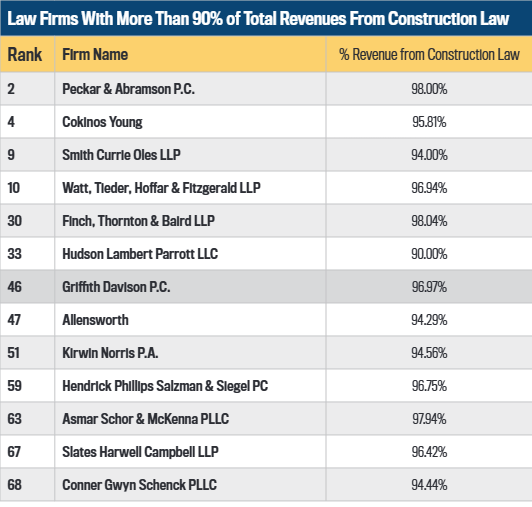
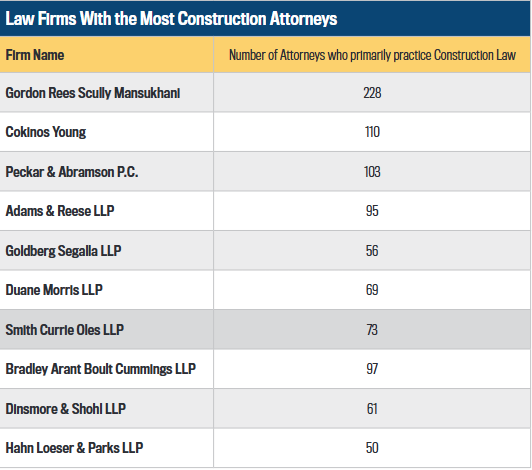
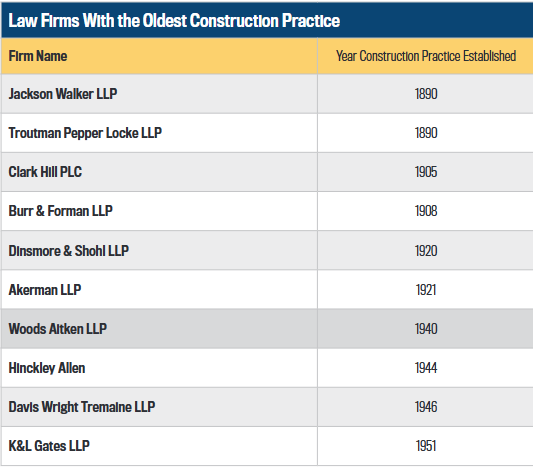
In the summer of 2025, contractors were consumed by one major issue: tariffs. Owners, builders and suppliers were trying to understand how shifting trade policy would affect bid pricing and ongoing projects. While those concerns have eased after a Supreme Court ruling, some of the industry’s top legal experts—all of whom practice at some of CE’s Top 50 Construction Law Firms—point to a different set of worries that are keeping their clients up at night and keeping their offices busy.
Inflation is not fading away, creating continued price challenges. Artificial intelligence is moving at a breakneck pace, offering potential time-saving benefits paired with major liability concerns. The federal government continues to make surprising policy changes, and contractors remain focused on managing financial risk across increasingly complex projects.
What does successfully navigating all those changes look like in 2026? There’s no one-size-fits-all answer, but following the cues from these legal minds can offer a roadmap toward limiting liabilities, completing your next project and protecting your bottom line.
COST PRESSURES FUEL CONTRACT HEADACHES
There is one question mark that looms over nearly every segment of the construction industry: How much is all of this going to cost? Contractors are grappling with a marketplace where soaring oil prices, financing costs and geopolitical events can quickly reshape a project’s financial outlook. In June, ABC’s analysis showed that materials prices had jumped by nearly 10% over the past year.
“Cost uncertainty has taken the pole position as the biggest challenge facing my clients,” Josh Levy, a Wisconsin-based partner at Husch Blackwell and leader of the firm’s Construction and Design practice, says. “I have had more clients embark on their first cost-plus fee contract negotiations over the past 18 months. I would primarily attribute the uptick to tariffs and the war in Iran that has spiked cost increases across the board.”
The shift toward cost-plus contracts reflects a broader recognition that fixed-price agreements are difficult to manage when pricing remains volatile. Rather than attempting to lock in costs over the life of a project, owners and contractors are looking for contract structures that better account for uncertainty while sharing risk. Levy believes those conversations need to begin much earlier than they traditionally have. Instead of waiting until design is complete to establish budgets, he encourages owners to involve lenders and key trade contractors during the preconstruction process to create more realistic cost expectations.
“When you get to the point of having the design completed, you already have a reliable budget,” Levy says. “The most critical piece of success is a truly collaborative approach that acknowledges that things are going to happen. If you’re building an $80-million multifamily project, the owner needs to have more than $80 million available to account for change orders and avoid the blame game.”
Gary Stein, co-managing partner of Peckar & Abramson’s Miami office, says that while many of his clients are confident in their ability to manage their own money, they have concerns about whether the rest of the project team will remain financially stable through completion.
“They are concerned about whether some of their subcontractors will make it to the finish line,” Stein says. “If they don’t, there is a dramatic impact on their projects.”
Data from Octus Intelligence shows that Chapter 11 bankruptcy filings reached a 10-year high last year. And in the construction industry, going out of business has always felt more common that staying in business: Approximately 44% of construction-related businesses manage to stick around for at least five years, according to figures from the Bureau of Labor Statistics. Rather than accepting that risk as an unavoidable part of doing business, Stein has seen contractors strengthen their prequalification processes and spread work across a broader pool of trade partners instead of relying too heavily on the same subcontractors. “The risks have always been there,” Stein says. “It’s promising to see contractors getting better at managing them.”
ARTIFICIAL INTELLIGENCE: COMPETITIVE EDGE, LEGAL CONCERNS
As contractors search for ways to relieve the pressure of tighter margins, many are increasingly turning to artificial intelligence. While research from International Data Corp. shows that 60% of construction firms are using AI, there are plenty of reasons to pump the brakes. “I put myself in the AI phobia camp,” Levy says.
Despite those fears, Levy believes construction may ultimately realize some of the biggest gains from generative AI of any industry. Unlike many businesses that are still searching for practical applications, contractors are beginning to use AI to analyze years of estimating data, specifications and bid histories to improve both pricing accuracy and project execution.
“Some companies are making their own generative AI programs that allow them to feed the spec book into the program,” Levy says. “When these companies have such a large library of data on bidding for every category of work, they can predict their costs on upcoming projects better to arrive at a more reliable bid.”
Levy also sees AI changing how projects are managed once construction begins. He pointed to one contractor that encountered a complicated steel connection in the field. Traditionally, resolving the issue would have required submitting a request for information to the project’s architect and waiting for a response, potentially delaying work for a day or longer.
Today, generative AI can often analyze the project documents and provide an immediate answer, allowing crews to continue working while reducing costly downtime. “If you can avoid losing a day of work,” Levy says, “that’s a huge advantage.”
Yet the same technology creating new efficiencies is also introducing legal issues that many contractors have only begun to consider. “Deepfakes, hallucinations, authenticating evidence—AI is complicating all of that,” Levy says.
Those concerns extend well beyond the courtroom. Stein cautions contractors against rushing to adopt AI tools without understanding how they handle sensitive information.
“I hear stories of saving time and money, but on the legal side, contractors should be consulting with lawyers to make sure they understand the potential landmines,” Stein says. “When companies use AI for reviewing contracts or analyzing project systems, they may be jeopardizing attorney-client privileges and work-product privileges.”
For contractors performing federal work, the compliance picture gets even more complicated. Keeley McCarty, a Washington, D.C.-based partner at Fox Rothschild, says companies should pay close attention to evolving federal regulations governing AI, particularly requirements involving technology developed by companies in certain parts of the world. Just as importantly, contractors need confidence that any AI platform they use will adequately protect proprietary company information and project data.
“Make sure you’re using a good AI system that will not create vulnerabilities for the data you’re inputting,” McCarty says.
She encourages contractors to adopt AI deliberately, beginning with lower-risk applications while developing internal policies and human oversight before relying on the technology for more consequential decisions.
“Is it going to give you the output that you expect, or is it going to give you something that will create a liability for your company?” McCarty said. “You can’t really point the finger at your AI. Test it and use it for small needs while developing proper oversight.”

DATA CENTER BOOM BRINGS MORE LEGAL WORK
While plenty of questions surround AI’s applications in the construction industry, there is no question that the industry loves the facilities that will power the technology. Driven largely by the explosive growth of artificial intelligence, data centers have created one of the industry’s strongest sources of new work. Contractors involved in data center construction are reporting significantly healthier workloads than many of their peers—backlogs of approximately three months longer, according to ABC’s latest estimates—making the market an increasingly attractive target for firms looking to expand.
The legal work surrounding those projects, however, extends well beyond negotiating construction contracts. Levy says his firm has seen a growing volume of work related to obtaining the approvals necessary to move data center developments forward. While developers rush to capitalize on demand, many communities remain hesitant to welcome the massive facilities into their neighborhoods. More than 70% of Americans oppose having a data center built in their area, according to spring research from Gallup. “Communities don’t want an eyesore,” Levy says.
Public resistance has made entitlement and permitting more complicated, requiring developers and their legal teams to devote additional time to addressing local concerns before construction can even begin. Levy has even seen those changing expectations reflected outside his legal practice. His nephew, who works for a global engineering and architecture firm, has spent much of his time designing data centers that blend more naturally into surrounding communities rather than standing out as industrial structures.
As a result, developers are increasingly treating aesthetics as part of the project’s business case rather than simply an architectural consideration. “Developers will need to adjust their budgets to satisfy them with something more aesthetically appealing,” Levy says.
THE CONTINUING EVOLUTION OF FEDERAL POLICY
As private-sector contractors continue to adapt, firms working in the federal marketplace are dealing with a new set of norms. It’s not nearly as volatile as a year ago when nearly 130 executive orders forced attorneys to rethink their entire playbooks, but there are still changes impacting companies involved in public projects.
“It’s been a lot of reading and relearning because the old rules no longer apply,” McCarty says.
McCarty says that one of the most closely-watched developments remains the evolving legal landscape surrounding diversity, equity and inclusion initiatives. Many contractors continue to evaluate hiring, training and promotion practices to ensure they comply with the Trump administration’s enforcement priorities.
A recent $17-million settlement between IBM and the U.S. Department of Justice under the Civil Rights Fraud Initiative provided one of the clearest indications yet of where federal enforcement agencies are drawing the line.
“The DOJ alleged that IBM was tying executive bonuses to reaching certain demographic targets in their workforce and that they were making hiring goals based on protected characteristics,” McCarty says. “The DOJ also alleged that IBM was limiting certain training and mentorship programs based on race or sex.”
For federal contractors, the case serves as a reminder that compliance programs cannot remain static. Policies that may have aligned with previous administrations or corporate initiatives should be reviewed regularly as enforcement priorities evolve.
At the same time, contractors are also seeing meaningful changes in how federal construction projects are being procured. McCarty pointed to the 2026 National Defense Authorization Act, which authorized the use of progressive design-build as a delivery method while expanding the use of Other Transaction Authority. Together, those changes offer agencies additional flexibility by allowing certain projects to move outside the traditional Federal Acquisition Regulation framework.
“It’s supposed to get contracts done much faster and allow parties to define the terms they need to attract non-traditional defense contractors and get the government the best technology,” McCarty says. “That’s been a huge deal over the last six months. The U.S. Army Corps is rolling out new projects where FAR will not apply.”
A HEALTHY, RESILIENT MARKET
Sifting through hundreds of pages of contract language, analyzing appeals court opinions and stressing about the potential for AI to hallucinate an answer that puts a contractor out of business—none of this paints a rosy picture for the current state of the industry. However, construction has always been fraught with risk, and Stein believes that the work on his desk—a combination of new contract work paired with some significant project administration issues—points to a relatively healthy market.
“It’s not heavily focused on one area,” he says. “The short-term picture looks good.”
While contractors won’t be able to control the numbers in the next inflation report or the next wave of geopolitical tensions, many of them have demonstrated an ability to withstand whatever shock comes their way. “I have observed a battlefield education for our contractor clients over the past 18 months,” Levy says. “They weathered COVID, and applied lessons to the disruptions brought by tariffs and spiking oil prices. I think developers appreciate the realities that require flexibility if they want their projects to move ahead.”
SEE ALSO: CONSTRUCTION EXECUTIVE’S TOP CONSTRUCTION LAW FIRMS