Who would’ve thought that water, the oldest and most prevalent fire extinguishant, could also be the most hazardous, damaging or impractical form of fire extinguishant?
An effective fire safety plan is vital when it comes to protecting employees, assets and production. In situations where water may not be the most ideal agent to use, the next option is clean agents used in special hazards fire suppression.
What Are Special Hazards Fire Suppression Systems?
A special hazards fire suppression system is able to quickly and completely extinguish a fire without damaging electrical components such as servers, telecommunications equipment or control panels. These special hazards can include anything from an entire building to a single piece of equipment in buildings such as telecommunications facilities, power plants and data centers.
Following are the different types of systems.
Foam and Water Deluge Systems
A deluge system consists of open sprinkler heads with pipes that are not pressurized. Instead, these systems are connected to a water supply through a deluge valve that is operated by the operation of a smoke or heat detection system. When the detection system is triggered, foam and/or water discharges through all of the sprinkler heads connected in the system.
Deluge systems are often used in places that are considered to be high-hazard areas, such as chemical storage facilities, processing facilities and aircraft hangars. To prevent the spread of fires, high-velocity suppression is needed.
Chemical and CO2 Suppression Systems
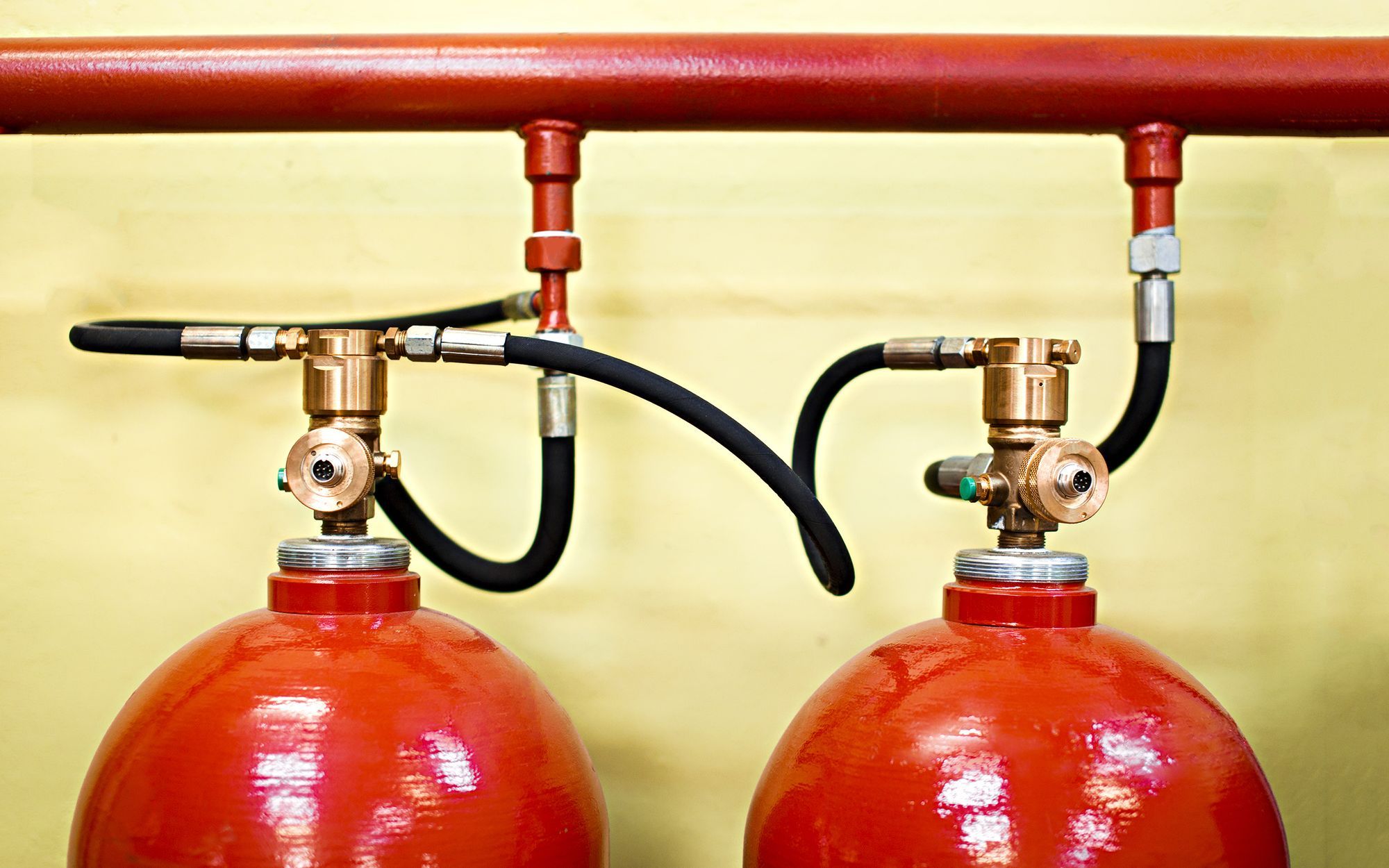
Another alternative to using water as a primary or sole extinguishant, is chemical suppression systems. This type of fire suppression system uses dry chemicals such as FM-200 or CO2, which are non-conductive and non-corrosive means of extinguishing fires.
FM-200 systems are preferred by many businesses because they are environmentally friendly, and the agent used is colorless. The cleanup after any fire or false event is significantly minimized and the downtime required after such an event is much less.
These systems allow for a safe, efficient and effective means of fire protection for use in areas with sensitive electronic equipment such as control rooms, museums and art galleries, medical facilities, pharmaceutical facilities, data centers, telecommunications facilities, computer equipment and power generation equipment.
Other Important Considerations
Room Integrity Testing and Door Fan Testing
Room integrity testing, which is also known as door fan testing, is a simple way to measure the gaseous leakage of an enclosure. This enables a general contractor or building owner to ensure the gaseous fire suppression agent is retained in and restricted to the protected room so it can quickly and effectively extinguish a fire to protect employees, equipment and facilities.
During this test, a large ducted fan is temporarily secured in the doorway to pressurize the room, which helps to stimulate the pressure exerted during a typical fire suppression system discharge. By reversing the flow of the fan, the room is depressurized. Throughout this process, airflow and pressure readings are monitored and recorded, calculating the equivalent leakage area through specialized computer software.
According to the National Fire Protection Association, these clean agent extinguishing systems require a minimum concentration of 85 percent of the adjusted minimum design concentration be held at the highest level of combustibles for a minimum of 10 minutes.
Specialty Fire Detection
Traditional fire detectors don’t work effectively in rooms that have a large volume of airflow or high-ceilings, because they require a significant amount of heat or smoke to be triggered. This places employees, equipment and facilities at greater risk. An alternative is to install additional detectors, but that is not usually a cost-effective solution.
Specialty fire detection, on the other hand, uses components such as air sampling units or optical smoke and fire sensors, which are better alternatives in certain environments. Examples of these type of components include:
- Air sampling units/air sampling smoke detector;
- Optical smoke sensor/photo-electric smoke sensor; and
- Optical fire sensor/optical flame detection.
Explosion Protection
Explosion protection systems do exactly what the name insinuates: they are used in protecting hazardous environments from massive explosions that are likely to occur in chemical and refining plants, bulk solids handling facilities and pharmaceutical manufacturing. Once again, the enclosed space makes all the difference.
For example, consider dust explosions, which can occur during the conveying, processing, pulverizing and storage of a wide range of solid materials that form a fine dust particulate, such as aluminum, cellulose, corn, flour and grain.
A study by the Chemical Safety and Hazard Investigation Board found that between 1980 and 2005, there were at least 281 combustible dust fires and explosions, which have taken more than 119 lives, injured 718 people and caused untold financial losses.
There are many methods that can be used to help avoid such occurrences, including the following.
- Explosion detection devices, which help to identify critical warning signs and make the decision on when to activate explosion isolation and/or explosion suppression systems.
- Explosion suppression systems, which are designed to immediately identify and chemically suppress an explosion.
- Explosion isolation, which stop the spread of flame from one location to another using explosion isolation valves and/or chemical barriers.
- Chemical isolation, which instantly discharges an explosion suppression agent into the duct work to suppress the flame, preventing its expansion.
- Mechanical isolation, which activates a protective mechanical barrier within the pipeline.
- Explosion venting, which creates a planned pathway for the expanding gases from an explosion to safely escape.