The construction industry has long struggled with waste. Surplus materials, rejected components and over-ordered inventory routinely end up in dumpsters—not because they lack value, but because traditional supply chains leave little room for reuse. Can a company build a business around solving that problem? repurposedMATERIALS is. They’re creating a practical marketplace for used, surplus and reclaimed industrial materials—including ballistic glass panels and military parachutes.
Often described as “America’s industrial thrift store,” repurposedMATERIALS works with contractors, manufacturers, utilities, government agencies and agricultural operations to divert usable materials away from landfills and into new, productive applications. Rather than breaking materials down through recycling, the company specializes in repurposing—keeping items intact and functional so they can be reused with minimal processing.
“For us, the goal isn’t perfection—it’s practicality,” says company owner Damon Carson. “If something is still strong, still safe and still useful, then throwing it away doesn’t make sense. We exist to connect that material with someone who can actually use it.”
SEE ALSO: ADAPTIVE REUSE PROJECTS ABOUNDED IN 2025
A Practical Approach to Construction Waste
Construction waste is often a byproduct of timing, specification changes or liability constraints—not material failure. repurposedMATERIALS focuses on capturing that overlooked value. With warehouse locations across the United States, the company accepts everything from surplus building materials and industrial components to highly specialized items that no longer fit their original purpose.
This approach allows builders and project managers to solve two problems at once: reducing disposal costs while gaining access to affordable materials. In many cases, materials available through repurposedMATERIALS can cost a fraction of new inventory, while still meeting the functional needs of the project.
The company’s impact becomes especially clear when looking at real-world case studies that demonstrate how creative reuse can solve unexpected challenges.
Case Study #1: Bulletproof Glass Finds a New Home in a Zoo

One of repurposedMATERIALS’ most striking examples involves a semi-truckload of unused level-8 ballistic glass panels. Originally manufactured for installation at the state capital complex in Sacramento, California, the two-inch-thick panels—measuring 42 inches by 10 feet—were rejected after being produced to the wrong specification.
For many suppliers, this kind of mistake would result in scrapping the glass entirely. Instead, repurposedMATERIALS accepted the material, recognizing that its strength and quality were still exceptional.
The glass would find its home in an unexpected place. A zoo in Texas, preparing for construction of a new lion exhibit scheduled to begin in 2026, needed large, durable viewing panels capable of safely separating animals from visitors. repurposedMATERIALS re-homed 24 of the ballistic glass panels to the zoo.
Although the glass was technically over-engineered for the application, the zoo gained a far more affordable solution than purchasing new specialty panels—and the material avoided the landfill entirely.
“That glass didn’t fail,” Carson explains. “It just didn’t fit one project. But for the zoo, it was a perfect match. That’s what repurposing is all about—finding the right second life.”
Case Study #2: “Expired” Natural Gas Pipe Solves an Agricultural Challenge

In another example, a major natural gas utility company in Illinois faced a familiar regulatory issue. Polyethylene natural gas pipe must be installed and buried within three years of its manufacture date to meet safety and liability requirements. Once that window closes, the pipe becomes unusable for gas service—even if it is brand new and structurally sound.
Rather than discarding the material, the utility sent the “expired” pipe to repurposedMATERIALS. The company then matched it with a Minnesota hog farmer facing a different problem altogether.
The farmer needed a cost-effective way to transport manure from his hog barns to his cornfield irrigation system, where it would be sprayed as fertilizer. He buried 2,800 feet of the expired four-inch polyethylene pipe to move the manure efficiently across his property.
For the farmer, the manufacturing date was irrelevant. He needed pipe that was strong, reliable and affordable—and the reclaimed gas pipe met those needs perfectly.
“Regulations can turn perfectly good materials into waste overnight,” Carson says. “But outside of that original use case, those materials can still be incredibly valuable. In this case, one problem became another person’s solution.”
Case Study #3: Retired Military Parachutes Become a Monastery Workshop

Not all repurposing solutions come from construction or utilities. Sometimes they come from the Department of Defense.
The U.S. military routinely retires massive cargo parachutes used to deliver tanks, Jeeps, ammunition and food supplies to battlefields. These are not standard parachutes—they range from 35 to 100 feet in diameter and are built to withstand extreme forces. Once retired, they are typically destroyed or discarded.
repurposedMATERIALS stepped in to redirect these parachutes toward a completely different mission.
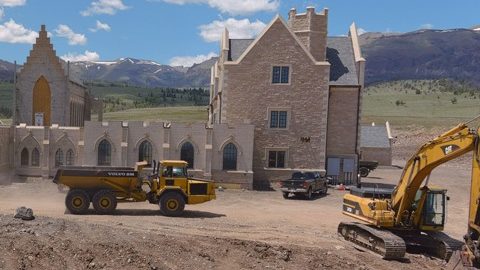
When Brother Joseph and the Carmelite monks in Wyoming needed a warm, workable space to help build their monastery, they chose creativity over conventional construction. Using eight repurposed military parachutes sewn together and reinforced with one-inch blended webbing tied to concrete-filled drums, the monks engineered a temporary workshop enclosure.
Once a portable propane heater was turned on, the parachutes expanded like a hot air balloon, creating a surprisingly effective and insulated workspace. Within three hours, the structure transformed brutal Wyoming winter conditions into a usable environment where the monks could continue their work.
“That project is a perfect example of thinking differently,” Carson says. “Those parachutes were designed to save lives in combat. Now they’re supporting a peaceful, productive purpose. That’s the beauty of reuse.”
Smart Solutions for a Changing Industry
Builders face increasing pressure to reduce waste, lower embodied carbon and control costs. By reusing materials as-is, contractors avoid the environmental impact of manufacturing new products while also cutting transportation and disposal costs. The result is a more efficient material lifecycle—one that aligns sustainability with common-sense economics.
“Construction doesn’t need more buzzwords,” Carson says. “It needs options that work in the real world. Repurposing gives people a smarter way forward without sacrificing quality or performance.”
SEE ALSO: WHAT’S OLD IS NEW: ADAPTIVE REUSE ACROSS AMERICA