Faced with taking appropriate measures to reduce the risk of coronavirus infections among office workers, companies are deciding how to design highly functional offices during and after the pandemic.
To achieve that goal, companies should adopt the following design strategies.
Improving Indoor Air Quality Through HVAC Systems
Consider the following strategies to building HVAC systems to reduce transmissibility of airborne pathogens like SARS-CoV-2. Each of these approaches presents unique challenges that require input from a registered mechanical engineer.
Increase Filtration
- Upgrade mechanical filters to MERV13 or higher at all air handling units.
- Install electronic air filters where upgraded mechanical filters are not feasible.
Inactivate Pathogens
- Use bi-polar ionization in central supply air systems.
- Deploy UV-C ultraviolet lamps in central air handling units.
Improve HVAC Delivery
- Raise flow rates of outdoor air to reduce concentrations of indoor contaminants.
- Maintain indoor relative humidity between 40% and 60%.
Maintaining a Safe Distance
Many companies are taking a flex-work approach to curb infections by having some employees work in the office while others work remotely on different days or weeks.
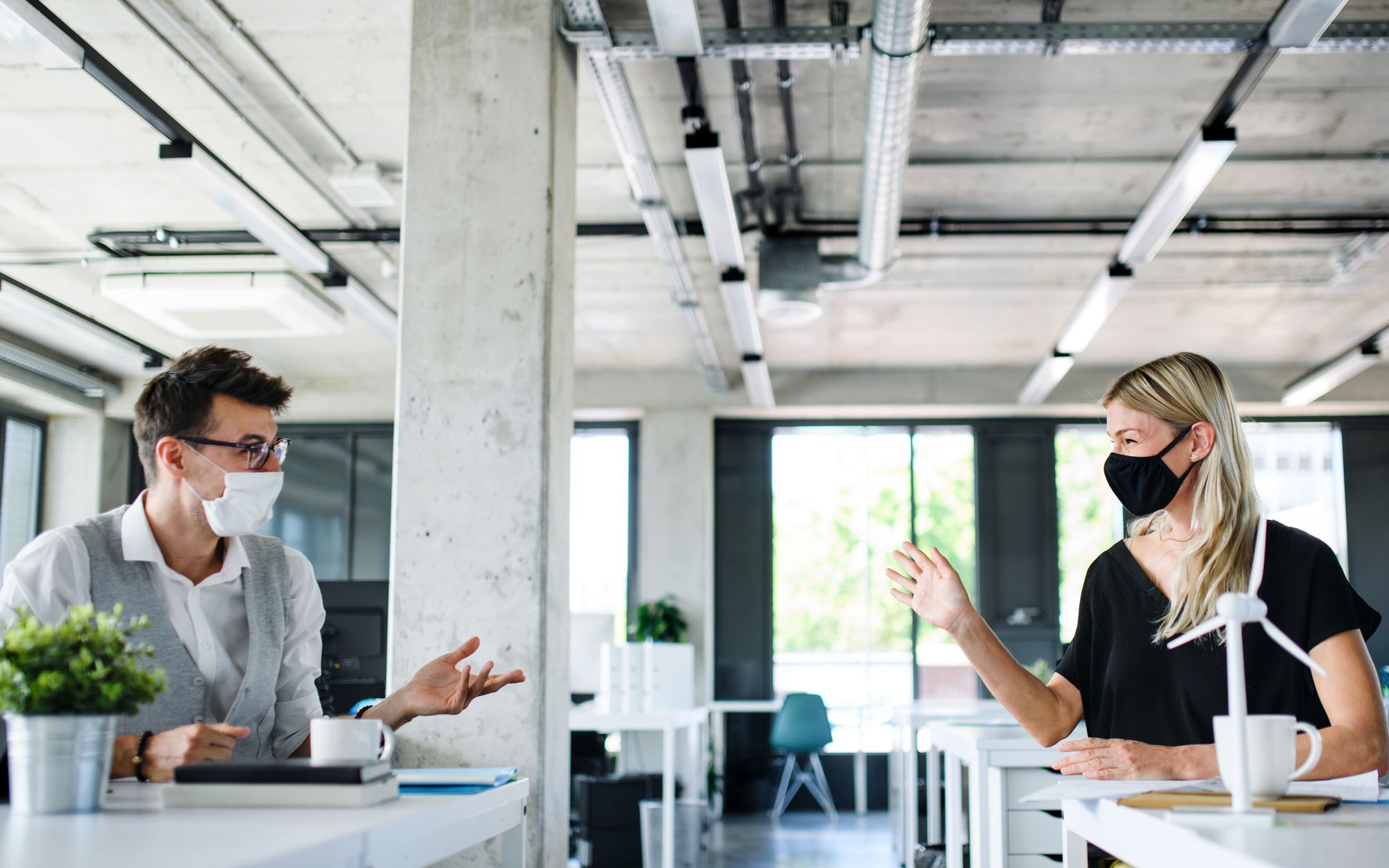
Open-system style offices also will ensure that employees are working at least 6 feet from one another to avoid potential exposure to the virus.
This can be accomplished by installing temporary partitions, removing chairs and other furniture, creating one-way traffic flows by adding arrow diagrams to the floors, adapting community rooms and other large spaces where employees gather as well as find other temporary uses like storage for chairs.
Proposed office projects will need to consider the size of maximum occupancy of spaces and how they can be easily and quickly expanded or reduced to avoid costly and time-consuming renovations.
Creating a Touchless Environment
Contemporary office building design allows people to avoid touching things like push buttons for elevators and water fountains. However, with the virus’ potential to temporarily live on surfaces, the trend toward no-touch office design may accelerate.
Restrooms are prime candidates for a touchless environment. Hands-free faucets, sensor-controlled paper towel dispensers in place of air hand dryers, and electronic flush toilets and urinals would be effective methods used in restroom germ control.
This approach also should be applied throughout the office. Consider voice-activated virtual assistants and appliances in kitchens and office cafes, phone-activated copiers, motion sensor lighting and automated room reservation systems.
Hand cleaning stations also need to be added beyond the restrooms and kitchens. Water fountains are already being replaced with bottle-filling stations. Hand-washing sinks or hand-sanitizing stations should also be added throughout the office.
Using Antimicrobial Materials and Coatings
Virtually all modern office buildings are built with stainless steel and plastic furnishings. They are also ideal surface environments for airborne pathogens like SARS-CoV-2 to thrive.
Designing offices with antimicrobial materials and coatings may reduce the incidence of viral transmission. But there is some debate that the long-term effect of this approach could negatively impact air quality and human health.
Another strategy is to adopt practices used by health care facilities. Hospitals and other medical buildings control the spread of germs by providing easily wipeable surfaces and limiting horizontal surfaces (dust shelves) where potential viruses can thrive.
Transformative Impact of Technological Innovation
Technology has played a critical role in allowing companies to continue operating during the pandemic. With many office buildings closed to comply with shutdowns, collaborative technology like Zoom has been used by those working remotely to connect with clients and staff.
Advances in cloud computing, artificial intelligence and machine learning, automation and other 21st Century technologies have the ability to transform steel-and-concrete structures into smart office buildings that could cushion the blow from the next global pandemic.
Longer-term design strategies could signal the next phase of office design. In fact, major epidemics have influenced architectural design. This has the most potential and needs further exposition.
As the world recovers from the pandemic’s impact, it’s inevitable that workplaces will change if the past is an indication of future events. If the pandemic has taught us anything, now is the time to create and implement new and improved designs for office buildings that will provide safe, healthy and worry-free work environments.