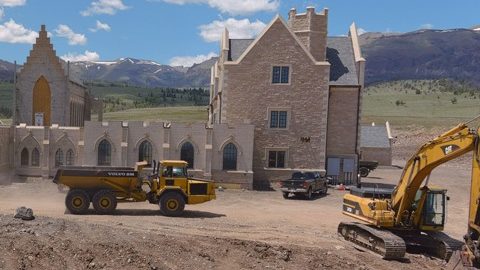
Road construction is ranked as one of the world’s most hazardous occupations. Ground workers are often having to undertake tasks while large vehicles and moving machinery are in close proximity.
According to a study carried out by The Center for Construction Research and Training’s Data Center, nearly half of road construction workers who were killed onsite between 2011 and 2016 were struck by a vehicle or machinery, such as a dump truck.
One of the major factors contributing to collisions of this type is the omnipresent vehicle “blind spot,” which is often the main reason ground workers are killed or injured. As roads get even busier, more construction work is being undertaken after dark, meaning visibility becomes poorer and the potential for collisions increases. Blind spots on large worksite vehicles and machinery can be particularly deadly. The front, rear and nearside are problematic areas of vehicles, particularly those with elevated driver positions. Harsh construction site terrains, where thick dust and mud often decrease visibility even more, further increase the risk of collisions.
In addition, ground workers are required to wear hearing protection. This means they cannot always hear vehicles approaching, further adding to the possibility of incidents occurring onsite. Clearly, preventing deaths and keeping workers safe is a challenging, yet essential, task.
In such a high-risk industry, organizations are increasingly choosing to invest in enhanced safety systems to protect their workers and keep their reputations intact.
Technology is now playing a crucial role in solving many of the safety issues facing the road construction industry. These include eliminating blind spots on vehicles and assisting drivers working in difficult conditions when visibility can be compromised, such as bad weather or overnight.
While large mirrors have traditionally been used, they cannot completely eliminate blind spots—but 360-degree commercial vehicle camera systems can. Safety technology can give drivers better visibility as they maneuver their vehicles by providing the driver with a complete surround view of the vehicle, in real time, in a single image. A 360-degree camera system combines images from ultra-wide-angle cameras, resulting in a bird’s-eye view of the vehicle and surrounding area. Research has shown that, in the time it takes to scan four mirrors, assess and then react to hazards, a vehicle could travel as far as 33 feet. Vehicle camera safety systems protect the driver and ground workers in the vicinity of the vehicle.
Simple back-up alarms have long been a solution to alerting those on the ground, but research has shown that old-fashioned tonal alarms may be adding to the problem as pedestrians and workers cannot always locate the direction from which the alarm originates. Multi-frequency alarms fitted to vehicles are helping to solve this problem. Instead of the traditional “beep beep” of tonal alarms, they create a “ssh-ssh” sound which is gentle on the ear and dissipates quickly, meaning the alarm can be instantly located and heard only in the danger zone.
Radar obstacle detection technology is further enhancing safety in the construction industry. It alerts drivers to potential risks and works by emitting a frequency-modulated, continuous-wave radar that is faster than pulsed-radar products. Some detection systems can produce false alerts, which can lead to frustration for drivers, resulting in genuine alerts being disregarded. Continuous-wave radar protects against false alerts, thanks to the controlled beam pattern, which can be programmed, allowing organizations to fix a custom detection area specifically suited to their needs. When a moving or stationary object is detected, the driver is alerted via an in-cab visual display and an audible warning.
Heavy-duty radar systems are able to operate even in high or low temperatures. Radar obstacle detection is also waterproof, dust resistant and can be heard easily in noisy environments.
While technology is key to helping prevent injuries and deaths, it is also essential for companies to be fully committed to implementing robust safety strategies and plans so that demonstrable progress can be made.