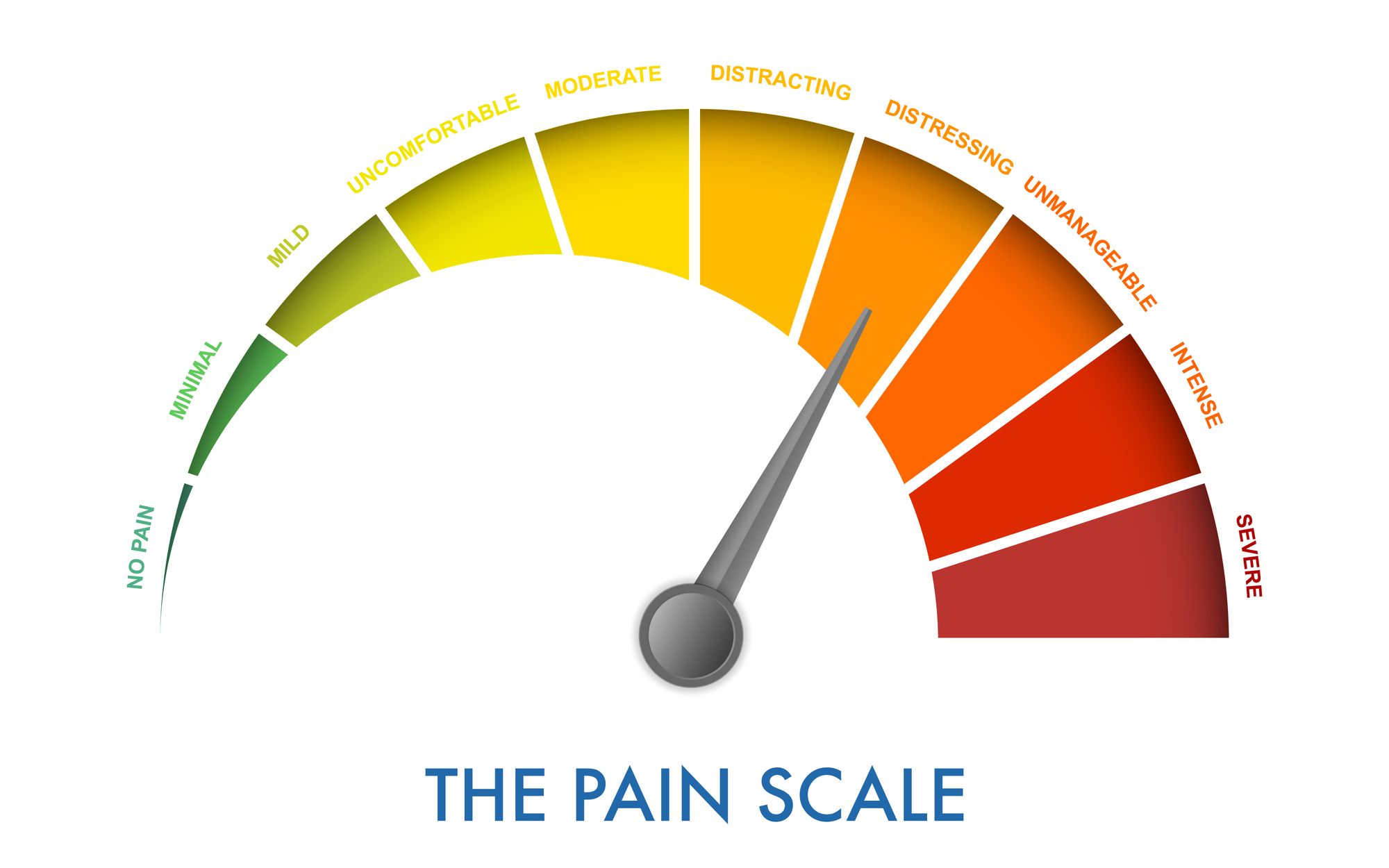
In 2001, The Joint Commission, which accredits and certifies health-care organizations in the United States, waged a campaign to include pain as the “fifth vital sign,” according to the book Less Pain, Fewer Pills: Avoid the Dangers of Prescription Opioids and Gain Control Over Chronic Pain. Because pain was being treated as a vital sign, patients were asked to rate their pain level at every medical visit. The visual analog pain scale used to rate pain on a scale of 0 to 10 didn’t mention the nonbiological factors that are now known to feed the experience of pain. As a result, the assumption by patients and clinicians using the pain scale was that if someone continued to feel pain after starting treatment for a work injury, there must still be a “pain generator”—i.e., damaged tissue—causing the pain.
However, discussing pain levels and numbers on a scale hasn’t proven to be an effective approach to accurately assessing a patient’s recovery or achieving the desired health outcomes. Research reveals that the discussion of pain must go beyond a patient’s degree of physical discomfort.
REDEFINING PAIN
In 2020, the International Association for the Study of Pain (IASP) updated its previous definition of pain. After two years of study and deliberations by a 14-person task force of experts—as well as input from IASP members—the organization arrived at its current definition: “Pain is an unpleasant sensory and emotional experience associated with, or resembling that associated with, actual or potential tissue damage.” They further noted that pain is always a personal experience influenced to varying degrees by biological, psychological and social factors. The important takeaway is that pain isn’t necessarily associated with tissue or structural damage, and its perception is influenced by psychosocial factors.
In 2019, the cost of workers’ compensation injuries in the United States was $171 billion. Because roughly fewer than 10% of cases accounted for more than 80% of total expenditures, and most high-cost claims were for non-catastrophic musculoskeletal conditions, resources were (and are) largely being expended on problems that are not medically complex. That is why it’s particularly important that employers and the health-care providers they work with understand that pain is more than biological. Employers should also manage workers’ compensation injuries with this realization in mind.
“HOW WOULD YOU RATE YOUR PAIN?”
Typically, physicians who rely on the pain scale embark on a search focused on finding and fixing structural/tissue damage. There is little (if any) thought given to the fact that when the initial injury is objectively healing—yet the subjective pain complaints are not decreasing (or are in fact increasing)—the source of the patient’s ongoing pain might be nonbiological. Rather than looking at the patient within the context of environment—with consideration of psychological and social factors likely to be contributing to the severity of the pain—clinicians wedded to the pain scale focus solely on the biological. This leads to unnecessary diagnostic studies and procedures. For example, an MRI will not reveal that the patient had a dispute with a supervisor. An epidural injection will not help the pain inflamed by a heated argument between an injured employee and a spouse or partner. And opioids will not dispel worries or fears an injured employee has over finances.
The pain-informed construction executive will seek to work with health-care providers who approach pain in a holistic way by focusing not only on physical symptoms but also on the person dealing with the pain. Research in the neurosciences has demonstrated that pain and emotion share real estate in the brain, according to Less Pain, Fewer Pills. Anger, anxiety, fear and other strong emotions activate the same areas of the brain that are activated when someone feels physical pain. The brain creates pain in response to strong negative emotions—just as it does to physical injury. In fact, all pain is created by the brain, and the brain takes into account information coming from a person’s senses, thoughts, emotions, life outlook and sensations from internal processes going on in the body. It sifts and evaluates this data, and if it concludes the individual is in danger, it sends a danger signal—it creates pain. And sometimes, the brain gets it wrong. Pain is the brain’s conclusion, not a fact.
Every time a caring employer, a concerned workers’ compensation manager, adjuster, clinician, family member, friend or supervisor asks an injured employee about their pain, that individual’s pain pathways are activated. The individual being asked about pain continually “learns” pain as their neural pain pathways grow faster and denser. Ultimately, the individual develops overly aroused and hypervigilant neural pathways.
A FOCUS ON FUNCTION, NOT PAIN
The most effective approach to help injured employees whose pain is not improving (or getting worse) with treatment appropriate to the injury is to focus concern and questions on function rather than pain. When a patient’s subjective pain complaints do not align with what an objective medical evaluation reveals, it’s a good time to have a conversation explaining the neuroscience of pain, review testing/evaluation findings thus far and confirm that there is no evidence of a serious, underlying physical disorder that is being overlooked. A clinician’s reassurance that the pain is “real” but not a symptom of something structurally being “seriously wrong” helps to calm down the patient’s nervous system.
ADDRESSING PAIN IN A WORKERS’ COMPENSATION CLAIM
It’s crucial for stakeholders in the workers’ compensation system—e.g., employers, payors, third-party administrators—to recognize that ongoing pain unsupported by medical findings is not by that very fact or act a sign of fraud, weakness or moral failing. Rather, it’s most often a sign of hypervigilant neural pain pathways, and injured employees can learn to turn down the volume on pain by being taught to calm those pathways. Accusing an injured construction worker with aroused pain pathways of malingering only adds fuel to the fire. The anger that comes from feeling misunderstood and unjustly accused increases the brain’s perception of threat and danger, inflaming the perception of pain.
Pain is complex. Human brains are not passive computers that receive and register pain signals; they’re actively involved in either shrinking or growing pain. How and how often patients think about their pain can make perception of pain better or worse. An injured employee can actually “grow” pain by thinking about it and how terrible it is.
Savvy, pain-educated construction executives will help their injured employees renormalize their lives after a work injury and better control workers’ compensation costs by working with health-care providers who focus their dialogue with patients around functional restoration rather than pain. Injured employees may improve more quickly if the conversation between clinicians and patients centers around activity (e.g., what and how much patients are doing) and if clinicians offer positive reinforcement for functional improvement and progress restrictions accordingly.