The Wisconsin Center District (WCD) is a quasi-governmental agency that owns and operates three venues in downtown Milwaukee: UW–Milwaukee Panther Arena, a 10,000-seat sports arena; the Miller High Life Theatre, a 4,100-seat performing-arts center and concert venue; and the Wisconsin Center, a meeting and convention facility. The latter building, which opened in 1998, is now expanding to the tune of $420 million, a venture that, although it only broke ground in October 2021, actually began years before.
This is its story—from conception to COVID-19, preplanning to piledriving and demolition to diversity, equity and inclusion.
BOOK IT
Marty Brooks, president and CEO of the Wisconsin Center District, took on the ambitious expansion project because “I like a challenge,” he says. Luckily for Brooks, a transplant from St. Louis and former general manager of the Rams’ old stadium (where they played before they relocated to Los Angeles in 2016 and won the Super Bowl this past February), the WCD had conducted several studies since the convention center first opened to assess its competitiveness and viability in the market. The most recent market and feasibility analysis, conducted in 2014, revealed that the center was losing business due to a lack of available space—in fact, losing almost as much as it was able to book.
“Once the ballroom was booked and the accompanying meeting rooms,” Brooks says, “no one else could come in and use the dates, because we had already been committed.”
The solution, the WCD concluded, was simple: The center needed more space to accommodate the flow of multiple events into and out of the building. For instance, a meeting or convention might require three days for move-in, followed by up to four days for the program itself, followed by another three days for move-out. While the event takes up 10 total days’ worth of rental space, it only provides high traffic for area hotels, restaurants and other businesses during the four days of the actual meeting. By adding square footage, the center would have the flexibility to host more than one event simultaneously, adding to local profits.
Armed with this information, Brooks began the expansion project in January 2018. To acquire the necessary funding, he first had to prove to the WCD’s 17-member board—which is made up of public- and private-sector appointees—that the project would be profitable. In April 2019, he commissioned a tax-projection study that identified several steps the WCD could take to move forward with the project. These included:
- Seeking a lender to administer a bond (in this case, Morgan Stanley).
- Asking the State of Wisconsin to assume “moral obligation” as guarantor for project bonds, which would ensure better borrowing rates.
- Raising the cap on the value of project-related agreements that the board is authorized to enter into to $1 million.
In August 2019, the board authorized Brooks to spend up to a million dollars to develop the project. In September, Brooks and his team hired CAA ICON as the owner’s representative. That December, the WCD chose tvsdesign and EUA as the architecture team followed by the team of Gilbane|Smith as construction manager in January 2020. Renderings were presented to the board on March 6, 2020.
BEYOND 2020
Then the project—and the world—hit a snag. Brooks’ team had been working relentlessly to fine-tune pricing for the project only to run headlong into the pandemic. Brooks says: “We were asking, ‘Is this really wise, to be pursuing a multi-hundred-million-dollar project during a period of uncertainty?’”
Everything was on the line. “There were influential people in the Milwaukee community who, while they had supported the expansion project in concept and the impact it could have on business, really felt that moving forward [during COVID-19] was not appropriate because of the amount of uncertainty,” Brooks says.
When businesses stopped in late-March 2020 and people in and around Milwaukee began to work remotely, the Wisconsin Center project sat very much in the balance. “Our mayor said that only essential people should be venturing out of their homes and working in the city,” Brooks says. “But we kept coming back to the same conclusion, and that was the project was going to take another year to design. We needed to get the financing secured. And then it was a two- or three-year construction project. So, we took a future-oriented approach. The center we were looking to expand was not for 2020.”
Considering that the meetings and conventions industry, as a rule, works years in advance, Brooks’ forward-thinking optimism was right on the money (as it were). With a projected opening date sometime in the first quarter of 2024, groups looking to book conferences in Milwaukee will be walking into a convention center with the highest possible infectious-disease mitigation strategies in place.
ONCE IN A CAREER
Demolition on the plan-spec job finally began with the center’s old parking lot in October 2021. (To see a live camera feed of four different cranes driving 2,000 foundation piles into the ground, visit buildingmore.com.) The build itself is being conducted by the practiced team of Gilbane|Smith, which recently constructed the State of Wisconsin Hill Farms State Office Building in Madison. Co-leading the Wisconsin Center project are Dan Zess, general superintendent at Gilbane Building Company, and Ben Entringer, senior superintendent with C.D. Smith Construction.
“This is an exceptionally large project for us,” Zess says. “It’s not the type of project that comes around every year or other year.”
And with great budgets come great responsibilities. “This is going to be a difficult job by any stretch of the imagination,” Zess says. “We’re going to do things that are probably once in a career. But you can take that experience and draw on it in the future when you’re up against tough challenges or tough projects.”
Entringer is equally optimistic about the scope. “I like to glean whatever I can to put my best foot forward relative to the next endeavor,” he says. “It’s going to be a very good learning curve for us all.”
According to Zess and Entringer, that learning curve is steep and challenges abound. Here are just a few:
- Clear-span trusses to create the volume of space in the exhibit hall will be 30 to 40 feet deep on the ends of the building and more than 15 feet deep in the center of the building.
- The clear-span trusses will require links between 90 and 150 feet long.
- The logistics of a downtown, urban environment.
- The steel erection process, which currently includes driving piles through old foundations of previous site buildings.
- Tying onto an existing building without interrupting day-to-day activities.
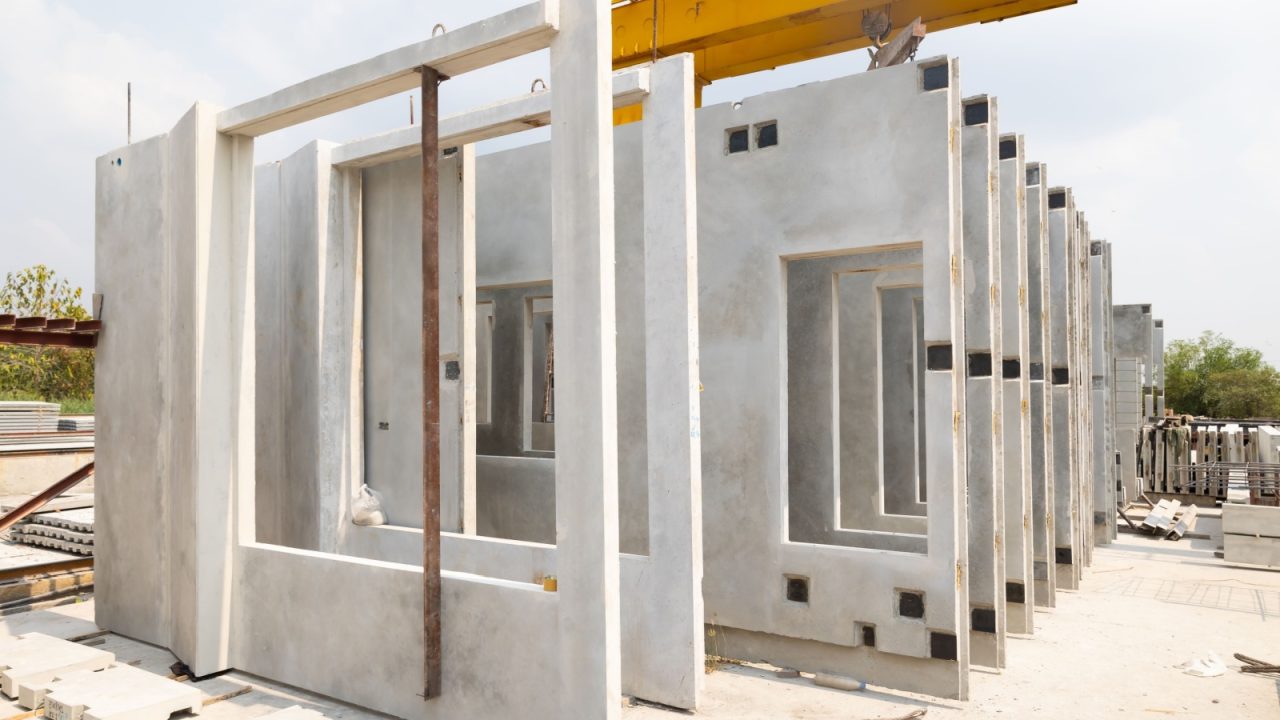
- Prefabrication and the associated logistics.
Each of these challenges, while complex, can be mitigated with planning and communication. “We provide crystal-clear and concise communication with our owner and make sure they are apprised from marketing, event-planning and operations standpoints,” Zess says. Entringer agrees: “Preparation for these tasks is a lot of work on the front end in order to make sure that it goes smoothly and the owner is happy.”
For his part, Zess has encountered moments when pre-planning wasn’t appropriately executed—he is experienced at solving problems on the ground but prefers measuring twice and cutting only once. “I’ve been on a job (not this one) where we were supposed to tie onto an existing building and found out that the old building was five feet in the wrong direction—farther away,” Zess says. “In that instance, we just made the building five feet bigger. But what it really boils down to is good due diligence on the front end to make sure that your tie-in on the back end is seamless.”
FROM OLD TO NEW
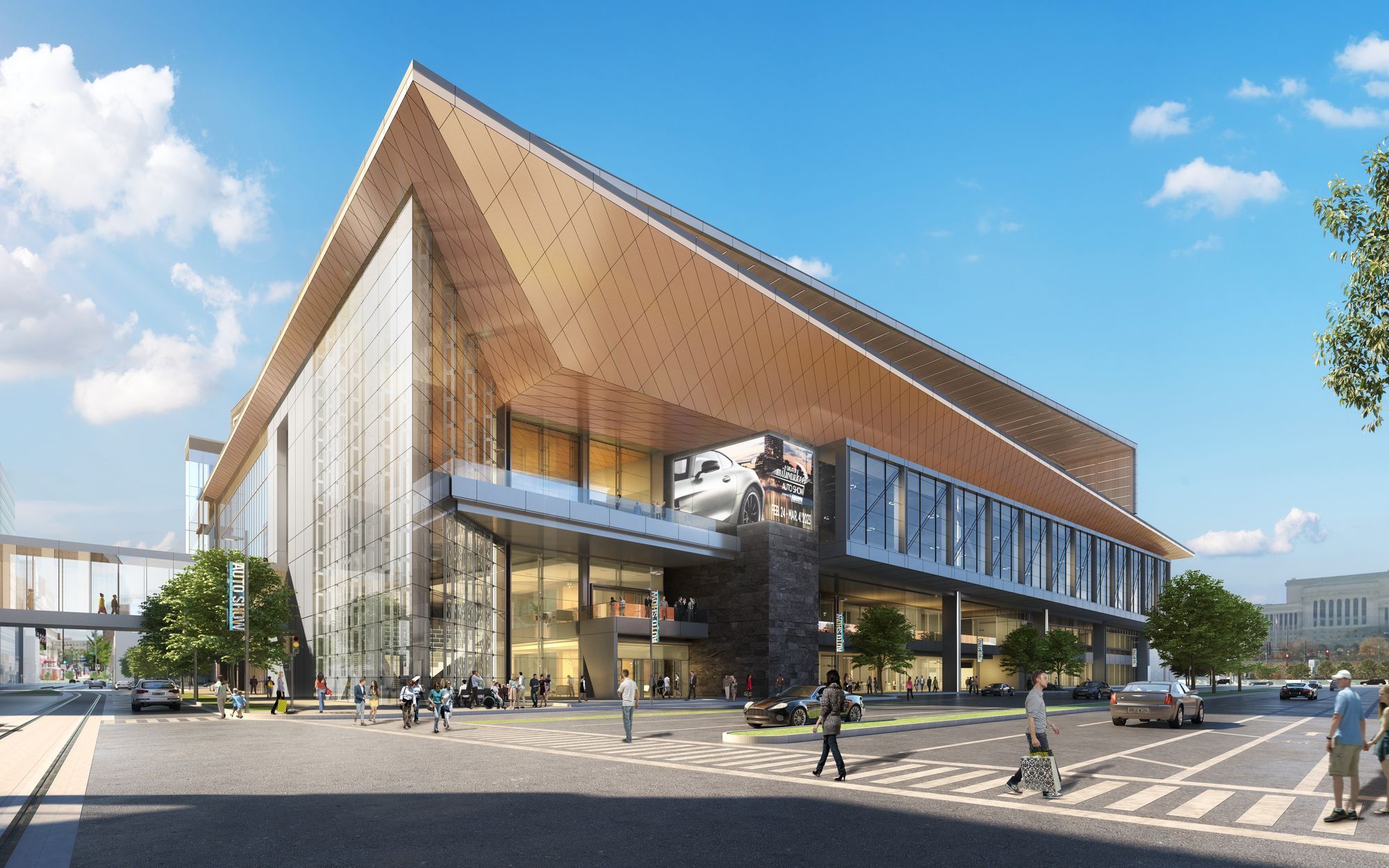
The current convention center layout will be replicated in the expansion. It runs north to south, so there will be north and south wings. Besides doubling the exhibition space, the expansion will include a fourth floor, 30,000-foot ballroom, along with prefunction spaces, outdoor terraces and spectacular downtown views. A façade will be installed in three, multimedia parts: glass metal panel with masonry veneer, glass and metal paneling, as well as metal with some masonry. An expansive water feature is also planned.
Updates will incorporate state-of-the-art technology, infrastructure, Wi-Fi and other devices. Approximately $20 to $25 million has also been budgeted for modifications to the original facility, including directions, signage, carpets and paint, ensuring that the transition from old building to new is seamless.
Further, Brooks and his team are prioritizing inclusion, diversity and equity (IDE) as part of hiring practices during the build. The WCD will apply for a Minority Business Enterprise certification from the National Minority Supplier Development Council, a private third-party organization that certifies minority-owned businesses on behalf of U.S. corporations. It has also made a commitment to ensuring that 40% of the onsite workforce is part of the resident participation program. In addition, disadvantaged business enterprise goals include 25% minority, 5% women and 1% disadvantaged veterans. Equivalent percentages are reflected in the project’s business partnerships.
Beyond the build itself, designs incorporate IDE into the use of the final product. For instance, 20% of restrooms will be gender-neutral at all times, with the ability to change all men’s rooms into stalls and all restrooms into gender-neutral spaces depending on the needs of a particular convention.
When asked why IDE initiatives are such a priority for the WCD, Brooks offers a shrug. “It’s a tough question, because I can’t imagine why it wouldn’t be,” he says.
DEEP IMPACT
For the WCD, the impact of being able to book overlapping events can’t be overstated. “That’s the real opportunity we see for the region,” Brooks says. “Anyone who touches the hospitality business, from movie theaters to Uber drivers, will benefit and support services.”
As for Gilbane|Smith, the building itself is reason enough. “Anytime you get the ability to build in large, open spaces like this in terms of design, it brings certain challenges,” Zess says. “That’s something I’m excited to see and to make sure we’re executing at the highest level.”