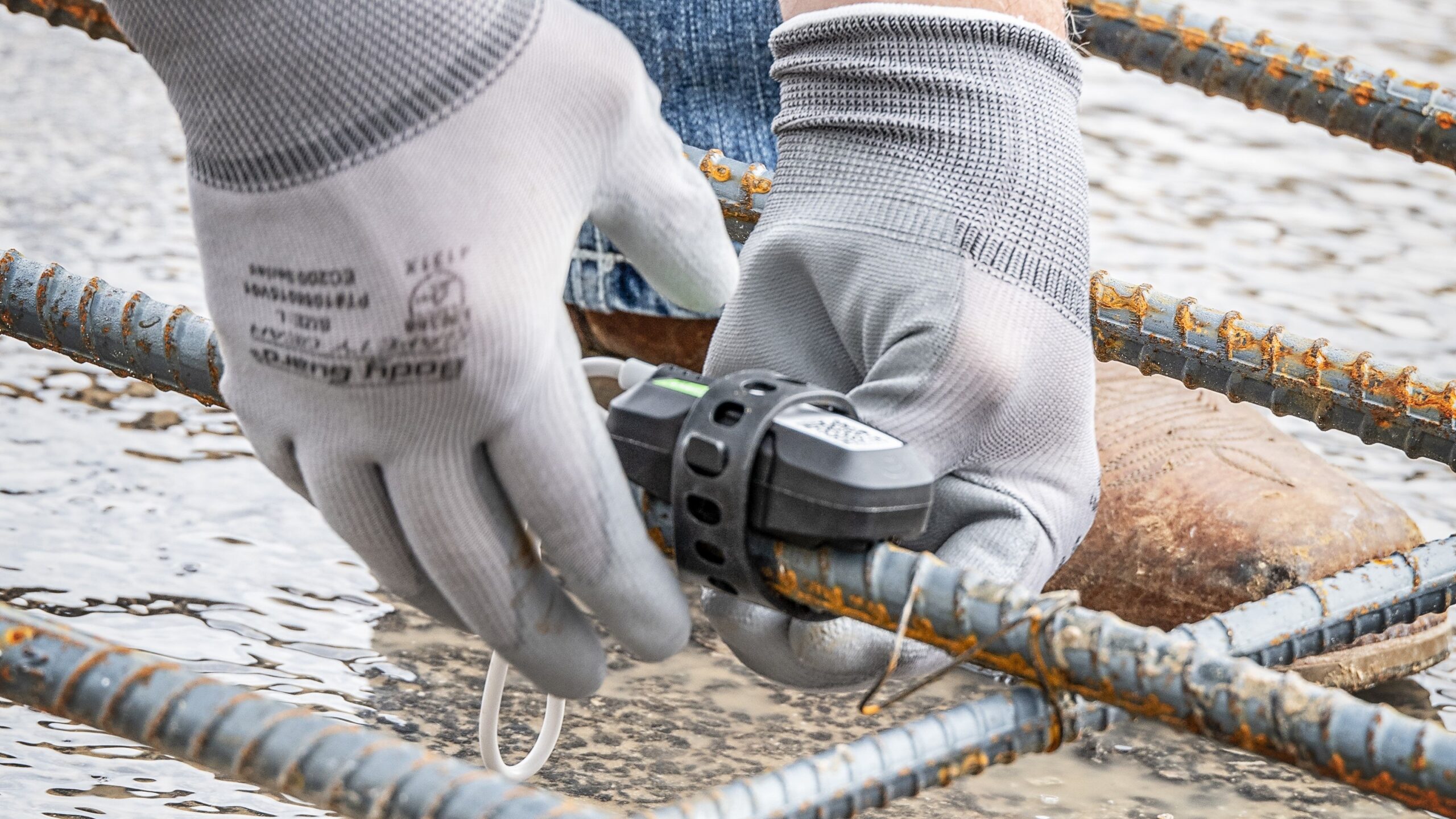
Maturity monitoring, a non-destructive way to estimate the compressive strength of in-place concrete, uses digital sensors to capture inputs such as time and temperature in order to monitor strength in real-time, saving the design and construction team time and money. The sensor technology can reduce the frequency of traditional, destructive cylinder break tests as well as provide an extra set of datapoints about what is happening with the in-situ concrete, providing greater certainty regarding project metrics.
The ASTM C1074 standard defines maturity monitoring as “a technique for estimating concrete strength on the basis that different concrete-mixture samples achieve the same strength if they achieve the same index maturity value.” Digital maturity monitoring makes this process easier and more cost-effective. The process relies on mix-calibration data, which determines a maturity-strength relationship for the mix.
Traditional cylinder testing involves having certified personnel cast cylinders from the pour and crush them offsite, measuring the pressure required to break them. In comparison, digital maturity monitoring allows the user to gauge strength development in-situ, accurately and in real time—and can result in validation of strength sooner than is possible with the use of cylinder tests. Cumulatively, the elimination of wait times associated with cylinder break tests can significantly shorten a project’s timeline.
Cylinder break testing can lead to unintended delays and timeline slippage in the earliest phases of a project, when concrete is being placed. One reason is the cost of third-party lab and technician time spent traveling, casting, collecting, delivering, testing and reporting results. Additional labor and financing costs may occur due to project-scheduling disruptions that are attributable to lab-report delays. Digital maturity monitoring and the more accurate jobsite planning it enables can reduce labor costs by up to $10,000 for each floor of a high-rise building.
Digital maturity monitoring can eliminate the environmental costs associated with third-party lab testing—such as transportation-related emissions and multiple rounds of wasted concrete. Additionally, maturity monitoring can reduce the amount of cement used in a concrete mix. This is because concrete mixes are often over-designed, with an excess amount of cement being used as a way to increase strength and avoid low-cylinder breaks. This is especially common on jobs that require high-early-strength concrete mixes. Preventing this addition of cement to a mix is highly beneficial because excessive cement can increase shrinkage, shrinkage cracks, creep potential, thermal cracking, brittleness and water permeance, besides causing a greater environmental footprint and embodied carbon for the project.
Importantly, cylinder samples may not accurately reflect the strength of in-place concrete, since incorrectly prepared, stored or tested cylinders can affect test results. Cylinders are often tested at improper temperatures or tested too early or late in the curing process. Transportation and mishandling of the cylinders can also affect results by causing micro-fractures in the concrete that lead to a misleadingly low-break strength. Testing concrete in place using maturity monitoring with digital sensors is thus more accurate than using a removed sample. Testing in place can also show local variations for different structural locations.
SAFER, FASTER CONSTRUCTION
Whether concrete frame or precast construction, buildings can have their schedules expedited as a result of real-time digital monitoring, which can be done remotely with long-range wireless capability and updated readings in frequent intervals.
“A benefit that has been realized for precast panels has been ensuring minimum strength is achieved before the panels are removed from their casting beds. Achieving minimum strength before demolding is a matter of safety, and it can also be a matter of convenience, since sensor data from casting beds is typically sent via Bluetooth to a data-gathering hub. Having a hub, rather than relying on mobile phone applications, can be helpful for modular facilities,” says Steve Lemay from Heidelberg Materials Southeast Concrete.
Another benefit of digital maturity testing is the ability to watch the behavior of concrete in different seasons of the year.
“In the winter, digital testing will allow a team to determine whether they need to add hot water or non-chloride accelerators to speed the concrete set and, conversely, in the summer the data will allow them to decide whether to add chilled water or retarders,” says Lemay.
General contractors Brasfield & Gorrie used maturity sensors to determine early concrete strength and accelerate the construction schedule for an elevated beam and slab building. Shoring elements that were causing congestion on the jobsite were removed sooner than would have otherwise been possible, allowing construction to proceed at a faster pace from one floor level to the next. Safety was also improved on this project, since strengths were always guaranteed to be within the engineers’ parameters.
Carter Concrete Structures used digital maturity testing for both an Army Corps. of Engineers mass concrete project and a post-tensioned concrete project.
For their multi-story, post-tensioned concrete structure, the company used maturity sensors to get real time data on early strength (at 48 and 72 hours). The sensors indicated when minimum strength requirements had been achieved, allowing the team to proceed with cable tensioning. Having the real-time data enhanced safety and accelerated the schedule of the project.
“We often find that testing concrete in-situ using the maturity method keeps projects on track and often will accelerate timelines. This is due to the fact that strength readings are readily accessible, and monitoring the behaviors of the actual concrete elements improves accuracy over traditional cylinder testing methods,” said Jason D’Angelo, a manager at Giatec Scientific Inc.
For mass concrete, assessing temperature differentials is particularly important. This is because of the large temperature difference that can occur between the relatively hot internal temperature of the concrete volume and the cooler temperature of its surface. When the temperature differential is too great, cracking can occur. With maturity sensors installed on rebar at a depth of 10 feet inside the concrete placement for the Carter Concrete Structures’ Army Corps. project, both internal and surface temperatures of the concrete were monitored simultaneously.
CASE STUDY
Contractors for a multifamily building in Edmonton, Canada, requiring a mass concrete pour made maturity sensors part of their thermal control plan. The project used one sensor at the concrete’s core and another sensor to gauge ambient temperature. Having access to real-time data from the maturity monitors influenced the team to change the concrete mix design to be high-early-strength less than a week prior to the pour, with lower heat of hydration.
“Verifying the in-situ strength of concrete at the crane base was particularly valuable for this project,” said Chris Herbert, a technical services supervisor at Heidelberg Materials Northwest Concrete. “Because the team was able to confirm that the concrete in the base had reached its strength within three days of the pour, they erected the crane at that time, which was sooner than they otherwise would have.”
Another project in the Edmonton region, which involved construction of a concrete tower, used digital maturity monitoring to allay concerns about freezing in winter conditions. Using in-situ temperature readings, the team was able to quickly mitigate potential damage from the drop in ambient temperature and avoid the use of costly destructive testing.
When designers and construction managers have insight into the real-time condition of concrete, mix-design experts have the opportunity to adjust factors that will influence the concrete’s long-term performance. They are able to optimize the concrete further regarding carbon footprint, the economy and overall performance. Maturity monitoring has the potential to help projects stay on schedule and within budget and even to enable concrete mixture selection based on improved sustainability.