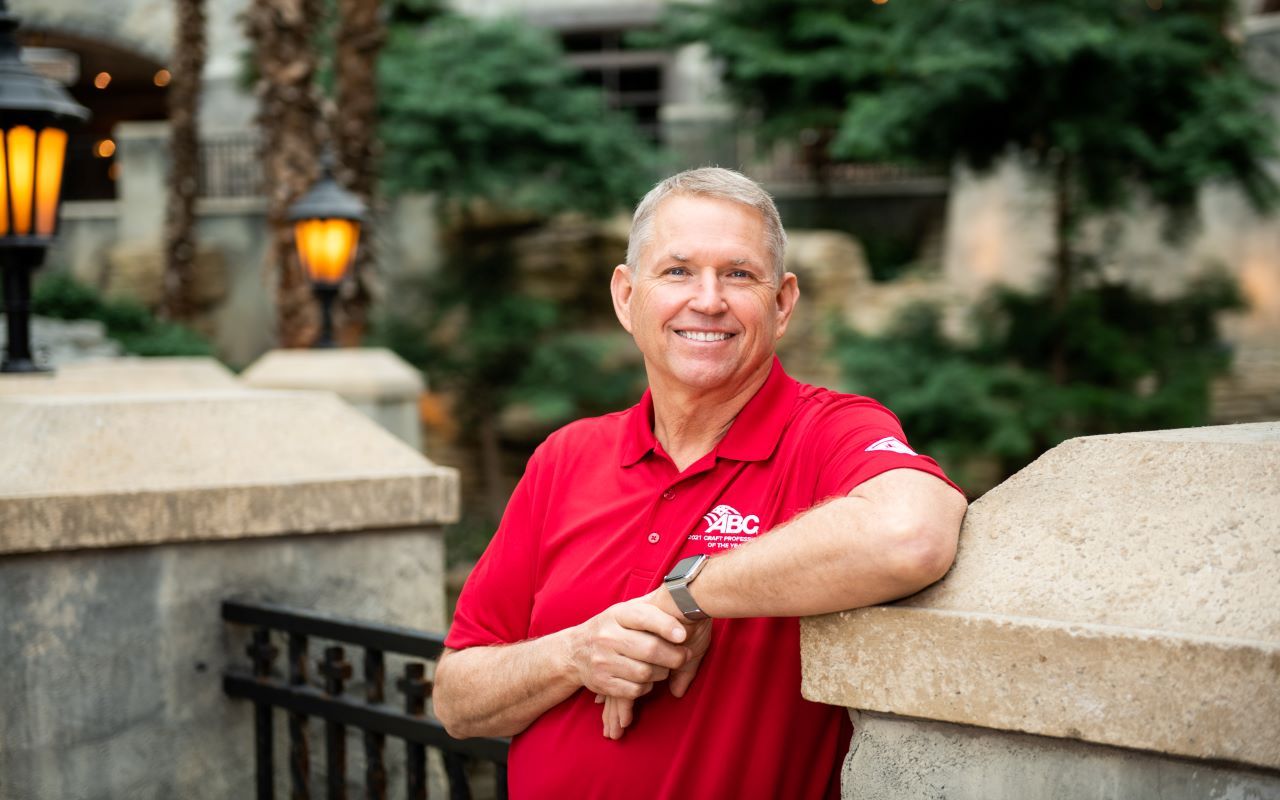
Pat Willburn was selected as ABC’s 2021 Craft Professional of the Year not just for his experience and educational background alone. This accolade has a lot more to do with his dedication to the merit shop spirit, his insistence on mentorship and his mantra that motivation is equal to success.
As one of the oldest employees at DynaTen Corp. (div. Comfort Systems USA), Willburn has been with the company for 33 years. He started as a plumber, worked his way up to senior project superintendent and has supervised projects such as the Bass Performance Hall in downtown Fort Worth, Texas, and the George Bush Presidential Library in Dallas.
With an associate’s degree in business, Willburn also has the education to back up his experience. He carries a journeyman plumbing license from the state of Texas, a med gas endorsement, as well as OSHA COSHO, OSHA 500 and OSHA 501 certifications. He knows the business so well, in fact, that he serves as instructor for continuing education and CPVC.
FLYING THE MERIT SHOP FLAG
When Willburn started in the trades, he was making just an hour. Now, having made more than he might have dreamed, “I still strive for the company to become more profitable,” Willburn says. “The merit shop allows me to push myself to better myself—which opens doors of opportunity. The relationships that I have developed over 20 years have become valuable to the company, which adds value to me.”
Willburn says his passion for the construction industry is not only based on this circle of benefit, it is also based on an involved trust. As an example, he says, “I had to call our president and tell him I had committed to $300,000 worth of work, and it had to be done in 10 days. He just said to me, ‘Can we do it?’ And I said ‘Yes.’ After I went through it with him, he told me to go with it.”
In other construction workplaces, those opportunities simply don’t exist, says Willburn. “When you look at the merit shop, it means I’m out working in the ditch with the lowest-paid person on the jobsite. And then I go into a meeting and am working with the highest-paid people who go onto that particular jobsite.”
This crossing of boundaries and ability to create his own destiny, rather than being limited to just a desk job or just a field position or just working at-height for the duration of his career, is what truly excites Willburn. “That’s what makes it challenging,” he says.
One of his personal missions is to pass on his love of the industry to future generations. As an instructor and mentor, Willburn has the ability to influence those just choosing construction as a career—and Willburn is well aware of the stakes involved. “I take the time to help my mentees see that if they aren’t satisfied with their current situation, there are other directions they can go.”
For example, one worker, while not well-suited to the role in which he worked, still worked hard and tried to succeed—so when a technology position opened up, Willburn recommended him. The young man is now BIM manager at Willburn’s company.
CIRCLE OF MENTORSHIP
Inextricable from the merit shop philosophy are mentorship and volunteerism—ideas that exist as primary objectives for inveterate tradespeople like Willburn. Besides the trade council board, Willburn has developed classes for the school and volunteered to mentor both up-and-coming employees, as well as supervisors and foremen at DynaTen. “It’s really a never-ending curriculum,” Willburn says.
Wilburn is proud, in particular, of a program known as “Lessons in Leadership” (developed by ComfortSystems USA), which he chose to execute after seeing a need. “Once every two weeks as a job progresses, I meet with the supervisors and foremen to see what will make them better managers and how they can use that to advance themselves as well.”
This initiative is personal to Willburn, who knows what it’s like to be both the younger man—and now the older man—on campus. “I’m 61-years-old,” he says. “For me to relate to a 20-year-old is not the same. That program helped those tradespeople to see how to relate to, learn about and motivate those younger individuals.”
If done correctly, this process becomes rather circular, says Willburn. “I’m trying to help them to become better mentors themselves because there’s such a huge need in the industry. If we don’t start training these young people, we’re going to have to select which buildings get built. We won’t have the people to build them.”
A positive working culture and an atmosphere of mentorship—that fosters growth based on merit—is the way to ensure the future of the industry, according to Willburn. His belief in this system comes not only from his own experience in construction, but from numerous positive relationships with his mentees.
“Everybody wants to be treated with respect. Then, as you do that, you have to mentor them so that they see a place to improve toward. And you have to have a positive attitude,” Willburn says. Workforce development efforts must be seen through a lens toward the future. “If I can build the people up underneath me, if I can make them better, my job gets easier,” Willburn says.
MOTIVATING FACTOR
Of course, a person cannot take advantage of connections and opportunities or forge ahead in a career or even muster a positive attitude without the kind of extraordinary motivation conjured by Pat Willburn during every moment of his construction career. It’s a quality that comes to him as naturally as breathing—and it’s one he thinks all craft professionals should possess.
“You have got to stay motivated to want to do better,” he says. “If you’re motivated and you want to succeed and you want to grow—and you’re honest about everything—I think you can go as far as you want.”
Motivation, for Willburn, should not only pertain to career ambitions. It relates to the soul. “I don’t measure success as money. I would measure success as, what do you enjoy doing? You can have a job you hate and make more money. But do you have satisfaction in what you’re doing? Are you making a difference? Are you helping other people?”
If nothing else, Willburn says he is “motivated, creative and positive.” Those three traits means that “There’s nothing I can’t do,” he says.
‘I DID THAT’
A man always looking ahead and on the move, Willburn already has his next project in the works—and it’s a doozy. With no intention to retire anytime soon (he was asked a couple of years ago if retirement was on the horizon; Willburn said he would make that call “when it’s no longer any fun”), the veteran craftsman has agreed to move temporarily to Austin, where DynaTen will be branching into some larger projects.
The reward of his extensive career is both physical and metaphorical. “As with any craftsperson, you can always point at a building and say, ‘I did that,’” Willburn says. But beyond being able to walk up and display a landmark, he says his legacy is “developing the people and watching them grow. It gives me a lot of satisfaction to take people and see them find their place in the industry. They just have to be willing to work hard enough to achieve it.”