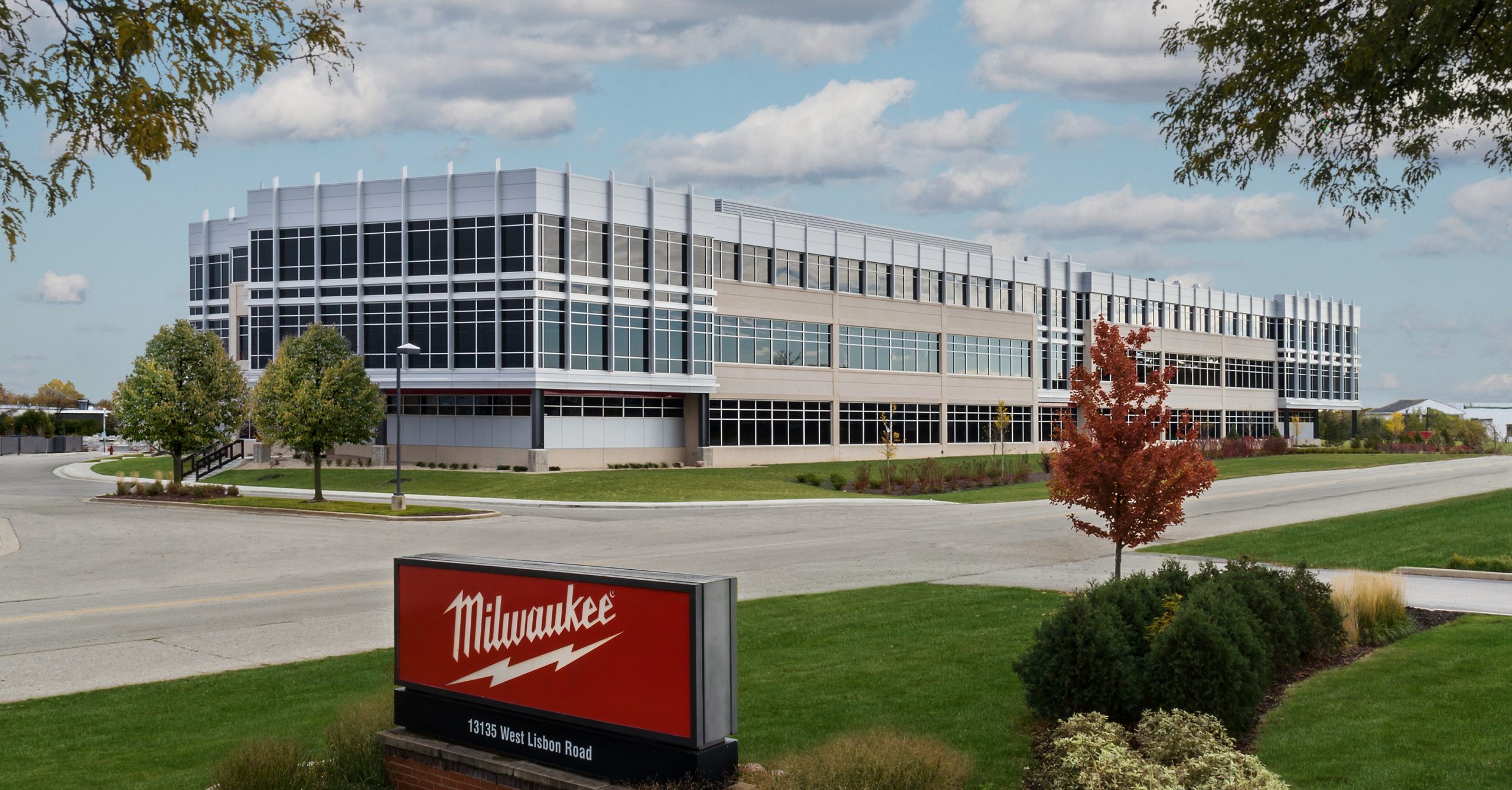
Some companies have found a way to stand the test of time—and that is to evolve with the times. Founded in 1924, the power tool company Milwaukee Tool burst onto the scene with cutting-edge motor technology. The very first product can still be seen on the eras wall at their headquarters in Milwaukee, Wisconsin. Since that original invention, the company has developed hundreds of new products and improved iterations of those products, honing its research, development, design, manufacturing and marketing processes down to a science.
With a history dating back more than 100 years, Milwaukee Tool has time and again disrupted industry standards, and that is the theme for Milwaukee PIPELINE 2026: Disruptive Innovation. This year, Construction Executive was invited to the high-powered showcase to tour the headquarters for a behind-the-scenes look at their creative and engineering processes, test out some brand new inventions, gauge the culture curated by the company and hear the feedback from users in real time.
Unlike the typical trade show, Milwaukee makes it a point of inviting a curated list of attendees to PIPELINE: reporters, editors, influencers, podcasters and other members of the media from across the construction industry.
For one day only, these attendees get hands-on opportunities with Milwaukee’s newly released and still-embargoed products, and Milwaukee gets direct, immediate and invaluable feedback.
Some of that feedback sounded like awe at the power behind the new battery design, or praise for the auto-stop safety tech and heated shirt-jackets; other feedback sounded like ideas for even further product improvement. Some attendees were looking for specific products for their clients or companies; others were eager to speak with Milwaukee professionals, from company presidents all the way down to new employees.
Milwaukee then takes that feedback and instantly begins to process, synthesize and redesign. Thanks to its scientific model of in-house manufacturing (for the last 10 years, Milwaukee has been building its own machines to manufacture their tools), it can do that with remarkable speed–sometimes turning products around within 24 hours from receipt of user feedback.
Bradley Herzog, a product manager in Milwaukee’s outdoor power company, says, “We don’t launch a product if we don’t fully believe in it.” Yet, there is no such thing as perfection—which is why PIPELINE is just as valuable to the company as it is to the attendees. But how does Milwaukee know a product is ready for launch? Herzog says, “It’s a very intense process from start to finish.” This process includes a lot of prototyping and internal testing, real-life-scenario and stress testing, during which Herzog says they “really try to beat the heck out of the products.”
Virtual reality has even made its way into the fold from initial design to final inspection. From there, functional prototypes make their way onto the jobsite, where users might find areas for improvement in things like the weight, grip, balance or power of a tool. Then, Herzog and his team take that insight back to the engineers for tinkering and retesting. “Throughout that process,” he says, “dozens of prototypes go out into the field with dozens of users across the country. Once we’ve incorporated all that feedback plus done all the internal rigorous testing, we can very confidently say that we believe in the product.”
Those quality standards don’t just apply to Milwaukee’s product creation, but to its overall company culture—one which emanates from every single Milwaukee employee. Group President Shane Moll says, “Culture’s really important to us—everybody’s very passionate about what they do and hopefully you see that shine through our work.”
While that culture is carefully cultivated within the company, it is fair to say that it is also a reflection of the skilled trade workers the company serves. Moll says, “We are constantly trying to catch up to what the trades are seeing every day. We have thousands of people in the field every day talking to workers on jobsites. But the reality is we can’t replicate what those workers see and do every day, so we’re constantly keeping pace with them.”
SEE ALSO: THE EVOLUTION OF CONSTRUCTION JOBSITE SAFETY: LESSONS FROM THE FIELD