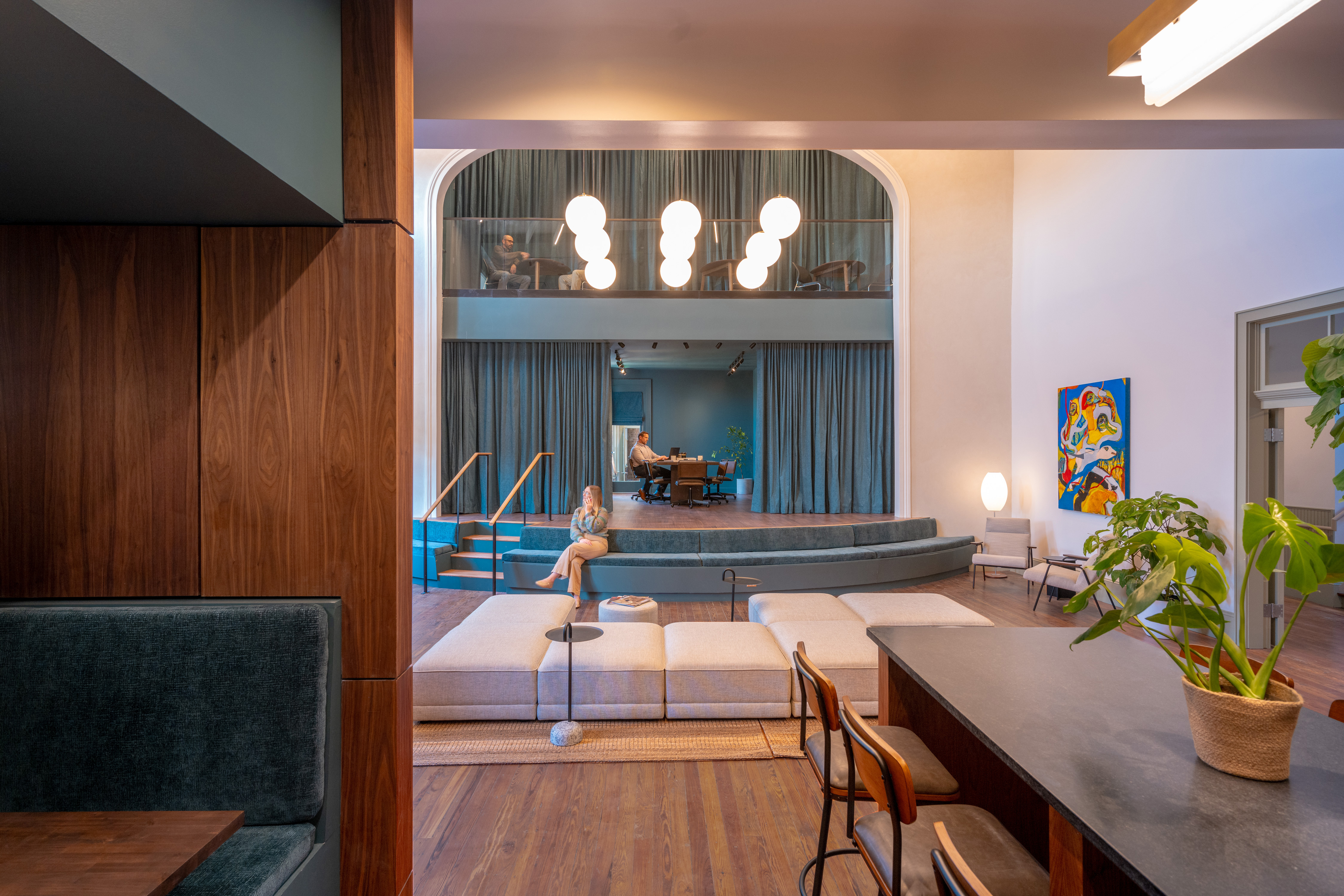
Residents of Gretna, Louisiana, have new reasons to get excited about an old space: a 100-year-old schoolhouse that’s been revitalized for use as Primary Workspace, a coworking and event space that launched in February. Across from uptown New Orleans on the Mississippi River, the building opened in 1911 as a school, and current historic guidelines required the workspace’s developer, New Orleans-based Formwork Development, to preserve a two-story, second-floor auditorium. That requirement led to some definite architectural oomph. With its majestic arch and mix of modern flourishes and historic grandeur, the auditorium is the centerpiece of the 20,000-square-foot buildout that includes offices, conference rooms and hot desks (desks used by different people at different times).
The six-month project had its challenges. The Italian Revival building was vacant for more than 50 years. When its school days ended in 1945, it was used by the Parish Welfare Department, the Red Cross and then the Jefferson Parish School Board. After that? Desolation. And yet despite decades of emptiness, the space was not in total disrepair.
“I actually didn’t realize until recently that it had been vacant for 50 years,” says Brett Perrier, principal of Perrier Esquerré Contractors, which handled the renovations. “The exterior was in pretty good shape. The parish did a good job with upkeeping the exterior facade and the roof.”
The project was initiated through a public-private partnership between the nonprofit Jefferson Facilities Inc., an economic development corporation, and Formwork Development. The $3.5-million renovation was funded with $2.7 million from the City of Gretna (using money from the American Rescue Plan Act, signed by President Biden in 2021) and $800,000 in Louisiana state historic tax credits.
Perrier was engaged by the developer during the design process, about eight months before the start of the project.
“Thankfully, the client got us on early enough where we could do multiple inspections,” says Perrier. “We could bring our trades in there pre-contract, refine the scope, find the problems, offer solutions to designers, abide by the historical tax credit requirements and keep the budget at the same time.”
Among the challenges: Some of the wood floors were rotted and infested with termites. Crews had to determine which portions were salvageable and which they could afford to replace and refinish. The floors then had to be aligned. Workers also identified water leaks from the envelope of the building which had caused certain structural joists to mold and deteriorate. Another issue: Many of the walls were built with old barge board, a common building material in the New Orleans area. Barge board is wood taken from ships such as flat boards or barges, which carried cargo down the Mississippi River.
“It’s not dimensional lumber. You really can’t find the same size these days,” says Perrier. “If you have a new wall butting up to an existing wall, that existing wall is going to be wider, because they’re all different. The old wall will be plumb, but then putting in the new wall—whether it’s a two-by-four wall or two-by-six—you’ll have to fur out that old wall to match the plane.”
The building’s double-hung windows are a key feature, providing sunlight in large corridors, which lead to sleek spaces such as private offices and meeting rooms. Workers restored most of the windows in the field and fabricated a custom aluminum sill pan to put under every window, while also glazing, sanding and painting.
“You have to do that every three years anyway for a wood window, and these had been sitting there for 50 years,” Perrier says.
Portions of the plaster arch required renovation—“It was stick framed, so we just matched the profile and matched the radius, and made sure to support the frame correctly,” he says—but the toughest task involved the nearly 60 doors, which had to meet historic guidelines.
“To get the budget to align with the doors, and then fabricate them locally, that was a challenge,” Perrier says. “We had a custom mill workshop until we realized we had to match the historical styles and profiles of the buildings. After that, we had to go to a larger fabricator for quantities.”
The resulting building is impressive. Primary Workspace’s second-floor entrance, which leads to the auditorium, features classic black-and-white checkered tile and a grand split staircase. Private booths are tucked under a mezzanine. Some of the meeting rooms showcase the building’s original brick walls. The auditorium itself remains the elegant, eye-catching jewel, serving as a center of activity and a unique event space.
“You can tell there’s history behind it,” Perrier says. “When you walk in there, you can tell it wasn’t a design-intentional space. It was, ‘Okay, we have a space we have to keep. What are we going to do with it?’ The overhanging mezzanine with glass handrails—you’re not expecting to see a stage in the workspace. That’s the wow factor.” As Formwork’s founder and principal, David Hecht, puts it, “Primary Workspace brings new life to a beautiful, historic building.”