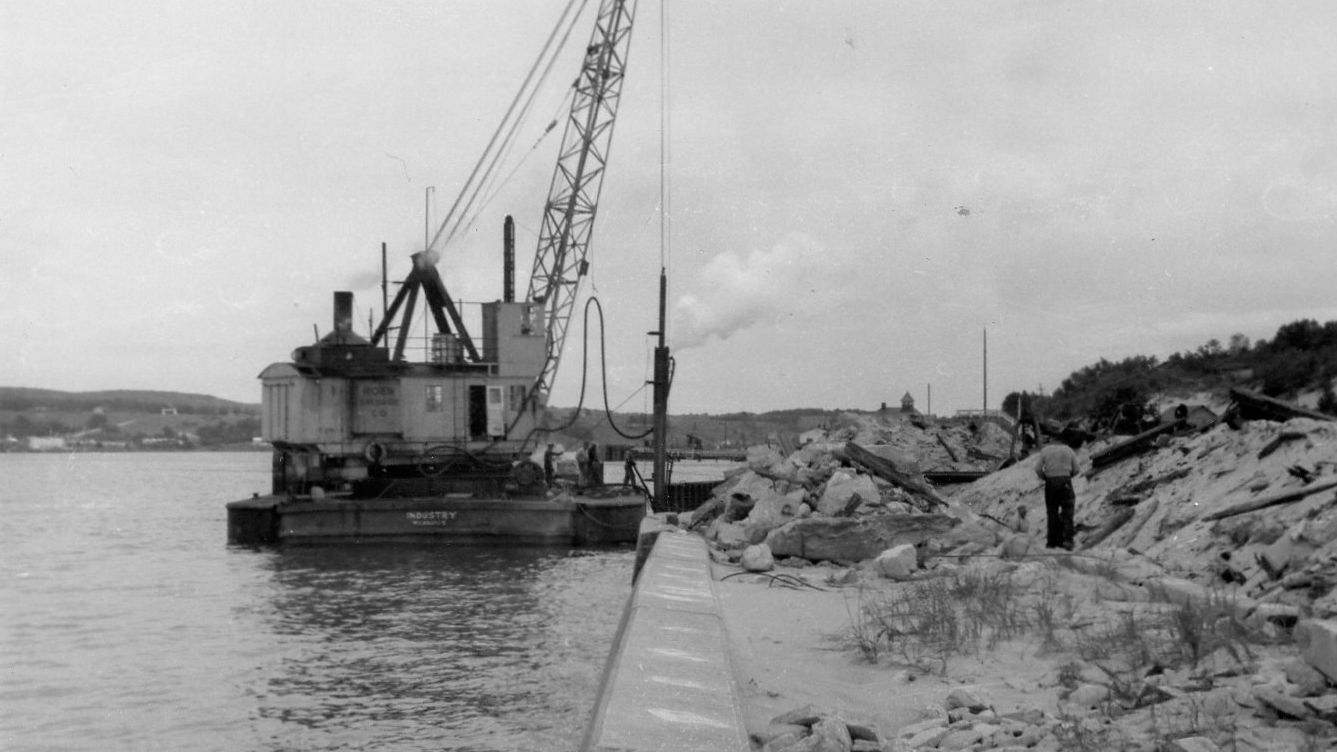
Roen Salvage Co. began operation shortly after Capt. John Roen raised the 600-foot freighter George M. Humphrey from where it had sunk in the Straits of Mackinac—connecting Lake Michigan and Lake Huron—in 1944. With no other salvage company willing to take on the challenge, this success put Roen in high demand in his field. In 1949, he joined his daughter Hilda Roen Asher and her husband, Charles W. Asher, in officially founding Roen Salvage.
Today, the Sturgeon Bay, Wisconsin–based dredging and marine construction company is led by Charles’ son John Roen Asher as CEO, with John’s stepson David Schanock serving as president. Roen Salvage operates on and around the Great Lakes, from Duluth, Minnesota, to Toledo, Ohio, completing projects for the U.S. Army Corps of Engineers, the Coast Guard, various state and municipal departments as well as private companies. While many aspects of the construction industry have changed with time, the basic principles upon which the company was founded have not: tenacity, hard work and integrity, which Asher and Schanock say combine with Roen Salvage’s inherent family values to create success and organic growth.
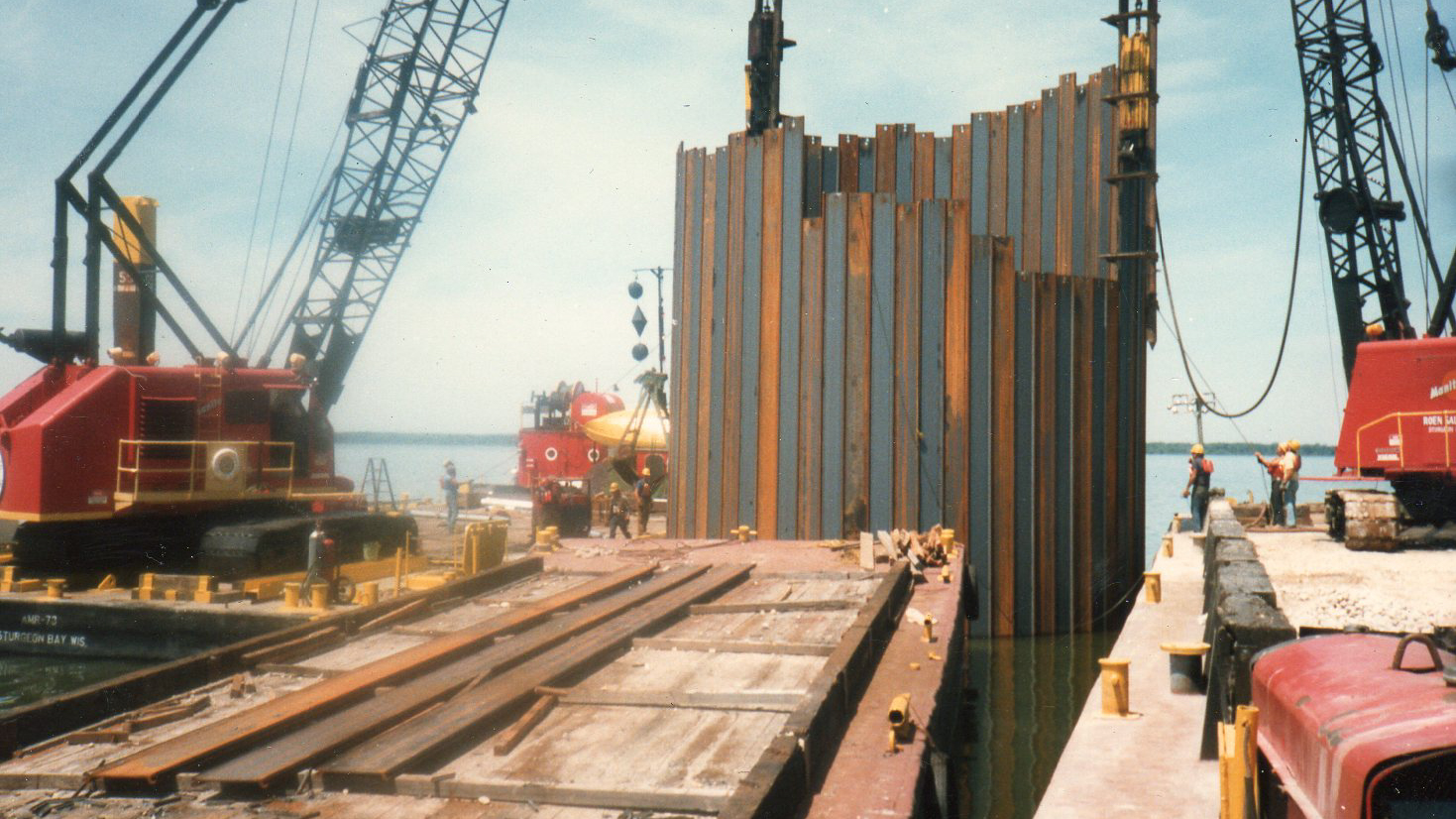
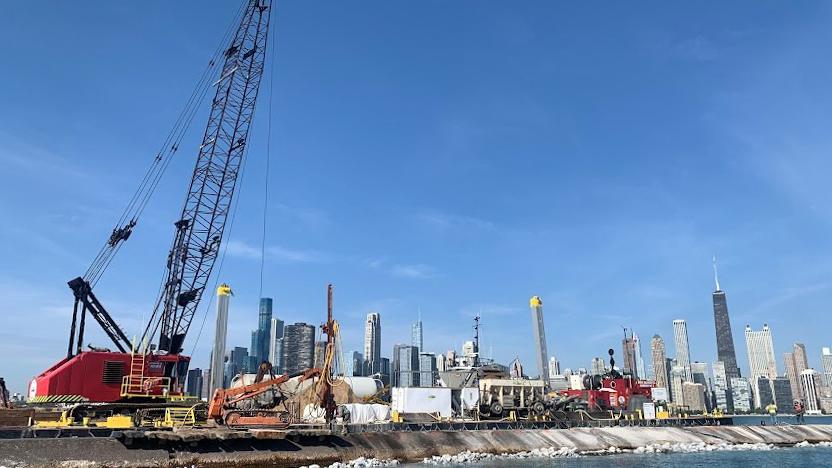
“Projects have come along that required more equipment than we had, so, over time, we increased capacity to take on more work,” Schanock says. “May 25 was the 75th anniversary of the company. So, the equipment has slowly grown from a small barge, a small tug and a crane to six tugboats and 13 barges—five of which are crane/spud barges.”

ATLANTIS IN THE 21ST CENTURY
With so many moving parts, what exactly do the operations of a dredging and marine construction company entail from day to day? Roen’s work includes projects such as navigational dredging, building stone or sheet-pile breakwaters in harbors or sheet-pile docks, incorporating corrosion protection for existing sheet-pile construction, habitat restoration and environmental remediation.
“Basically,” Asher says, “everything under the gamut for marine construction and dredging.”
Roen’s growth—in size and reputation—has coincided with technological advancements across the construction industry. The marine sector is no exception. While Asher and Schanock note that AI and other of-the-moment solutions haven’t significantly impacted their business just yet, they’re not saying they won’t someday. Still, marine construction “involves a little bit different of a configuration than working on land,” Schanock says. “In some regard, there’ve been some changes in technology.
“Say we’re on a dredging project. Years and years ago, we used to go out with a piece of rope with a rock on the end of it, and you’d let that down in the water to find out the different depths that you were dredging to. Today, that’s all automated. We have special depth recorders that can show a pebble on the bottom of the lake or the channel that we’re dredging. So, that’s changed quite a bit.”
The company also employs crane technology that shows exactly where into the depths of the water they’re digging. “In the past,” Schanock says, “you were putting the bucket down and then moving over a little bit and putting it back down, hoping you were hitting the right spot. Now we know the exact spot that we’re hitting with GPS technology.”
While technology evolves, something that hasn’t changed much is Roen’s approach to winning bids, which is based on the company knowing its strengths—and playing to them. With the vast majority of work being completed for the Corps of Engineers—“with private work sprinkled in,” according to Schanock—Roen’s bidding process involves various strategies. When considering whether their company would be the best fit for a project, Asher, Schanock and their team consider many factors, from how to perform the work involved to which skilled laborers will be needed, what equipment is required as well as the location and any environmental variables.
“Since we’ve been in business for 75 years,” Schanock says, “we’ve done a lot of different types of projects and have an idea of how most of the jobs will get done, at what pace and what is needed along the way. But every job is different.”

CONSTANTS AND VARIABLE
Despite the variability of project types that Roen Salvage takes on, there is one constant when working in marine construction: Mother Nature. On top of location, equipment, workforce and other general considerations, the company must also take into account how each project might be affected by weather. Schanock makes sure to ask: “Are we working within a protected harbor or are we working 5 miles offshore? Which lake are we working in? Because you have different types of weather for different lakes or different times in the season that you’re going to get affected differently.”
Obviously, dredging is different from marine construction in that it involves removing things rather than building them. But, despite the differences, the two fields do share some similarities (beyond both taking place in or on water). Asher notes that Roen uses a crane and a barge on almost every single job, most of which run for 24 hours, with two 12-hour shifts of six to seven workers per shift. Certain aspects of a project may be subcontracted out, such as electrical work, but when it can, the company uses its own workforce.
These are the elements within Roen’s control. More unpredictable—and perhaps more consequential—variables include working around other vessels (whether commercial or recreational), marine life, potentially hazardous materials and more. Once again, this is where technology and 75 years of expertise come in handy.
“The navigation systems on our tugboats and all the other vessels that are operating within the Great Lake waterways are good,” Schanock says. “You know where the boats are located, you know where they’re going.” The company also uses marine radios to communicate through the navigational channel. “It’s all about communicating to make sure that you’re not impeding on the direction that other boat traffic is going, the motions that they’ll be making along the way when they’re crossing paths.”
Other potential areas of concern are preemptively addressed in the contract. When performing marine construction or dredging, for example, it’s often—if not always—a requirement to create an environmental plan, so the project doesn’t disturb any natural marine habitat. Most of Roen Salvage’s work takes place specifically on Lakes Michigan, Superior and Huron, where the routine is relatively smooth. But on occasion, the company ventures into other waters.
“We have gone down as far as the Mississippi River,” Asher says. “We did some work in 1993 rebuilding dikes that were blown out from flooding. So, there are some different regulations and navigation when you get into the river system.”
BEHIND THE BUBBLE CURTAIN
Given Roen Salvage’s decades of experience of navigating not only the waters of the Great Lakes but the logistical and contractual obstacles that have come along with that, the company has overcome its fair share of adversity. But Schanock recalls one particularly challenging project.
“The most complicated was a couple years ago,” he says. “It had entailed underwater blasting of rock in Marinette, Wisconsin, and it was for Fincantieri Marine, the shipyard there where they build naval vessels [on the Menominee River, which empties into Lake Michigan]. They were developing a boat lift and launch, and they needed to remove an exorbitant amount of bedrock in the channel that was along their dock wall. Well, you can’t dig that with a crane bucket or even with an excavator. So, it needed to be underwater-blasted with explosives and then removed with a long-reach excavator.”
Roen had done that type of work before, but this project was on a very active river, busy with traffic from pleasure boaters and fishing vessels; Roen’s own patrol boats used sirens and megaphones to cordon off the jobsite. The project was also complicated in terms of technology, requiring vibration monitors on land and throughout the shipyard to monitor the intensity of the underwater blasts.
“Some of these blasts were as close as a hundred feet from a 400-foot newly constructed naval vessel sitting on a dock in a cradle,” Schanock says. “So, it was a little nerve-wracking that, if you created just a little bit more of a vibration, you could shake a boat off of its cradle. But that didn’t happen.”
The project also necessitated creating a perimeter around the site using an underwater tube system known as a bubble curtain, which is essentially what it sounds like: hundreds of feet of bubbles shooting up from the bottom of the river to the surface of the water. The bubble curtain helped keep fish away from the construction site while also stifling some of the pressure from the blasting.
“So,” Schanock says, “all of that encompassed together on a project—even though we’ve done each of those components on other jobs—all of it, along with where it was located, made it the most difficult.”
REUSE. RECYCLE. RESTORE.
Two more questions for Roen Salvage: Where does all the refuse go when a dredging project is complete? And, where does the company source its construction materials?
Whether for the Corps of Engineers, another government agency or private projects, Roen always aims to source domestically—and is helped in this mission by having been in business for three-quarters of a century, during which it has created some lasting relationships with vendors. When disposing of materials, Roen operates as carefully and thoughtfully as it does underwater, sometimes offloading them into a confined disposal facility—oftentimes operated by the Corps—other times transporting unusable materials to a landfill, or reusing or repurposing materials for marine habitat restoration.
If variety is the spice of life, then a life dredging the Great Lakes must be incredibly flavorful. But with so many flavor options, how does someone choose their favorite one? Perhaps that’s the best part: There’s always something new to love.
“Every day brings a different challenge,” Schanock says. “And if you’re driven by challenges or by solving problems, I think that is a gratifying component of the job. Every job is a learning experience in some way. Even if it’s something that you’ve done a hundred times, there’s always something a little bit different on every job. And, you know, being in business now 75 years and being fourth-generation, continuing a legacy, is a gratifying and exciting component of the job.”
CEO John Asher adds: “This industry is more of a niche industry, and we’ve grown with it rather than overgrowing within it, because that’s when companies start getting hurt or going out of business. The reason why we’re reaching 75 years of operation is we haven’t gotten over our skis.”