Housing costs have been rising steeply for the past few years, with the country’s largest urban centers taking the brunt of price increases. Accelerating urbanization is putting intense pressure on a housing stock that’s already insufficient, despite the relatively intense pace of new construction.
Since the beginning of this decade, building permits for over 600,000 multifamily units have been issued annually, according to U.S. Census data. But even with that steady output, demand continues to far exceed supply in most major urban centers.
Cities like New York, Los Angeles and San Francisco continue to attract professionals, students, creatives and entrepreneurs, drawn by the promise of economic opportunity, culture and connectivity. Yet, these same cities often price out the very people who make them vibrant. As a result, many are rethinking what urban living should look like and discovering that smaller may actually be better.
COMPACT LIVING WITH AN EXPANSIVE LIFESTYLE
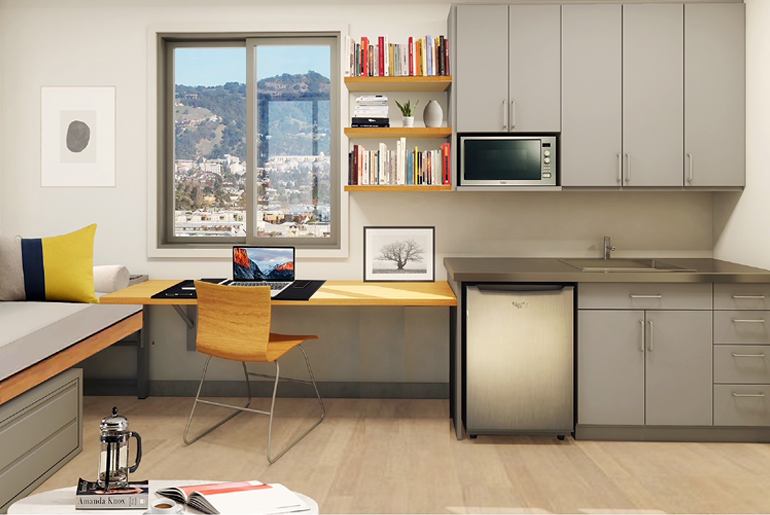
One response to the housing shortage is the rise of micro-housing—compact-living units that typically measure under 415 square feet. While that may sound modest, micro-apartments are often built in amenity-rich environments where shared spaces, like gyms, coworking areas, lounges, rooftops and even communal kitchens enhance the quality of life for residents.
Residents trade square footage for walkability, location and community. And increasingly, cities are embracing this model to make high-demand neighborhoods more accessible to single renters, young professionals and downsizers alike.
Micro-housing isn’t just a short-term fix—it’s also aligned with broader goals for urban sustainability. Smaller homes mean a lighter environmental footprint and lower energy consumption. They also ensure more efficient land use, which is crucial in high-density cities where developable space is scarce and expensive.
In many cities where real estate prices are among the highest in the nation, micro-housing offers a practical way to densify without drastically altering neighborhood character. With thoughtful zoning and design, these units can integrate seamlessly into the existing urban fabric.
MICRO-HOUSING IS MOST POPULAR IN THE WEST
According to a recent story from storage space marketplace StorageCafe, micro-housing is most prevalent in cities with long-standing affordability issues and high population density. Seven out of the top 10 cities with the highest share of micro-housing units are in the West.
San Francisco leads the way, with a substantial 15% of its total rental stock consisting of very small apartments. This is no surprise in a city where housing costs are among the most unaffordable in the country and the tech-driven economy continues to push housing prices up. The city’s interest in compact living is only increasing, with a very consistent 30% of the new rental stock under current construction in San Francisco falling under the same category.
And it’s not just the city of San Francisco that is delving into micro-housing to solve the affordability issue, but the rest of the Bay Area as well. For example, in Berkeley, development company Panoramic Interests is in the process of building CITYSPACE Studios, a project offering compact, 160-square-foot living spaces where residents enjoy shared amenities that foster a sense of community: kitchens, social lounges and private courtyards.
Seattle comes next in terms of local share of micro-housing in its local inventory, with 8.7% of the apartments and homes here qualifying as such. Driven by both housing need and local innovation, the city has embraced compact living as part of its broader approach to urban planning.
Portland follows the same trend, with a 6.7% share, reflecting the Pacific Northwest’s openness to urban experimentation and density.
However, micro-housing isn’t limited to the West. In the Midwest, Minneapolis has taken a progressive stance on zoning reform and housing access. Here, over 10% of rentals are micro-units, a number that reflects both policy support and resident demand for affordable, efficient spaces close to jobs and transit.
Chicago also ranks high, with micro-units making up 7.4% of its rental stock, largely concentrated in trendy, transit-accessible neighborhoods.
On the East Coast, Philadelphia leads the way, with close to 7% of the housing units in the city qualifying as compact living.
New York City, where space has always been at a premium, reports a 6.5% micro-housing share. In sought-after boroughs like Manhattan and Brooklyn, micro-units are helping to ease the strain on housing. Nearby Newark shows similar patterns, with micro-units serving as accessible options for people who love living in the midst of the city but without spending a huge chunk of their paychecks on housing.
MICRO-LIVING IS HERE TO STAY. CONSTRUCTION NUMBERS PROVE IT.
Micro-housing isn’t just part of the existing housing inventory but also an increasingly common component of new developments. In Seattle, a remarkable 66% of the new apartments under construction are micro-units. That’s followed by 56% in Boston, 50% in Newark and 43% in New York City.
These numbers reflect a change in the priorities of both developers and renters. In many cities, particularly those with high land costs, building smaller units is one of the few viable ways to increase housing supply in highly desirable areas quickly and affordably. And for renters, micro-apartments offer a strategic tradeoff: less personal space in exchange for a premium location and amenities-heavy lifestyle.
SELF-STORAGE SUPPORTS THE MICRO-LIVING TREND
Living small doesn’t mean giving up all your belongings. Self-storage serves as a natural extension of the micro lifestyle. Renters may keep seasonal items, sports gear, family heirlooms or business inventory in storage units while keeping their living space streamlined and uncluttered. In cities where micro-housing is expanding, we often see self-storage development closely following, filling a vital lifestyle gap.
Rather than treating self storage as a short-term fix during moves or renovations, micro-housing residents are incorporating storage units into their long-term lifestyle. A small, efficient apartment paired with a nearby storage unit can often meet a resident’s full spatial needs at a fraction of the cost of a larger apartment. Renting a self storage unit in Seattle, for example, a city that’s showing strong interest in compact living, costs around $179 per month, which is a very cost-effective way to supplement a small home without needing to upsize.
Compact living is emerging as a forward-thinking response to some of the biggest challenges facing U.S. cities. As urban populations grow and housing affordability becomes more urgent, micro-housing offers a real, concrete solution. These small-footprint apartments can unlock access to high-opportunity, desirable neighborhoods, reduce environmental impact and create close-knit communities.
SEE ALSO: PLAN OF STEEL: RALEIGH’S NEWEST ADAPTIVE-REUSE PROJECT