A four-legged yellow robot named Spot walks across reddish-brown dirt at the jobsite for HITT Contracting’s new headquarters in Falls Church, Virginia. His narrow frame resembles a greyhound (though one without a head) and his flat back carries cartographic imaging equipment. Spot is providing highly accurate, on-the-ground mapping data while drones provide equally accurate information from above. Together, the robots take hundreds of photos, which workers use to create a 3D model of the site. Among its benefits: HITT can calculate how much material is left to remove onsite and track that against their schedule.
“This is the first HITT jobsite where we’re using both aerial and ground robots on the same site,” says Viktor Orekhov, HITT’s research and development manager and robotics lead. “The pairing of air and ground is going to be especially useful once we’re going vertical, where you have an aerial drone capturing exterior data, you have a ground robot like Spot capturing interior data, and that can all be used in the same platform to track progress that’s happening outside, inside, to get an idea of the full scope of the project.”
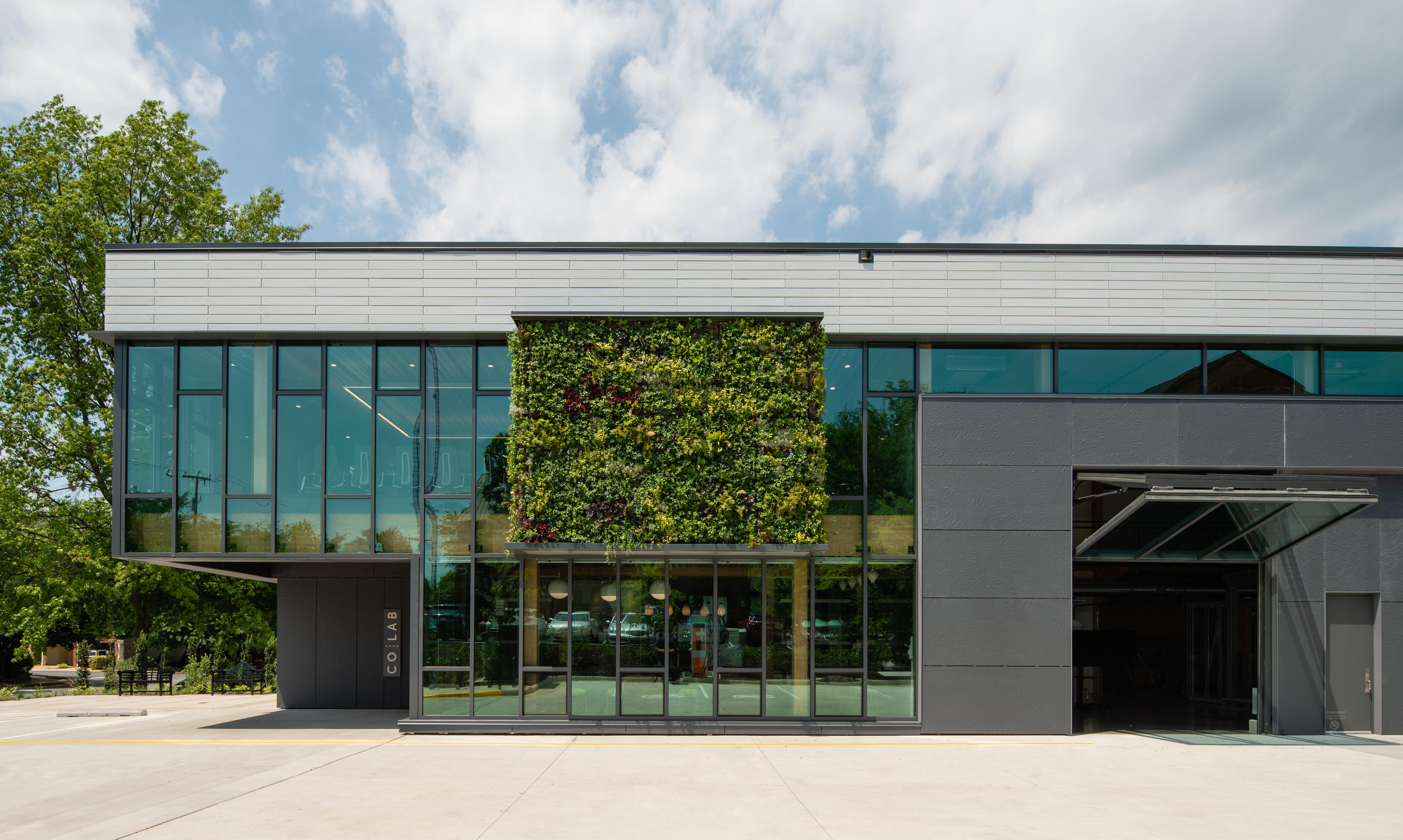
The robots were tested and developed at Co|Lab, HITT’s 8,600-square-foot research and development facility in Falls Church, Virginia. Each day, nine to ten members of the R&D team conduct research not just on robots like Spot, but on vital technologies such as 3D printing, power over ethernet (PoE) and prefabrication techniques. Much of the work focuses on sustainability, from renewable energy to the testing of more durable and efficient building materials. Co|Lab researchers have explored alternatives to drywall and conventional insulation and evaluated a variety of low-carbon, bio-based materials, including engineered bamboo panels, cork insulation, and sustainable interior and exterior products from companies such as Ekoa and Richlite.

“Stepping inside Co|Lab is like entering a space that’s equal parts workshop, think tank and inspiration hub,” says HITT CEO Kim Roy. “For decades, our industry has seen relatively little investment in R&D—less than 1% of revenue compared to much higher benchmarks in sectors like tech and manufacturing.”
Around 2017, Roy says, HITT’s leadership team began asking a question: “What if a general contractor created a dedicated space to explore new ways of building—faster, smarter and more sustainably?” That idea spurred HITT to open Co|Lab in 2019.
“Co|Lab was designed to be more than just a research lab,” says Emma Bracken, research and development associate. “While the R&D team works there daily, it’s also a collaborative hub where ideas are shared, tested and scaled.”
That commitment to sharing ideas runs deep. In 2024, Co|Lab received more than 3,300 visitors, “reflecting our deep commitment to education, transparency and advancing innovation across the AEC industry,” Bracken says. The mission, adds Roy, is “to disrupt the status quo, accelerate progress and push construction toward a more sustainable future.”
Co|Lab has also a fabrication lab, research bays and high-tech mockup spaces where teams test everything from robotics and prefabrication to low-carbon materials. Some of Co|Lab’s most interesting work focuses on 3D printing. The lab has a small 3D printing farm featuring a Caracol Heron robotic arm.
“Our team is learning about recycling opportunities for various materials—namely, after they’ve already been 3D printed—and what it takes to convert them back into re-printable pellets,” says Fernando Arias, director of sustainable construction. One goal is to use recycled plastics to print furniture. “An estimated 10 million tons of office furniture ends up in U.S. landfills every year,” Arias says. “We see an opportunity to change that by shredding, reconstituting and reprinting furniture components that can be reused or redesigned at end of life, ultimately reducing waste diversion to landfills. We’re planning to feature this technology prominently in the design and construction of our new headquarters.”

The new headquarters is like a laboratory for Co|Lab’s sustainability work. The plan is for the 270,000-square-foot, six-story building (groundbreaking occurred in January 2025) to achieve LEED Platinum certification and meet net-zero energy and net-zero carbon goals. To do that, the building will be powered by a 100,000-square-foot photovoltaic solar canopy and wind turbines. Other sustainable features include not only Co|Lab’s 3D-printed, made-from-recycled-materials office furniture, but a PoE system for lighting, electrical power and data.
The building will also debut the company’s patented prefabricated building skin system, branded as HyperWall and manufactured by an affiliate company, Building Composites. It’s a standard wall panel and subframe system, but the panels are designed to be lighter, more sustainable and more cost-effective than traditional systems. The panels are expected to reduce the building envelope’s carbon footprint, reduce waste and lower costs by 15-25% compared to conventional construction methods, Arias says.
The headquarters will also feature a 40,000-square-foot research lab developed in partnership with Virginia Tech’s Coalition for Smart Construction. HITT expects to launch 20 research initiatives at the lab, and as with Co|Lab, the focus will include innovations in sustainability.
“What makes us most proud about the work at Co|Lab is how it embodies sustainability not just in concept, but in practice,” Arias says. “Co|Lab serves as a community hub, promoting knowledge-sharing and collaboration around sustainable design and building practices. It proves that environmentally responsible design can be innovative, functional and inspiring.”
SEE ALSO: Q&A WITH MATT ABELES: CONSTRUCTION ROBOTICS