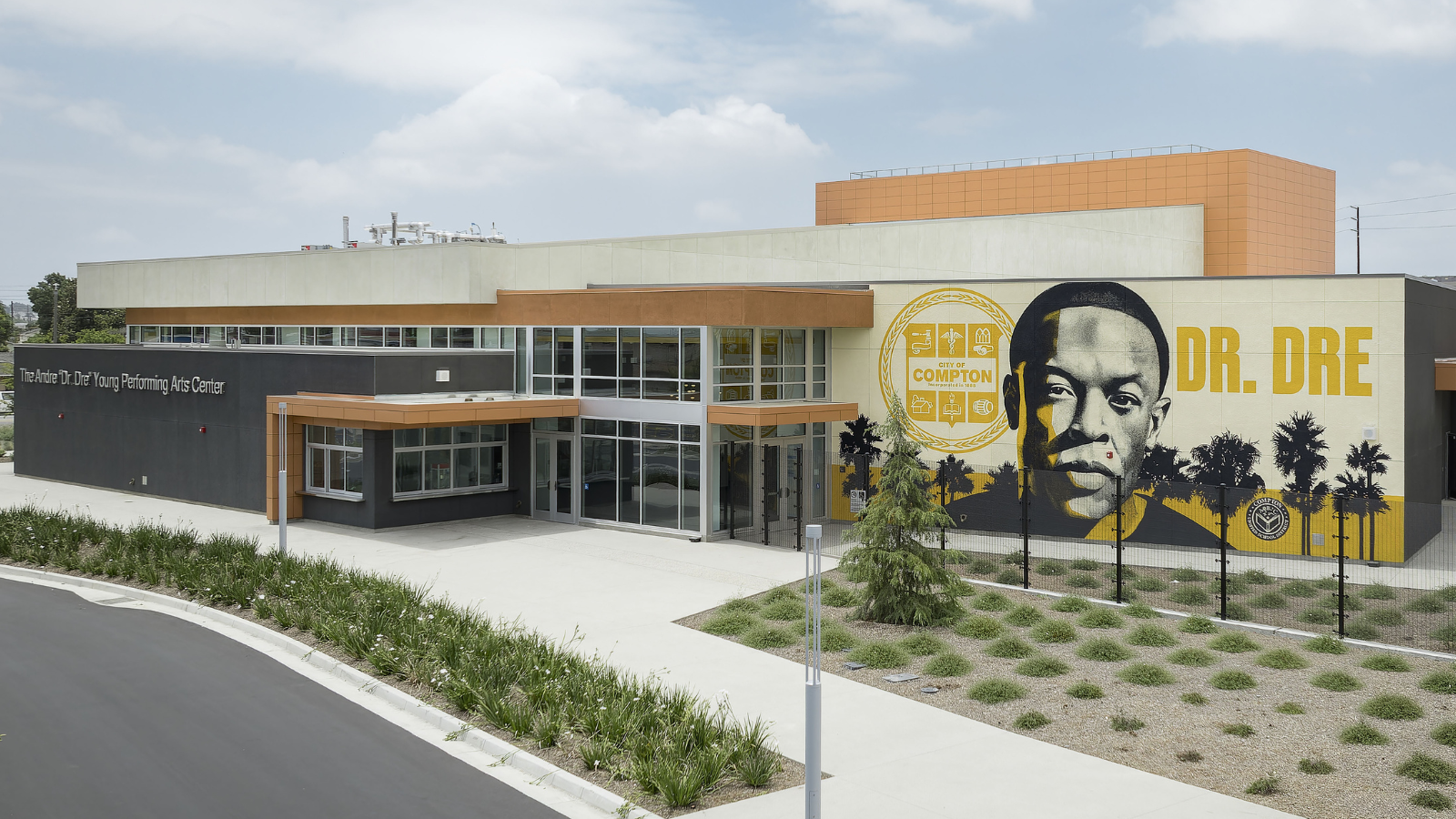
The two-story mural of Andre Young, better known as Dr. Dre, looms large on a wall near the entrance of the newly rebuilt Compton High School. The rapper was born and raised in Compton—one of Los Angeles County’s poorest cities—and he donated $10 million for the California school’s sleek new performing arts center.
“It was not my idea for my head to be as big as that on the side of this building,” he joked at a ribbon-cutting event in May. “[But] this is the type of building that I would have loved to go to when I was a kid growing up.”
The school’s 1,800 students feel that same exhilaration. The $232 million, 31-acre campus—built by Swinerton Builders—opened in August and features state-of-the-art facilities, including a daring digital-only library with no books.
“The unique part of Compton is that we built a full campus,” says Tim Ciciora, Swinerton’s project executive. “It was athletic fields, it was weight rooms, facilities, the performing arts building, academic building, gym, and a half-size Olympic pool.”
Construction began in 2019 with demolition of the original 126-year-old campus. Swinerton started work the following year, using drone flyovers to analyze and document major earthwork activities. The drones helped with everything from monitoring schedule progress to confirming quantities of dirt for import/export calculations.
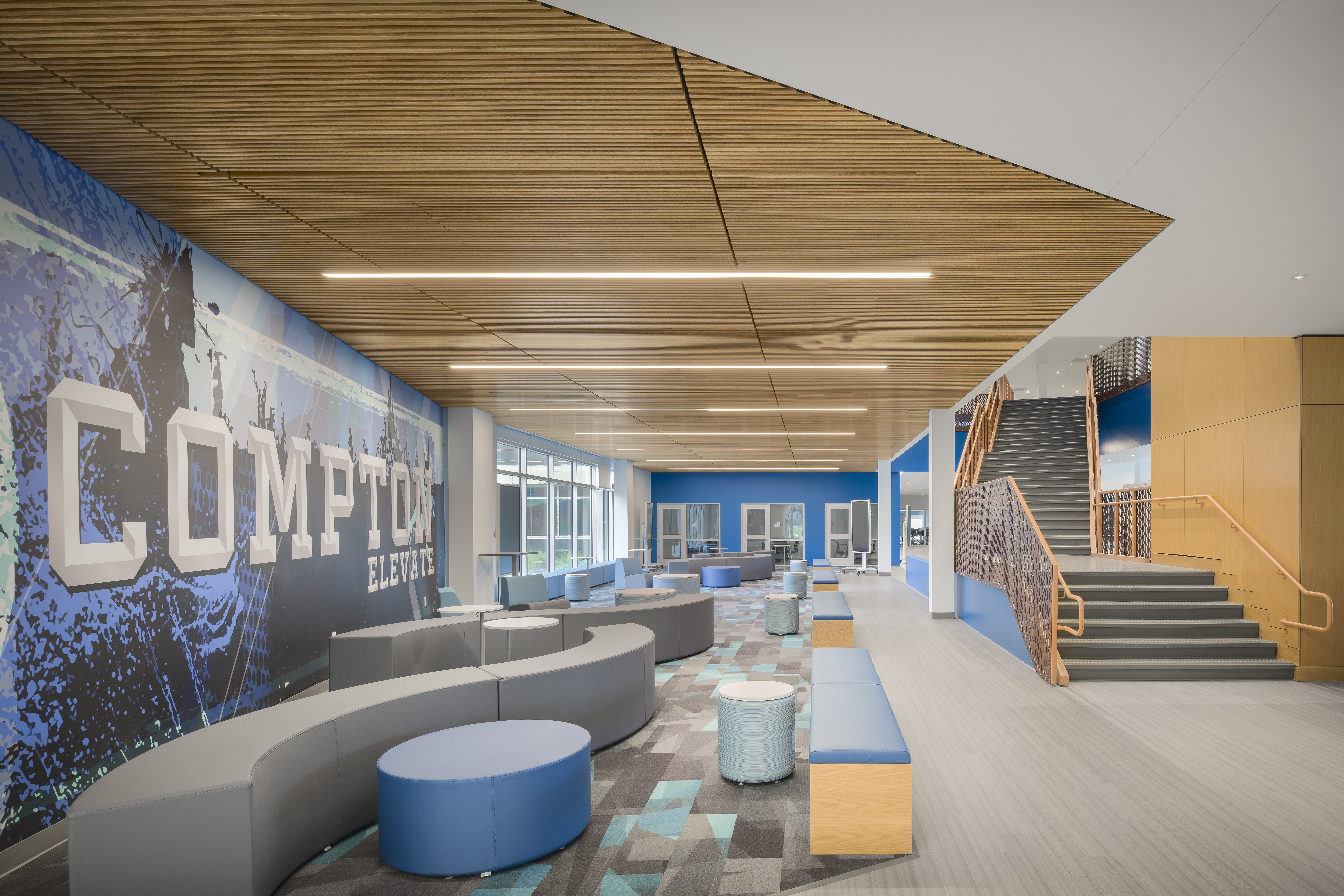
Drone videos served another important function: updating the client—in this case, the entire Compton community. Residents felt enormous pride in the project, and students and staff—who moved during construction to a temporary site that was formerly a middle school—were eager for info about their new home.
“We communicated on a monthly basis to the board members and the community,” Ciciora says. “This was a big moment for them to have a full campus constructed like this, so they were really interested in the construction.”
In addition to drones, Swinerton also deployed robots. In 2020, the company entered a partnership with Dusty Robotics, a construction-focused robotics firm. While the drones offered aerial perspectives of the project, the robots worked within the spaces themselves.
“It has the ability to lay out, on the actual concrete surface, all the framing, all the openings throughout. So with the academic building, every duct opening, every electrical outlet, understanding where the framing is going to go,” says Ciciora. “This allowed us to speed up the momentum in building those spaces.”
Swinerton also laser-scanned the interior walls. This enabled the company to not only provide BIM to the school district, but to show them what was inside the walls, so that “if they’re going to add something new, they knew where to pick it up from,” he says.
Each building has cutting-edge learning facilities. The 40,868-square-foot Performing Arts Center, for example, includes not only a 900-seat theater, but recording studios, which “I have not seen in performing arts centers specifically tailored for this type of learning environment,” Ciciora says.
He is particularly proud of the athletic spaces. The campus includes a football stadium that holds 2,000+ fans; baseball, softball and soccer fields; plus the pool, tennis courts, basketball courts and a 36,534-square-foot gymnasium. And yes, they’re all high-tech. The pool has sensors in the walls that record swimmer’s times as they complete a race or lap. The weight room has iPads for creating and monitoring workouts.
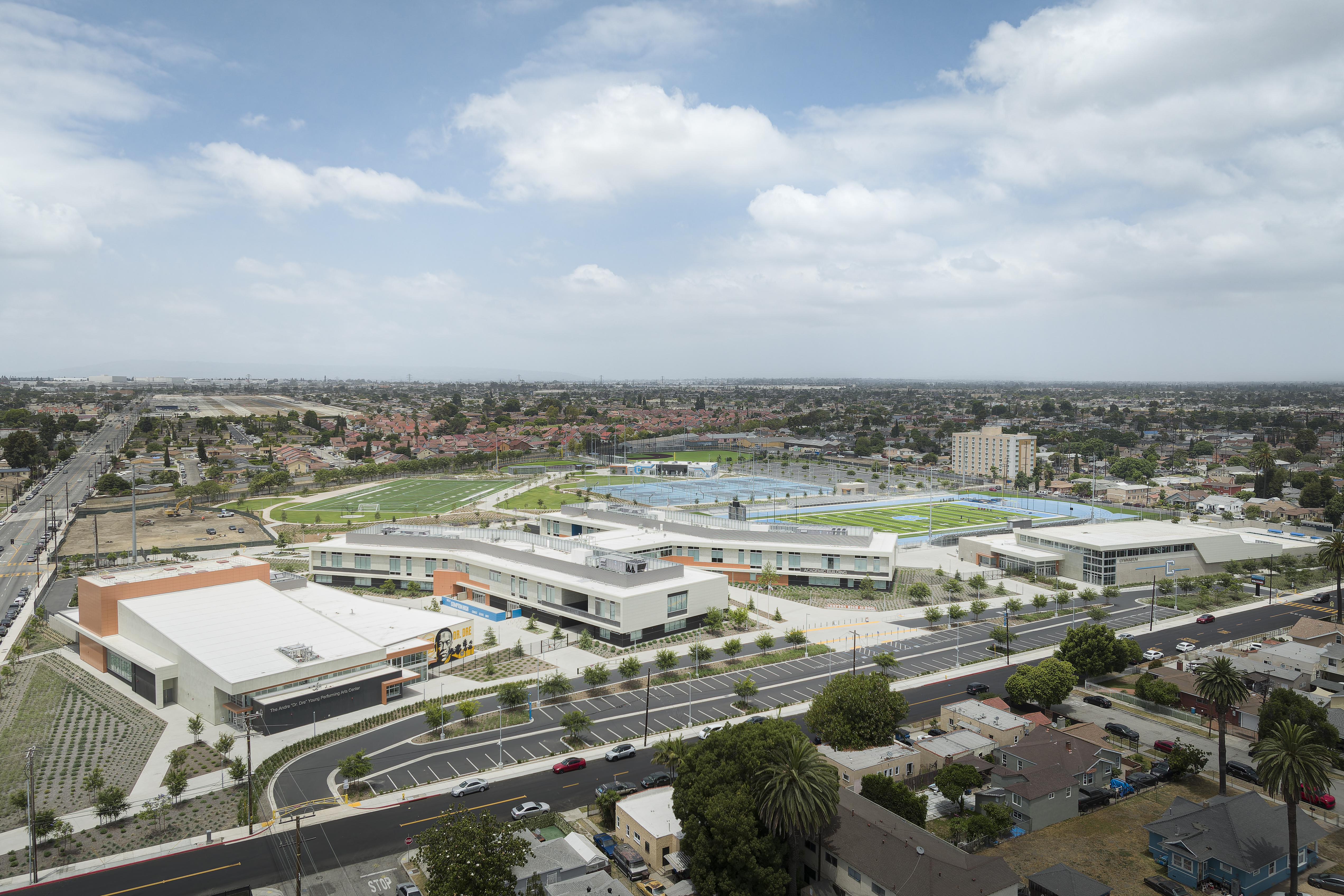
As for the library, it’s not just book-free, but wall- and door-free; a lounge-style space that encourages collaboration and conversation. The classrooms are also open spaces, similar to college lecture halls, and students can see inside. Compton’s principal, Larry Natividad, calls the classrooms “shared learning studios.”
“It’s teaching on display,” Ciciora says. “Students can see what’s going on in other classrooms. Maybe they see something they’re interested in and they want to pick that as an elective. It’s showing off what students are learning.”
The academic building features high ceilings, spacious walkways, a multi-level grand staircase, and plentiful natural light via expansive windows and sliding glass doors. Students are protected by a high-tech and largely invisible security system. The school has over 160 cameras from the Verkada company along with Schlage AD300 door readers, which track who has entered a space.
Construction finished on schedule in May 2025. The school held summer sessions as a soft launch, allowing administrators and teachers to test the open learning environment and receive input from students before the start of the 2025-26 academic year.
For Ciciora, community involvement made the project feel special. During construction, Swinerton hosted community events and brought students to the site for field walks. Sixty percent of the workforce came from local zip codes, exceeding the company’s 35% goal.
“For the last three years, this has been our home, so you create bonds and friendships,” he says. “It’s been great seeing all the students so excited to come to school. I [have built] education facilities in Southern California [for years], and I’ve never seen a facility like this.”
As a freshman told LAist.com as he marveled at the Performing Arts Center, “I’m just starstruck right now. This is phenomenal.” The project’s final grade? A+.
SEE ALSO: GOING BALLISTIC: THE NEW BALLISTICS TESTING FACILITY AT TEXAS A&M