A recent Construction Industry Institute (CII) study demonstrated a clear advantage of immersive virtual reality (IVR) over desktop solutions when reviewing 3D model measurements and practical instruction. CII’s Technology Committee Research team, led by Dr. Fernanda Leite at the University of Texas at Austin, examined the gap between the state-of-the-art and the state-of-the-practice for IVR applications. The results were published in Virtual Reality Implementation Guide for Construction Projects, which introduces key steps of IVR execution at both company and project levels, including implementation strategies, hardware and software setup, training for developers, model preparation procedures and cost-benefit analysis.
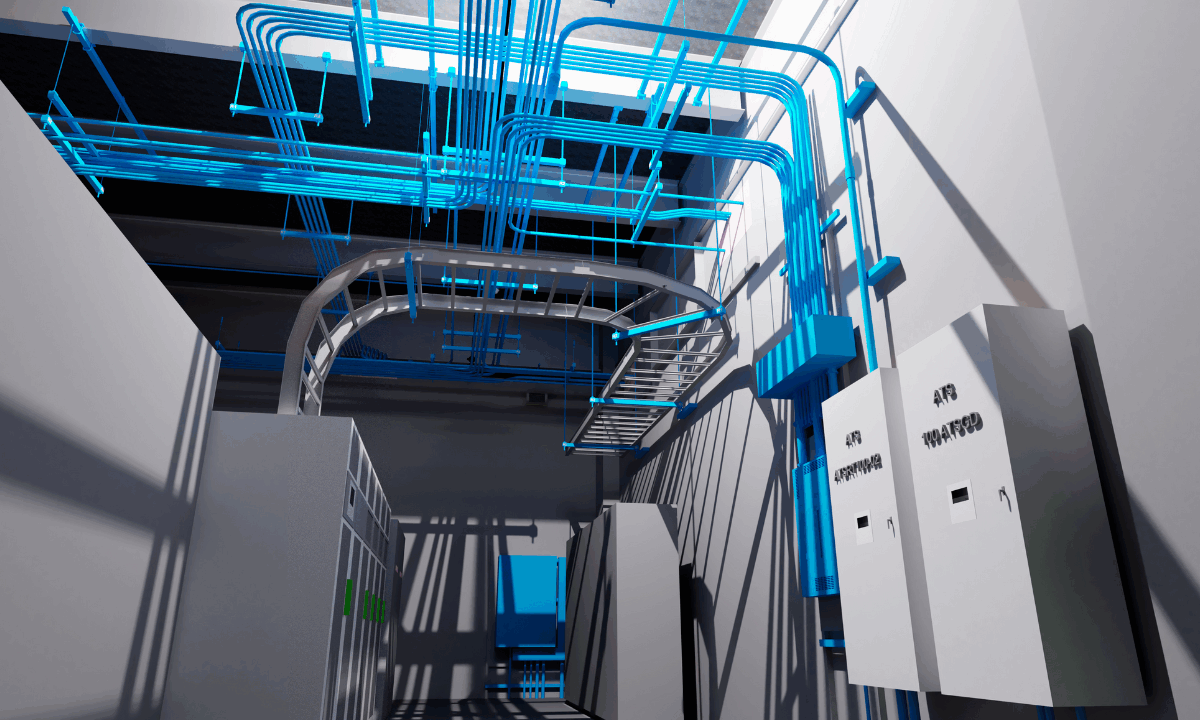
The research team conducted user tests on design review and planning tasks. Novice and expert participants were randomly assigned to a group that used the IVR system or a control group that worked in the traditional desktop setting. Both groups then reviewed a 3D model of a gasoline refinery facility.
The researchers measured and analyzed several indicators of user performance:
- detecting design errors;
- judging the scope of work;
- assigning an installation sequence for each installation work package; and
- remembering the scope of work.
Key Findings and Implementation Tools
IVR Improves User Performance
The research team tested participants with varying skill levels and compared their performance on two inspection tasks to see whether they performed better in a desktop environment or by using IVR. The group that used IVR scored higher (21.86% to 142.92%). There was a statistical significance in both tasks between the scores a user posted and the equipment used. The data also showed statistical significance in comparing the error-detection scores of novices versus industry experts.
IVR Implementation Scenarios
The research team found IVR capabilities are validated mostly in the following fields of application:
- design review or optimization;
- facilitating collaboration; and
- training programs.
IVR Model Preparation Procedures
The research team explored efficient approaches to transform the 3D model of a construction project into a VR-ready model for different applications. They investigated and documented four major steps and corresponding operations:
- selecting target components;
- optimizing 3D content;
- modifying the system to incorporate a game engine; and
- developing the user-computer interface and functions.
Cost-Benefit Analysis of Using IVR
The benefits of IVR applications clearly outweighed their costs. The analysis delivered two chief findings:
- the cumulative IVR investment will increase slowly after two years of implementation and
- the majority of the IVR investment will be devoted to the developers’ salaries.
Virtual Reality Implementation Guide for Construction Projects represents the state-of-the-practice IVR applications and identifies opportunities for the ongoing development of IVR. The guide documents the logic and major concerns for each decision-making point and gives construction companies step-by-step instructions to follow to develop leadership in the majority of visualization-dependent tasks.