Camp North End in Charlotte, North Carolina, started in 1924 as a Ford Motor Company factory that cranked out Model T’s and Model A’s. In 1941, it became a quartermaster depot for the U.S. Army, which built five warehouses on the site before transitioning to missile manufacturing in the 1950s. In 1967, the complex was sold to Eckerd Pharmaceuticals (later acquired by Rite Aid), until developer ATCO Properties purchased it in 2016. And now? The site will soon begin its most dynamic and vibrant chapter yet as a hub for pickleball.
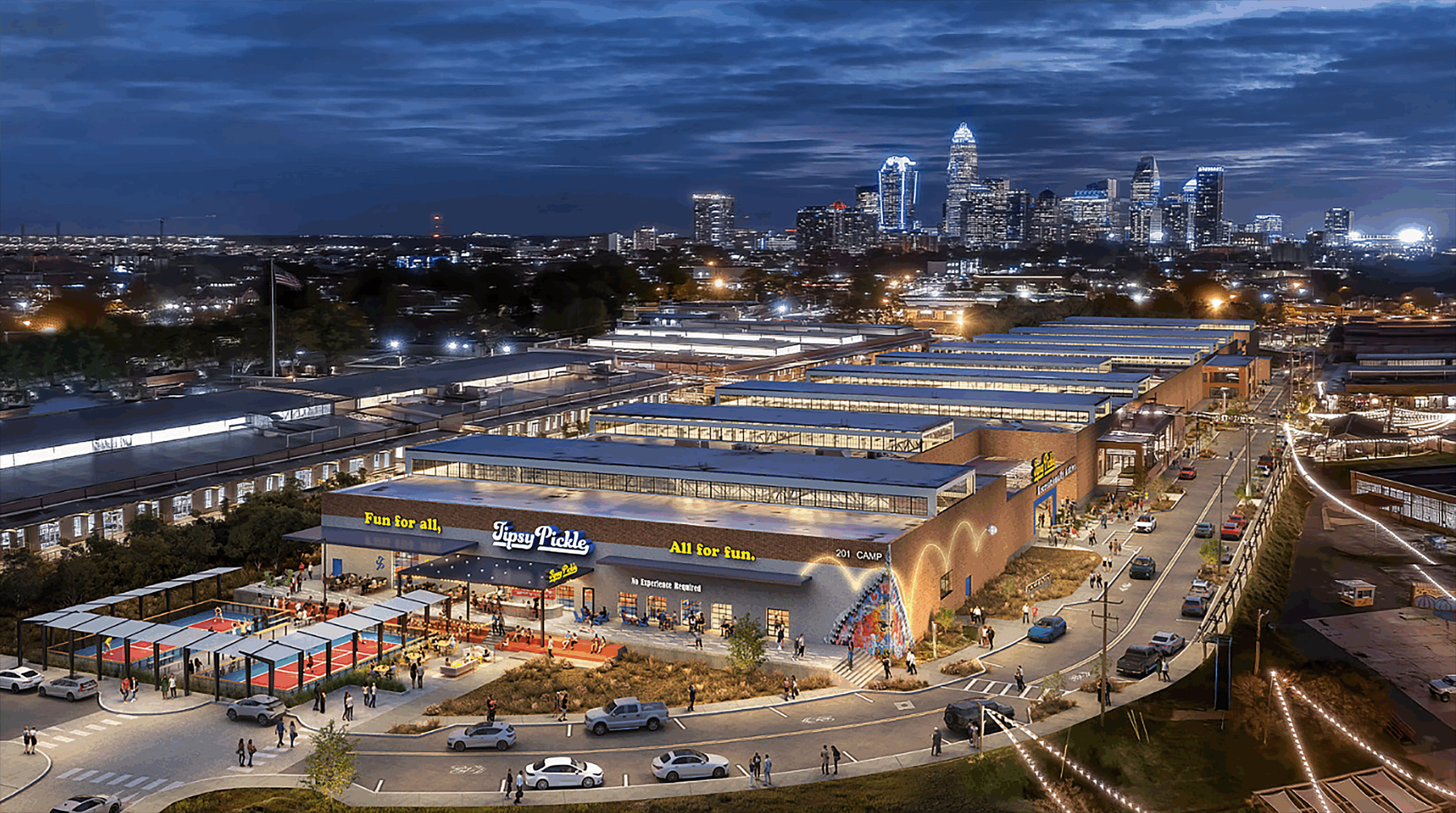
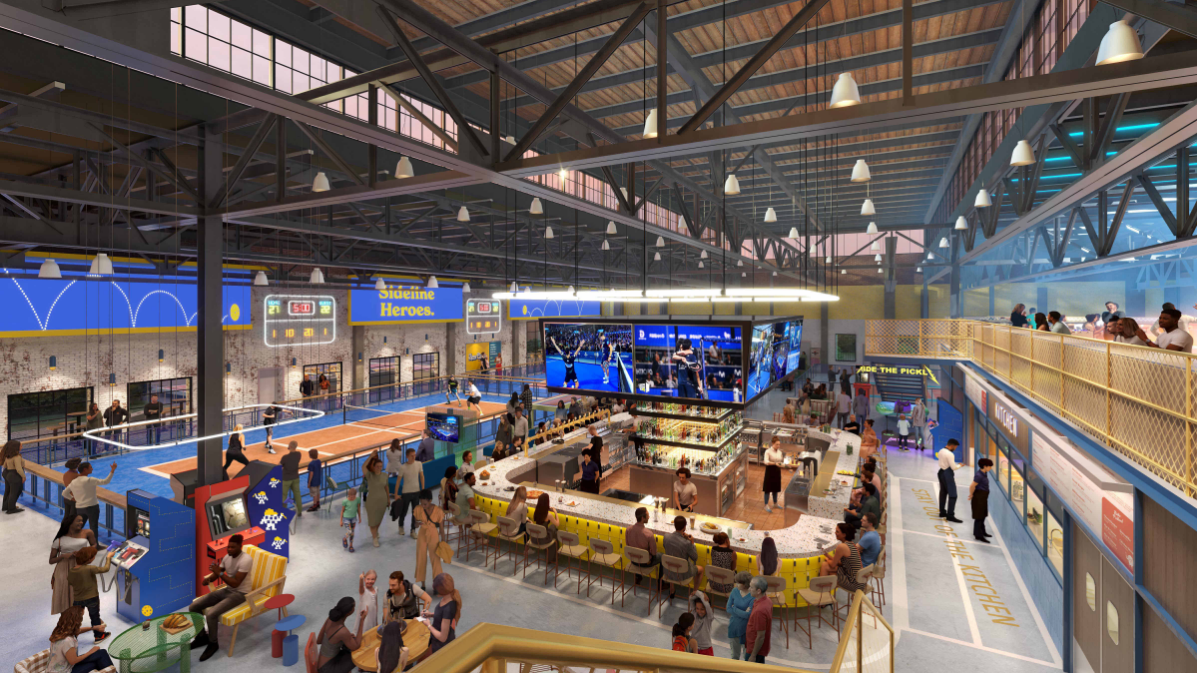
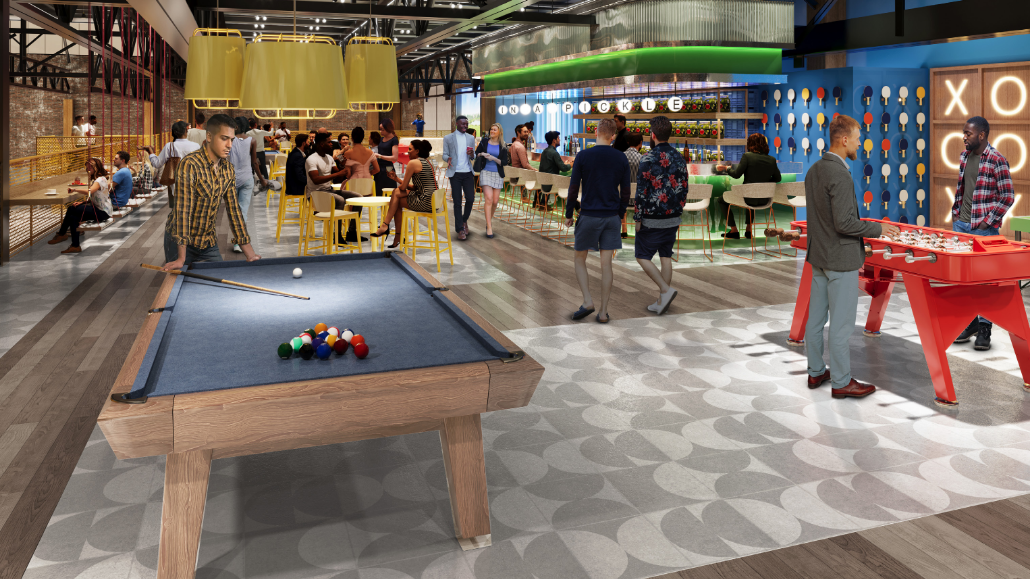
That’s right, pickleball. By the end of 2024, Camp North End—a 76-acre, mixed-use development with offices, restaurants, retail and housing—will unveil the Tipsy Pickle: a massive “eatertainment” venue focused on food, families and America’s favorite new sport. (Fun fact: Pickleball has been the fastest-growing sport in the United States each of the past three years, according to the Sports & Fitness Industry Association.) The site will feature nearly 26,000 square feet of interior space complete with pickleball courts, a Tex-Mex restaurant, two bars, arcade games, golf simulators, ping-pong, pool tables, tic-tac-toe, darts, shuffleboard and more. An additional 10,000 square feet of outdoor space will include a patio and a third bar. Guests can play pickleball on one of four indoor courts and two outdoor courts; retail space will sell pickleball gear and themed merchandise.
Construction began in April 2024. The Charlotte division of Swinerton, a construction firm with 22 offices nationwide, is serving as preconstruction manager and general contractor. Swinerton has experience with both restaurants and adaptive-reuse projects, and worked previously on another project with Tipsy Pickle’s developers, Charlotte entrepreneurs Mike Salzarulo (a local brewery owner) and Tanner Brooks (co-founder of a local-drinking app called Hopp, in which users can earn rewards for local businesses by visiting local breweries and bars). The pickleball venture has been particularly exhilarating given its size, the mix of indoor and outdoor spaces, its lively design (neon signs, bright color schemes) and the building’s storied industrial history.
“It’s one of those jobs that you can’t not be excited about,” says Thomas Ivy, senior project manager for Swinerton.
HISTORY LESSONS
While the project has been exciting, it has not been obstacle-free. Given the site’s status as a historic building, any modifications to the structure and façade must be approved by a historical review board. The project also has to comply with North Carolina’s Brownfields Program regulations. A brownfields site is “an abandoned, idled or underused property where the threat of environmental contamination has hindered its redevelopment,” according to the state’s Department of Environmental Quality. The program works with developers to revitalize properties with environmental issues. On the Tipsy Pickle site, DEQ testing uncovered soil concerns, so Swinerton is installing a vapor-intrusion mitigation system, and any excavated soil is sent to DEQ for additional testing.
Preserving the building’s century-old warehouse structure while installing kitchen equipment and ventilation systems has created other challenges for Swinerton.
“The kitchen space is directly under a mezzanine, which is tied into the structural walls of the building,” says Ivy. “And being a full-scale commercial kitchen, it’s got to have a number of kitchen hoods that exit through the roof, and there’s got to be structural support to address the weight of the make-up air units and some of the rooftop units and exhaust fans. It’s important to coordinate all of this so we don’t compromise anything.”
The kitchen installation began with a demolition that included saw cutting the slab for new underground electrical and plumbing lines. “Anytime you’re doing a new commercial kitchen, the underground plumbing is critical because of all the equipment that ties into the grease lines and the sanitary lines,” Ivy says.
Then there are the pickleball courts. Among the early questions: How will the courts be laid out? Will regulation-sized courts fit the available space? Swinerton staff and the design team from Southwick Architecture + Interiors two courts in Charlotte to inform the court layout and structure. The group specifically wanted to inspect courts installed on concrete and asphalt. Ultimately, the team chose both: The Tipsy Pickle’s indoor courts are installed over concrete and the exterior over asphalt.
Swinerton also encountered a roadblock with one of its planned outdoor courts. Two years earlier, before work began on the Tipsy Pickle, another restaurant was supposed to open on the site. Ivy and his team had to work around a grease trap from that abandoned project “right smack in the middle” of one location for an outdoor court. “We ended up changing the layout,” Ivy says. “You don’t want to play pickleball on top of where grease waste is coming out of your kitchen.”
HAVING A BALL
As the project nears its completion, Ivy is most excited about the main bar in the center of the restaurant. “It’s going to have this multi-tiered steel structure with floating shelving, and then above that it’ll have a couple of hefty televisions, and under-shelf lighting that illuminates the space. That’s gonna be a really cool element,” he says. “When you walk into a restaurant, one of the first things people are drawn to is, alright, what does the bar look like? It’s the focal point of the space. That’s where the beginnings of community and the buzz start in a place like this.”
Swinerton is striving to finish the project by Thanksgiving to accommodate December holiday parties: The Tipsy Pickle’s owners began receiving inquiries back in the summer.
“It’s been a fun job,” Ivy says. “This is more than just a restaurant. It’s an attraction. And it will draw people for years to come.”