Point in any direction, and XR technology—augmented reality, virtual reality and mixed reality—will fundamentally disrupt whatever it touches along that vector. The architecture, engineering and construction industries are no exception.
By connecting their data to industry-specific tools, project stakeholders may collaborate in a real-time, 3D-immersive environment.
Virtual Reality for Synchronization
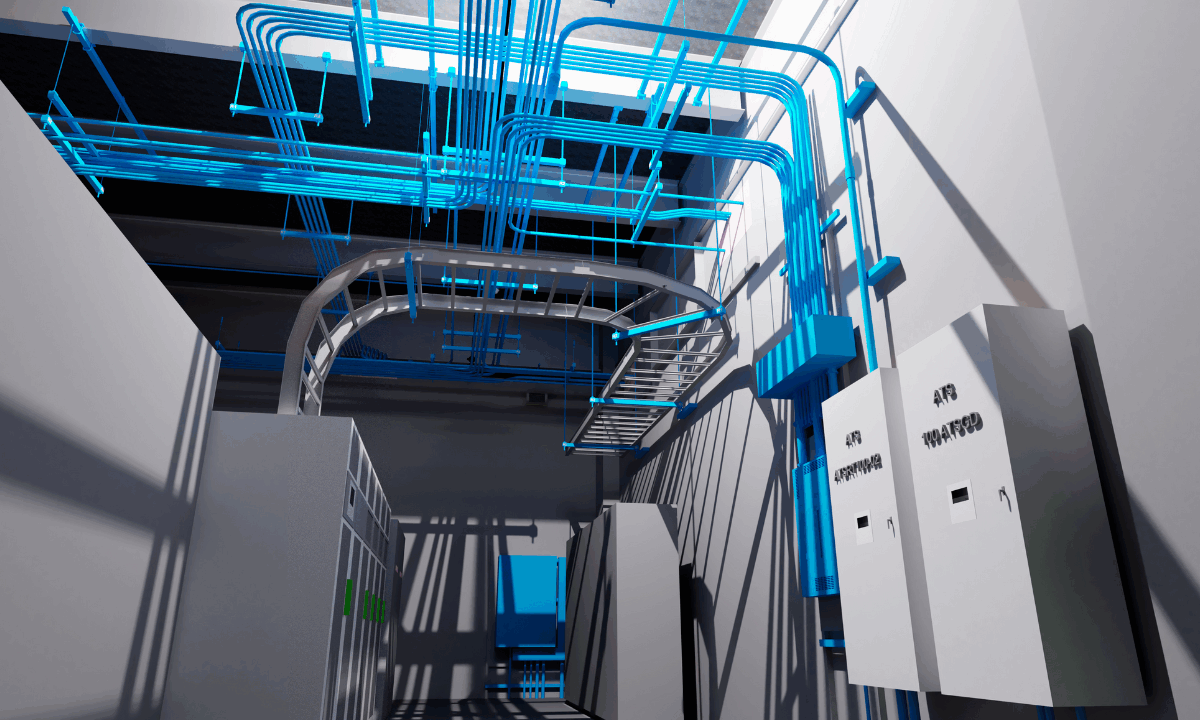
Model coordination is the process of synchronizing all 3D model data into a centralized master model. Each subcontractor provides a design to the model coordinator, who then overlays each model in its appropriate location.
Once the models are positioned and oriented properly, the model coordinator works with each subcontractor to resolve issues of intersecting geometry in a process called clash detection. This process is repeated until the model is clean and there are no more clashes.
The benefits of leveraging VR for model coordination are decreased decision time, increased decision accuracy, and unquestioned accountability through the contextualization of BIM data into the VR experience.
While implementation of BIM methodologies has vastly improved project performance and design capabilities for construction projects, the AEC industry continues to suffer from chronic waste and razor thin margins.
Greatly simplified, the BIM standard can be defined as providing the right information to the right people at the right time in order to facilitate faster and more accurate decision-making. Taking a closer look, the “right information” is a product of the right data in the right context. Context has traditionally been represented on paper or flat screens such as computer monitors or tablets.
When data is represented in the 2D context, i.e., paper, workers must use their subjective human brains to translate contexts in real time (2D > 3D > 2D) to make the best objective decision possible. This mental effort robs them of potential decision cycles and exposes inefficiencies in the BIM process.
The solution is to put workers and collaborators into the virtual space where data is represented spatially, eliminating the need to translate contexts, thus enabling the team to make better decisions in a fraction of the time.
In one real-world customer use case, four subcontractors submitted their designs for a small equipment room. When the concrete manufacturer later updated their drawings to show post-tension cables running though the precast panels, the electrical, fire pipe, mechanical and plumbing contractors were forced to reroute their designs. A scan of the paper drawing was passed around via email and marked up by each contractor. Fast forward three weeks, and little progress was made.
With the clock ticking, the customer had to fly a team onsite for three days. Eventually, they were able to resolve the issue and keep working. The damage was done, however, as the delay had negatively impacted the project schedule and cost the customer in travel and accommodations for three people.
Subsequent conversations with various industry-leading construction firms tell a similar story. The needless complexity involved in resolving the issue cost the general contractor, subcontractors and building owner time and money—dragging the project past its five-year lifespan. This begs the question: how many times does this happen on a medium to large project?
Today, decisions made collaboratively and in the immersive context will improve decision speed and accuracy by virtually eliminating “decision by translation”—the cumbersome process of visualizing 2D data in a 3D world.
Better Decisions, Faster
Immersive technology is at the nucleus of a changing world. Its breadth is infinitely wide and its application infinitely deep. It’s as inspiring as it is intimidating. The AEC industry can simplify its approach and enhance project performance by connecting people, data and tools via XR technology.
This new and exciting workflow is already helping the AEC industry to make better decisions, faster.