Why Construction Accounting Isn’t Like Standard Accounting
Construction accounting is a project-based financial system designed to measure profitability, risk and cost performance at the individual contract level. Unlike traditional accounting models that treat business activity as continuous operations, construction accounting isolates revenue, costs and financial outcomes for each project.
Every construction project behaves like a temporary business unit. Materials are purchased for a specific job, labor is assigned to particular phases, subcontractors work under defined scopes and billing follows milestone or schedule-of-values structures rather than recurring sales cycles.
This environment produces financial conditions that ordinary accounting models cannot handle effectively. Contractors must manage fluctuating labor demands, uneven billing schedules, change orders, retainage, equipment allocation and contract-based revenue recognition.
A functional construction accounting system therefore focuses on:
● Job-level profitability tracking
● Project cost forecasting
● Contract-based revenue recognition
● Work-in-progress financial reporting
● Cash-flow alignment with project performance
Without these controls, a contractor can appear financially healthy while projects quietly lose money.
WHY PROJECT-BASED FINANCIAL TRACKING DEFINES CONSTRUCTION ACCOUNTING
Project-based accounting exists because construction businesses rarely generate profit at the company level without first generating profit at the project level.
Every contract carries its own timeline, labor mix, material exposure, subcontractor obligations and operational risks. Financial success therefore depends on the ability to evaluate each job as its own financial entity.
When job-level accounting is weak, several problems appear quickly:
● Cost overruns remain hidden until late stages of the project
● Billing activity becomes disconnected from actual earned revenue
● Cash flow appears healthy even when margins are deteriorating
● Leadership cannot identify underperforming project teams or estimates
Project-level visibility allows contractors to detect financial risk early rather than discovering problems during final job closeout.
JOB COSTING CONVERTS FIELD ACTIVITY INTO FINANCIAL PERFORMANCE DATA
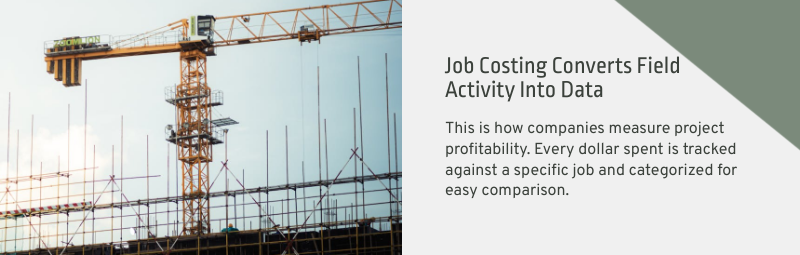
Job costing is the central mechanism that allows construction companies to measure whether a project is profitable.
Every dollar spent on labor, equipment, materials or subcontractors must be recorded against a specific job and categorized within an appropriate cost code. These cost codes allow financial teams and project managers to compare estimated costs to actual expenditures as the project progresses.
A disciplined job-costing structure typically tracks several major categories:
● Direct labor costs
● Materials and supplies
● Equipment usage and rental
● Subcontractor payments
● Project management and supervision
● General conditions and overhead allocations
Each category provides insight into where profit is being created or lost.
Job costing becomes particularly powerful when combined with forecasting. Contractors do not simply track what has already been spent; they estimate the cost required to complete the remaining scope of work. This forward-looking analysis helps determine whether the project is trending toward profit or loss long before the final invoice is issued.
WORK-IN-PROGRESS REPORTING REVEALS WHETHER PROJECTS ARE FINANCIALLY HEALTHY
Work-in-progress reporting is one of the most important financial controls in construction accounting.
A WIP report compares three essential figures for each active project:
● Costs incurred to date
● Revenue recognized based on progress
● Amount billed to the customer
This comparison reveals whether a contractor is overbilled or underbilled on a project.
Overbilling
Overbilling occurs when billings exceed the revenue earned based on project progress. While this situation can improve short-term cash flow, it also creates an obligation to complete remaining work without corresponding future billings.
Underbilling
Underbilling occurs when earned revenue exceeds invoiced amounts. This often indicates delayed billing, incomplete documentation or disputes with the client.
Both conditions carry operational risk. Overbilling can create future cash pressure, while underbilling can conceal financial distress if work is progressing faster than payments are received.
A properly maintained WIP report allows leadership to identify these imbalances and address them before they create liquidity problems.
REVENUE RECOGNITION IN CONSTRUCTION REFLECTS PROJECT PROGRESS RATHER THAN BILLING
Revenue recognition in construction accounting typically follows the progress of project completion rather than the timing of invoices.
Many construction contracts qualify for revenue recognition over time because the work being performed continuously transfers value to the customer. As construction progresses, revenue is recognized based on the portion of the contract that has been completed.
A common measurement approach is the cost-to-cost method. This approach compares the cost incurred to date with the estimated total project cost to determine the percentage of completion.
For example:
| Project Element | Amount |
| Total Contract Value | $5,000,000 |
| Estimated Total Cost | $4,000,000 |
| Costs Incurred to Date | $2,000,000 |
| Percentage Complete | 50% |
| Revenue Recognized | $2,500,000 |
This method aligns financial reporting with operational progress rather than simply tracking billing activity.
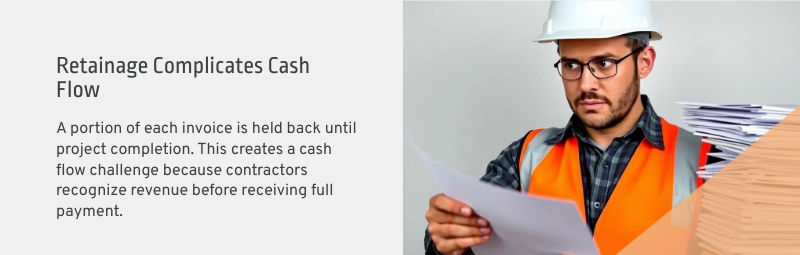
RETAINAGE COMPLICATES CONTRACTOR CASH FLOW AND ACCOUNTING
Retainage is a common payment practice in construction contracts that withholds a percentage of each invoice until project completion or final inspection.
Typical retainage ranges from 5-10% of contract value.
Retainage serves as a financial safeguard for project owners, ensuring contractors complete all work and address any deficiencies before final payment. For contractors, however, it creates a cash-flow challenge because revenue is recognized before the retained portion is collected.
Construction accounting systems must therefore track retainage separately from standard accounts receivable.
A typical retainage structure includes:
● Retainage receivable from project owners
● Retainage payable to subcontractors
● Final retainage release upon project completion
Failure to manage retainage accurately can distort cash-flow projections and create disputes during project closeout.
CONSTRUCTION PAYROLL INVOLVES COMPLIANCE AND COST ALLOCATION CHALLENGES
Payroll management in construction is significantly more complex than in many other industries.
Construction companies must allocate labor costs across multiple jobs while also complying with wage regulations, union agreements and reporting requirements tied to public projects.
Several factors complicate payroll accounting:
● Prevailing wage laws on government projects
● Union wage scales and benefit contributions
● Certified payroll reporting requirements
● Multi-state tax compliance for traveling crews
● Allocation of labor hours across job-cost codes
Accurate payroll allocation ensures that labor costs are properly reflected within each project’s financial profile. Without this level of precision, job-costing reports become unreliable.
Equipment and asset allocation influence project profitability
Construction companies frequently deploy equipment across multiple jobsites. Heavy machinery, vehicles and specialized tools represent major capital investments that must be accounted for within project costs.
Rather than recording equipment expenses only as company overhead, many contractors allocate equipment usage to individual projects.
This allocation often includes:
● Hourly equipment usage rates
● Fuel consumption and maintenance costs
● Depreciation allocation
● Transportation and mobilization costs
Tracking equipment utilization allows companies to evaluate whether assets are being used efficiently and whether equipment ownership remains financially justified compared to rental alternatives.

FINANCIAL REPORTING FOR CONTRACTORS EMPHASIZES OPERATIONAL VISIBILITY
Construction financial statements provide insights that go beyond traditional income statements and balance sheets.
Standard reports remain important, but contractors rely heavily on additional project-level reporting tools.
Key construction accounting reports include:
● Job-cost reports
● Work-in-progress schedules
● Project profitability summaries
● Cost-to-complete forecasts
● Change-order logs
● Subcontractor commitment reports
These reports connect financial performance with field operations.
For example, a job-cost report may reveal that labor productivity is below estimate in a particular phase of construction. Project managers can respond immediately by adjusting staffing, revising schedules or renegotiating subcontractor scopes.
Without this operational visibility, financial statements arrive too late to correct course.
CONSTRUCTION ACCOUNTING SOFTWARE IMPROVES FINANCIAL ACCURACY AND CONTROL
Modern construction accounting relies heavily on specialized software platforms designed to integrate project management and financial reporting.
These systems link field data with accounting processes so that financial performance updates in near real time.
A typical construction accounting platform integrates:
● Job-costing systems
● Project management tools
● Subcontractor management
● Payroll processing
● Equipment tracking
● Financial reporting dashboards
Integration eliminates the need for manual reconciliation between operational teams and accounting departments.
When field teams log labor hours or material deliveries, those transactions immediately influence project cost reports and profitability forecasts.
FINANCIAL RISK IN CONSTRUCTION OFTEN ORIGINATES IN ESTIMATING ERRORS
Construction profitability begins long before the accounting team records the first expense.
The estimating process establishes the financial framework for the entire project. Inaccurate assumptions about labor productivity, material costs, subcontractor pricing or schedule duration can cause margins to collapse even when projects are executed efficiently.
Estimating risk commonly arises from:
● Incomplete scope analysis
● Underestimated labor productivity requirements
● Unanticipated material price escalation
● Site conditions not fully understood during bidding
● Overly aggressive bidding strategies
Construction accounting helps detect these issues by comparing original estimates with real-time job performance. When discrepancies appear early, management can revise forecasts and mitigate losses.
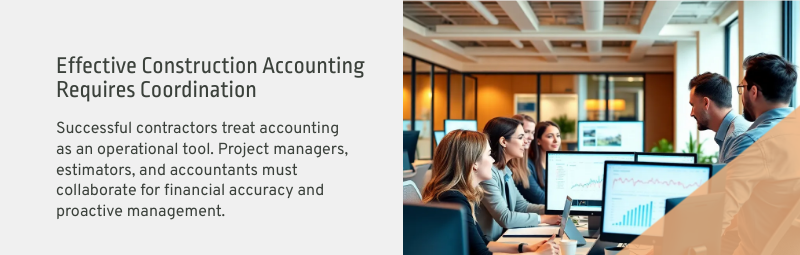
EFFECTIVE CONSTRUCTION ACCOUNTING DEPENDS ON COORDINATION BETWEEN FINANCE AND OPERATIONS
The most successful contractors treat accounting as an operational management tool rather than a back-office compliance function.
Project managers, superintendents, estimators and accountants must share responsibility for financial accuracy.
Operational coordination usually includes:
● Weekly job-cost review meetings
● Monthly work-in-progress analysis
● Project budget revisions during major scope changes
● Communication between field leadership and accounting teams
When this collaboration exists, financial reporting becomes proactive rather than reactive.
Leadership gains the ability to anticipate margin compression, manage cash-flow risks and allocate resources more effectively across active projects.
KEY FINANCIAL METRICS CONSTRUCTION COMPANIES USE TO EVALUATE PERFORMANCE
Construction companies monitor a set of operational metrics that translate accounting data into strategic insight.
Several metrics provide early warning signals when project performance begins to deteriorate.
| Metric | What It Measures | Why It Matters |
| Gross Profit Margin | Revenue minus direct job costs | Indicates project profitability |
| Labor Productivity | Output relative to labor hours | Reveals workforce efficiency |
| Over/Under Billings | Billing compared to earned revenue | Highlights cash-flow risk |
| Backlog Value | Contracted work not yet completed | Measures revenue pipeline |
| Change-Order Volume | Contract modifications | Indicates project complexity |
Monitoring these indicators allows leadership to intervene before financial problems become irreversible.
People Also Ask: Construction Accounting FAQs
What makes construction accounting different from regular accounting?
Construction accounting tracks revenue and costs at the project level rather than treating operations as a continuous stream of business activity. Each contract functions as its own financial unit with separate budgets, timelines and profitability metrics.
What is a work-in-progress report in construction accounting?
A work-in-progress report compares project costs, recognized revenue and billings to determine whether a contractor is overbilled or underbilled on a project.
Why is job costing important for contractors?
Job costing allows contractors to compare estimated project costs with actual spending in real time, enabling early detection of cost overruns and profitability issues.
How does revenue recognition work in construction?
Revenue is typically recognized based on project progress rather than billing activity, allowing financial statements to reflect the portion of work completed.
What is retainage in construction accounting?
Retainage is a portion of each invoice withheld by the project owner until construction is completed and all contractual obligations are satisfied.
Why is payroll complex in construction accounting?
Construction payroll must allocate labor hours to specific jobs while complying with wage laws, union agreements and reporting requirements for government projects.
What financial reports do contractors rely on most?
Contractors rely heavily on job-cost reports, work-in-progress schedules, project profitability reports and cost-to-complete forecasts to manage financial performance.